Showing posts with label Advanced/Gifted. Show all posts

Tuesday, October 24, 2023

Why Gifted Kids Sometimes Seem Behind


Most children have a desire to communicate and get themselves heard and understood. Most children have a need and desire for adult approval that leads them to do what is expected when expected. 

Gifted kids, often not so much.

However, all children perform better and with more enthusiasm when they see a REASON for their efforts, especially if that reason is personally gratifying through some enlightenment, intrigue or purpose. For gifted children, who often have so much going on in their heads, taking the time to focus and perform must have purpose, otherwise, they have better things to do.

It's not that they CAN'T do it.

I have a little girl, Miss A, who is going on 4. If she was an average child, I'd be looking at why she has not followed the normal developmental progression of drawing figures around the age of 3, and detailed figures by the age of 4. She makes little scribbles for people still, not even the "drawing" figures of a 2 year old, just random dark scribbles. 

But she's not average. She has a nearly photographic memory and at 3 3/4 can read nearly anything we place before her. She is artistic, creative, and music and has been dance inclined since birth. But drawing isn't her thing. Movement based expression and verbal expression are her strengths.

So I know why she doesn't draw figures. She doesn't see a purpose. 

The other two preschoolers have a need to put down on paper their story. They want to show it and tell it to their parents and others at some future time, and they want to make sure it is RIGHT. They put a lot of time and effort into getting their pictures the way they want them to be, and insist I journal their drawings in precise detail. 

Miss A, however, knows that she will be able to accurately tell her story to anyone at anytime. The picture in her head, which will always be there just the same, is so much grander than anything she could ever get down on a two dimensional piece of paper, that it just doesn't seem worth the time or effort to draw it. It will never be RIGHT. It will never be enough. She can draw her picture with words so much better. 

She'd rather write words. They have purpose. They can be perfect.

As her teacher, I know that her developmental level and intelligence level make it very apparent that she CAN draw figures. So I challenged her last week on Monday journal. She drew a circle for a dog. 

This week I challenged her again. I told her to look at her friends and draw them with shapes, starting with circles for their head and body. She drew a fairly detailed figure, exceeding the 10 identifiable features we look for in Kindergarten. 

It was perfect. In my estimation. 

She didn't really care, just shrugged when I complimented it, then started in telling me the story about her picture in extravagant detail. 

My oldest is gifted. He was nearly held back every year. When I took him out to homeschool, he was failing every class. Yet, he had an average test score in the high 90s in every subject. They wanted him to do worksheets, and games, and homework, projects and busy work. He found it painful to waste his time when he had better things to do. So he would go into his own head and spend his time there. He did great in college, though, because every class had a purpose towards his life goals.

My youngest is not gifted.. However, he has known from a very early age what he wants to be when he grows up. School work falls into three categories. 
  1. I need to know this. I must master it. [Java]
  2. I don't need to know this, but it is interesting, so I will find out everything I possibly can about it. [Mythology]
  3. I will never use this in my life and it is a complete waste of time. [Diagramming sentences] 
As his teacher, it is my responsibility to ensure that he makes these determinations accurately, and with an understanding that he may change his life direction at some point in the future. But yeah, some of what is taught in the school years is simply a complete waste of time. Probably not as much as most high school students believe, but some.

Gifted children are still CHILDREN, with limited life experience and incomplete data. They need guidance, but most of all, they need understanding, challenge, and PURPOSE. 

This is why project based education is such a better fit for gifted students. When they have a topic that interests them, the surrounding educational component has an intense purpose to their learning. A gifted child may not know their times tables, yet be able to instantly spout accurate, detailed statistics about a subject that interests them. Using their interest as a pathway, it can be very easy to slide educational components, of high complexity, along that path they are ready to run, and it can lead to such amazing learning opportunities and extraordinary retention.

Always look at the whole child. Never focus on one small skill and miss the much bigger picture of the child's abilities.


Friday, May 27, 2016

One Smart Cookie


This handsome young man, Mr. G, graduated pre-k from here last August. He was approved for an immediate double grade skip. which his parents chose not to do. He was provided differentiated reading and allowed to do math through Kahn Academy on his iPad. Once a week he went to do research with a 3rd grade class, where he made many friends. Otherwise, he remained with his same age group and flourished socially.

He has been blessed with an amazingly supportive school staff. They recommended that he be tested for the gifted program while still in kindergarten. He passed all testing in the 99th percentile. The highest achievable score. This was 2nd-5th grade gradient scoring tests. He was again offered a grade skip up to 5th grade. All the grades in between were also discussed.

While he is extremely advanced in reading, writing, math, (basically all skills), he retains the innocence of a normal 6 year old and has amazing friendships within his class. Next year, for first grade, he will remain with his class, but he will be doing skills in higher grade classrooms and going to another school once a week for gifted learning experiences. He will be the only first grader, but this young man has NO issue with making friends of all ages. 

He's smart, he's charming, and he has more personality in his little finger than most people do in their lifetime. I am so proud of what Mr. G has accomplished this year and so grateful for a public school staff that has met him and challenged him where he was developmentally and cognitively. His parents have had some tough decisions to make, and they have done so with extreme contemplation, always keeping their child's best interests for both now and in the future at heart. 

His kindergarten experience has been everything I could possible hope for my graduating kiddos.

Monday, January 26, 2015

Is My Preschooler Gifted?


My oldest son is gifted. My youngest is smart. Over the last twelve years, I've taught many preschoolers, with about 1/3 each average, smart and gifted. 

The parents ask me why I think their child might be gifted. There are some good lists out there, but I want to give my own perspective from my personal observations.  

Gifted children are different. They feel more intensely, they think differently. Their abilities arise from a brain that is wired in a much more complex, inter-connected manner. 

It starts early and doesn't let up. My gifted students have all had heads shaking from the time they were early toddlers. 

Gifted is not necessarily a blessing. They feel more intensely, they get analysis paralysis, they can be obsessive, their brains never stop and often their mouths as well, and they can easily be overwhelmed and overwhelming. Their view of our very gray world can be sharply black and white, and reality can be difficult for them to handle. 

Here's just a little of my perception of the differences. 

This is very simplistic and generalized and does not discuss varying abilities within children, outside forces that impact performance, gifted issues, etc. 

#1 FOCUS

Even with infants, I can tell a marked difference in their future abilities by their focus and tracking as early as a few months old; along with how they look for reinforcement and information from an adult. It can be a little uncanny to see intelligence shine from someone so young.

  • The average child pays the minimal attention and must be engaged through movement and fun.
  • The smart child will pay attention in order to "get" it, then be ready to move on.
  • The gifted child will pay close attention, ask questions, mull it over and ask questions throughout the day, and bring it back up for a week, or month, in different contexts until they feel comfortable that they completely UNDERSTAND the concept and all its applications. [One of the reasons I leave new material out and available for at least a week.]

Caught Miss H contemplating the whiteboard rather than playing during free time. Just turned 5.
#2 RESPONSES

  • The average child says, "OK," and accepts information as given.
  • The smart child will ask simple questions for clarification purposes or about a specific topic. Once answered to their liking, they move on to the next topic.
  • The gifted child asks big questions about a specific topic. A LOT of them. They will not let it go until they feel thoroughly informed.  "Ok, but what if...", "I know [concept] when [this] happens, but what about when..." "How about...?" 

#3 NEW CONCEPTS

  • The average child needs a lot of repetition and different contexts to understand and retain information.
  • The smart child needs just a few lessons.
  • The gifted child often only needs a 1-2 sentence INTRODUCTION of a concept to grasp the material, retain it, apply it and extrapolate it. 
Group ages 3,3,4 & 5 working on big numbers.
#4 ABILITY

  • The average child has to work to mentally retrieve relevant data and skills when set to a task.
  • The smart child easily assimilates into tasks that they have encountered before, or can apply known skills towards.
  • The gifted child can not only pull from experience, but can also extrapolate their own and observed experience to new situations to easily perform new tasks and skills and create new understanding.

#5 MEMORY RETRIEVAL

  • The average child pulls pockets of relevant memory to perform the task at hand.
  • The smart child pulls linear, linked strands of memory to perform the task at hand. Performs most tasks more quickly. They can extrapolate within a limited distance from the current learning.
  • The gifted child can pull un-linked pockets and strands of memory and knowledge and combine them into an entirely new, seamless, whole. Information retrieved can be as seemingly random as an overheard conversation when they were 2, combined with a tower they built when they were 3 that fell in just a certain way, along with a PBS show on physics that was playing in the next room one Friday night, and currently watching another child try to build a bridge. They can take these flashes of information from their memory and almost instantly have a solid insight or understanding of something new. 

#6 KINETIC

  • The average child needs to manipulate the world to understand, as appropriate to their developmental level.
  • The smart child still needs kinesthetic learning, but is able to do much more mental processing.
  • The gifted child spends much of their time in mental processing: daydreaming, mentally running through scenarios, contemplating concepts, imagining, thinking of possibilities, mulling over societal issues, and playing with words and ideas. While initial instruction is still best accomplished through hands-on learning, gifted children easily move forward to worksheets and board work as the level of difficulty increases.
#7 LEARNING

  • The average child is stimulated by new or interesting information and experiences, but can quickly be diverted in other directions.
  • The smart child pays attention long enough to get the gist of something.
  • The gifted child would rather learn and discuss than play. They seem to have an innate need to fill a seemingly bottomless knowledge pit within them. They simply blossom when learning something new or discussing ideas. They play with what they learn. If they learn about bridges, there will be bridges of all kinds all over the place. They naturally experiment and mentally record data for analysis and will want to talk at length and in-depth about their observations. It is not unusual for them to figure out the next level of instruction before it can be presented to them. They will also initiate learning objectives.


#8 SENSITIVITY

  • The average child is generally happy with the status quo. 
  • The smart child will manipulate to gain advantage.
  • The gifted child is emotionally hurt by injustice, perceived cruelty, unfairness, bad sportsmanship, and other societal issues. They have a tendency to worry about such issues and to try to bring peace and fairness about for all. They are more empathetic and willing to negotiate, and do not understand other children who do not have this same awareness.

#9 OVER EXCITABILITY

  • The average child will move on if things don't go their way. They will find another toy or another playmate.
  • The smart child will try to manipulate things to their advantage or view point.
  • The gifted child wants things, "Just so." They have a firm belief in how things should be and when others don't go along with that vision, they can have trouble dealing with it. They can't be happy with the way things are if they are WRONG, and they can't manipulate others, because that just wouldn't be RIGHT, and why can't these other kids not just see how it should be and do what they should? Then the world is too loud, or their clothes are too itchy, or someone took their favorite doll, etc. It can be overwhelming for any child, but for gifted children, it can be exceptionally overwhelming when they know how the world should be and it doesn't conform to their expectations.

#10 BOREDOM

  • The average child will usually be able to find something to occupy their time, even if it is twirling a stray piece of string around their finger.
  • The smart child will get bored and complain about it, looking for direction.
  • Many gifted children need constant stimulation of higher level learning to fill that knowledge pit within them to be their happiest. Whether it's doing a new art project, listening to new music, learning a new word, a new science experiment, etc. They are constantly craving new knowledge and experiences and the ability to explore known ones at a new level. When forced to participate in activities lower than their abilities and knowledge, they can grow depressed and anxious. 
These are simply my observations.

I keep hearing lately the comment, 
"Not all gifted children read early, but all children who read early are gifted."
Miss A 4 and Miss H 5. Yes, they can read it all, even with my bad handwriting.

If this is true, then my current three preschoolers are definitely gifted. But then, I pretty much already knew that.
Tags: preschool, child, care, child care, daycare, kindergarten, gifted, preschooler, homeschooling, 

Friday, October 31, 2014

Busy Bags - Advanced PreK/Elementary


My pre-k students, ages 4 1/2 - 5 1/2 years old, do not nap, but the younger ones do. The pre-k's formerly went into the preschool room, but they have SOOOooooo lost privilege due to inappropriate conduct. 

So now, they are stuck doing quiet activities within my direct sight. 

I do not want this time to be wasted, and I need them engaged so that boredom doesn't nudge them towards more inappropriate behavior.

These children are gifted and/or advanced for their age, so the classic preschool busy bags just won't cut it. I want busy bags that:
  • Hold a (fairly) unique activity 
  • Work a specific skill set at multiple levels
  • Have more than one mode of play
  • or Be dynamic, each play being different 
  • Are appealing visually and through play
  • Can be contained within about a 1 square foot area
  • Fit easily within a quart sized Ziploc
  • Do not require adult assistance beyond initial instruction
They have access to file folder games that use laminated manipulatives. I wanted the buys bags to be different.


So far, they LOVE them! They would play with them other parts of the day, but are only allowed to during nap time.


Each one works fine motor skills, so I did not list that under SKILLS. Most also work logic/reasoning, but...I'm kinda partial to that one.


Here's the ones we have so far and those pending. Each one is explained, in order, below.
  1. Alligator Chomp
  2. Build and Add
  3. Butterfly Symmetry
  4. Card Facts
  5. Color Links
  6. Fish and Chips
  7. Frozen Flakes 
  8. Geo Board
  9. Pumpkin Faces (seasonal)
  10. Puzzle
  11. Race to Odd & Even 
  12. Ribbon Weaving
  13. Silly Sentences Punctuation
  14. Sounds & Count 
  15. Stick Figures
  16. Write the Facts
  17. Tanagrams
In the works, I'll add to post when completed:
  • Animal Habitats
  • I Know Instruments
  • Food Group Gulp
  • Fraction Fun
  • Musical Notation
  • Types of Terrain
ALLIGATOR CHOMP
Includes: Craft foam alligator, numbers 2-10 playing cards
Instructions: Children children place 2 cards down and place the alligator greater than or less than to CHOMP the bigger number. Used cards are placed in a discard pile and new ones drawn. Advanced: use 2 cards added or subtracted for each side.
Notes: This may seem rather easy, but they like it, and it teaches a new skill. I have more advanced versions in mind for the future.
Skills: Visual quantity identification, greater than/lesser than, 1-1 correspondence counting, logic/reasoning


BUILD and ADD
Includes: 11 each of 2 colors of unit blocks, laminated activity cards, dry erase marker
Instructions: Follow instructions for building, add, write the sum in the box Advanced: write the number that comes before and the number that comes after on either side of the box.
Notes: This was a free download that I can't find. If I do I'll add the link, but you can definitely see how it's done. This is a little easy for these children, but it's good practice for writing their numbers.
Skills: 1-1 correspondence counting, logic/reasoning, word problems, writing, math vocabulary


BUTTERFLY SYMMETRY
Includes: 1 cream felt play mat, pattern cards, felt pattern pieces
Instructions: Choose a card, place it in the middle of the felt mat, use the pattern pieces to mirror the design on the card.
Notes: There is a free download for this activity, but I decided to make my own so I could change out the pieces or increase the complexity to keep it interesting.
Skills: Symmetry, logic/reasoning, visual/spatial, observation, geometry


CARD FACTS  
Includes: 2 sets of cards 1-10, laminated addition/subtraction card, dry erase marker
Instructions: Choose 2 cards, if doing subtraction place the higher number card on the left, place them above the add/subtract card, write the equation Advanced: use 2 cards added together to create each number.
Skills: Number identification, writing, 1-1 correspondance counting, creating and solving equations


COLOR LINKS
Includes: 1 set of color cards, 1 set of color links
Instructions: Choose a card, collect and button that link, choose another card, and add that link to the other one. Advanced: put the cards in alphabetical order prior to putting the links together.
Notes: It may seem rather easy, but keeping the links going in the correct direction is more difficult than you'd think.
Skills: Color words, color identification, logic/reasoning

FISH & CHIPS
Includes: 6 each of 3 colors of poker chips, pattern cards
Instructions: Choose a card, create that pattern, extend that pattern until you run out of chips
Notes: These go from the simple AB pattern to AABBCC. These kids are whizzes at this, but it's good reinforcement.
Skills: Patterning, logic/reasoning


FROZEN FLAKES
Includes: 2 game boards, 1 die, 6 each of two colors of chips
Instructions: 1-2 player, roll the die and cover the number rolled, if the number is already covered, lose that turn. Advanced: use 2 die and you have create a double, add, or subtract.
Notes: Yeah, not that challenging, but they love it, so it keeps them BUSY. For the younger ones we place the die in a small plastic container with a lid to keep it contained. Free download from Activity Mom.
Skills: 1-1 correspondence counting, number vs. quantity, number identification, taking turns


GEO BOARD

Includes: 1 geo board, 2-3 of each size of rubber band
Instructions: Have fun
Notes: I purposefully placed just a couple of each size/color rubber bands into here. When they have access to a LOT of rubber bands, they just go nuts with them and start tossing them about. Fewer resources make them more precious, and the children have to work harder to create interesting designs. I was going to include cards for them to match, but right now they enjoy just creating their own designs. Cards may come later. There are a ton of them out there.
Skills: geometry, grid manipulation, logic/reasoning, creative expression, architecture


PUMPKIN FACES (seasonal)
Includes: Pumpkin face cards, pumpkin face mat, pumpkin face pieces
Instructions: Pull a card and make a matching face. These range from easy to hard.
Notes: Harder than it may look, as the pieces often need to be flipped and rotated
Skills: Logic/reasoning, geometry, visual/spatial, observation


PUZZLE
Includes: 1 puzzle
Instructions: Put it together
Notes: Changed out regularly, harder puzzles have a picture included, but all their harder puzzles are now missing pieces, thus the busy bags...
Skills: logic/reasoning, visual/spatial

RACE TO ODD & EVEN
Includes: 1 play mat, odd and even number cards
Instructions: Choose a card, place it on the appropriate odd or even side. First side to be completed WINS! Advanced: Put the numbers in numerical order when done.
Notes: They truly treat this as a race with one side winning. I can change the cards out frequently to keep it interesting and advancing. It is self-correcting. To hinge the two sides, I laminate them separately and use heavy duty packing tape on the back side of the seam.
Skills: Odd/even, logic/reasoning, number recognition.


RIBBON WEAVING
Includes: 1 cream felt play mat, pattern cards, felt pattern pieces
Instructions: Choose a card, place it in the middle of the felt mat, use the pattern pieces to mirror the design on the card. Advanced: Create rainbow order.
Notes: A seemingly simple activity, but it works a lot of higher-thinking skills
Skills: creative expression, logic/reasoning, patterning, sensory stimulation


SILLY SENTENCES PUNCTUATION
Includes: 1 cream felt play mat, pattern cards, felt pattern pieces
Instructions: Choose a card, place it in the middle of the felt mat, use the pattern pieces to mirror the design on the card. Advanced: Some sentences are questionable between an exclamation point and period, leaving it open to their reasoning.
Notes: I think they like this better because they helped create the silly sentences.  
Skills: Reading, grammar, punctuation, logic/reasoning


SOUNDS & COUNT
Includes: 1 set of cards, red/green/blue clothespins
Instructions: Choose a card, place a green clothespin on the beginning sound, a red clothespin on the ending sound (if applicable), and a blue clothespin on the number of items in the picture Advanced: when I make these cards, I increase the difficulty by putting very similar sounds on the same card, making them work a little harder for it.
Notes: We have sets of these cards for all our themes. The newer themes include beginning sound, ending sound and number. These are changed out monthly at minimum. It takes a good amount of clothes pins. This amount only does half of the cards, then they have to take them all off to do the other half. I just put a dot on these ones with sharpies, but they aren't hard to paint.
Skills: Phonics/letter, 1-1 correspondence counting, number/quantity, logic/reasoning, observation, visual/spatial


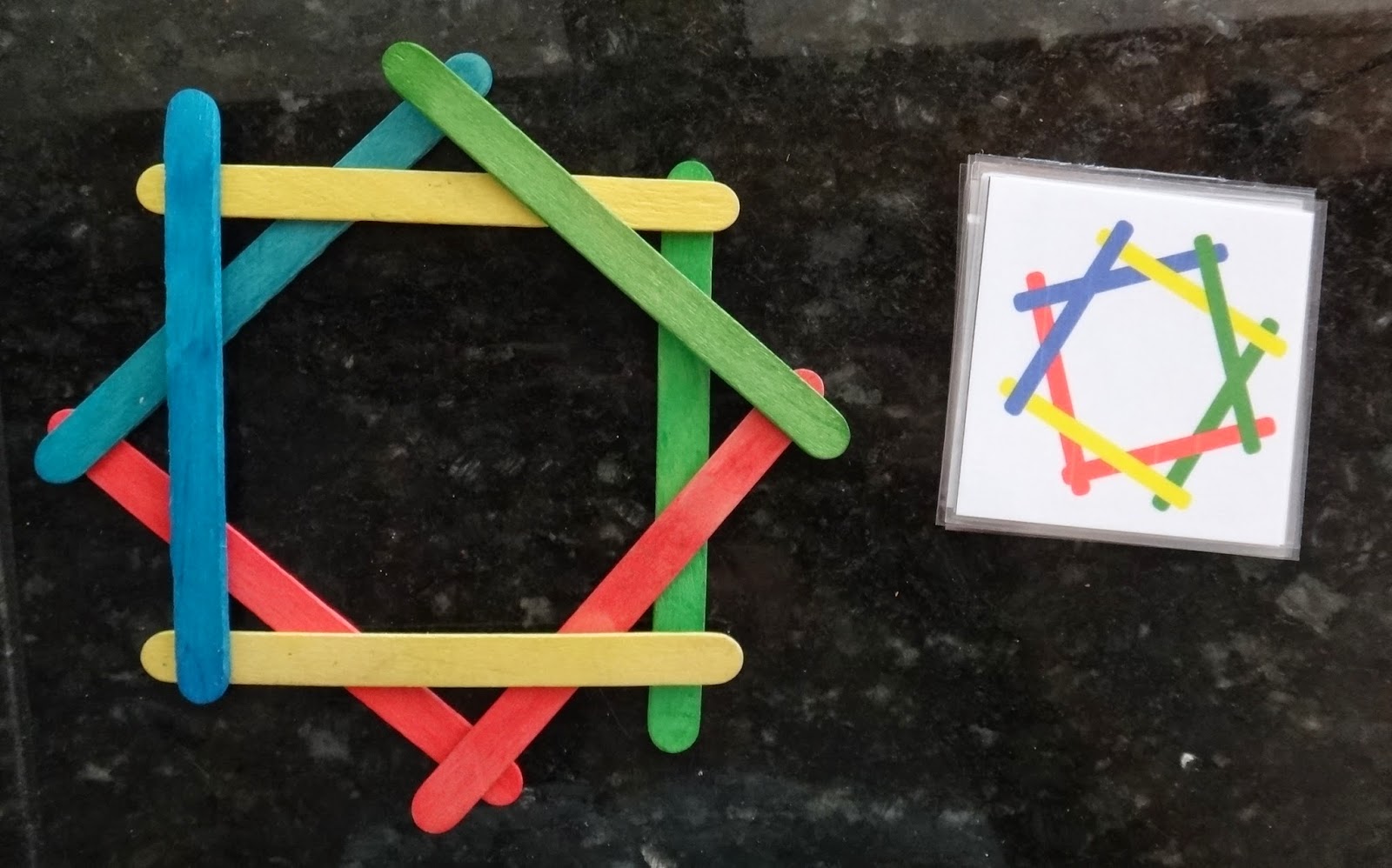
STICK FIGURES
Includes: 2 each of 4 colors of craft sticks, design cards
Instructions: Choose a card, create the design, or create your own design
Notes: The cards range in difficulty from fairly easy to very difficult. Even I find this one challenging if trying to get all the over/unders correct.
Skills: Logic/reasoning, observation, visual/spatial, trial/error, patterns, geometry


TANAGRAMS 
Includes: Set of uppercase tanagram cards, tanagram blocks to create all the cards
Instructions: Choose a card, re-create with tanagram blocks, or create your own design Advanced: make your own cards without the shape indicators, or just black/white.
Notes: The tanagram cards are a free download. I printed them out with the multiple page option on my printer so that they were smaller. I wanted these children to create FROM the cards, not ON the cards. Since the blocks have a tendency to drift off, I put the quantities needed on the front of the bag for easy inventory and re-stocking. There are a lot of free tanagram cards out there.
Skills: Geometry, visual/spatial, logic/reasoning, symmetry, counting, creative expression


WRITE THE FACTS
Includes: 1-12 bead circles, laminated addition/subtraction fact writing card, dry erase marker
Instructions: Choose a bead circle, move some of the beads to each side, write the fact. Advanced: write all the facts in the family.
Notes: The child can do as many or as few facts as they wish with a single circle before moving on to another. The circles are made with pipe cleaners cut in half and hot glued into the wooden bead after putting on the pony beads. I tried to make them colorful. The number is written on with sharpie.
Skills: Fact families, addition/subtraction, observation, logic/reasoning


In there right now, I also have a number writing cheat card, since we haven't been working on writing for very long, and they want to write RIGHT.


I also have a couple of seasonal I Spy books in there.


Busy Bags are not ALL they do during naptime. They also read books, and magazines, 


do educational apps on the iPad,


and color, among other activities.


But most importantly, 
they are QUIET so the little ones can get their rest.


Tags: gifted, advanced, homeschool, homeschooling, daycare, child care, preschool, pre-k, elementary, early, child, children, math, science, language, literacy, 
Follow Connie -'s board Sensory on Pinterest.