

Even though I have training in curriculum, it still took me awhile to figure out the different types of math concepts that I needed to be integrating into my teaching, how, and when. I hope this will help others who are teaching or homeschooling preschool.
One of my former students placed in the top 2% internationally in Math Olympiad. This is why...[in addition to her just being exceptionally smart!]
The main math skills I will cover here pertain to numeracy and are:
- Pattern recognition & sorting/classification
- Subitizing/quantification
- One-to-one correspondence counting
- Rote counting
- Counting on
- Grid counting
- Scatter counting
Note that on this list is NOT learning number names. This goes with my functional learning method. Knowing the name of a number 1 is not functional. It is vocabulary. Knowing the order or quantity for the number 1 allows for functional mathematical ability. The children all learn that a 1 is called a one, but incidentally, not as a focus of teaching.
This post goes to the next level from my Teaching 2's Math post which was a level up from my Learning Math From Birth. You may also want to read my post Early Math is as Important as Early Literacy
Math, especially, needs to be hands-on learning through play and manipulation in the early years. We are currently on our EGG unit, which is math intensive. This allows you to see some ideas on how to integrate the skill learning into a unit or theme.
These children, 2-3 years old, know their basic colors and can count to 10 in order to do the activities.
PATTERN RECOGNITION & SORTING/CLASSIFICATION
I put these skills together because they are complimentary skills. They both are observation and interpretation of where things belong. If a child can't sort/classify, then they can't complete a pattern activity, and sorting and classification are patterning activities.

The ability to recognize patterns is considered the NUMBER ONE key indicator for future math success. I start this in infancy, patting out song rhythms on their back or with their feet to music playing along. It builds that ability to begin linking patterns to their world. I use repetitive patterns, audio, physical or visual, for most of my infant and early toddler learning play, specifically to enhance this ability.
It works. My preschoolers can sort, categorize, and pattern forward and backward much earlier and better than their peers who have not had this early exposure.
Activity: The children create their own pattern and then extend it out in either direction until they run out of eggs.


It works. My preschoolers can sort, categorize, and pattern forward and backward much earlier and better than their peers who have not had this early exposure.
Activity: The children create their own pattern and then extend it out in either direction until they run out of eggs.


Patterning is not just a preschool skill activity. There are patterns everywhere - in the seasons, in our daily schedule, even our daily routines. It allows children to be able to tell time in a general way even as infants. It leads to understanding quantities of time such as weeks, months, years. It allows them to know that we always wash our hands before eating or brush our teeth before going to bed. Those are patterns. There are patterns in nature, music, and daily life. As they enter the preschool era, we work more hands-on and intentionally with creating and manipulating physical patterns.
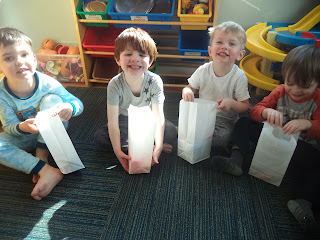
Activity: The children gather eggs as fast as they can, then sort their eggs by color. For younger children, I might have colored bowls or color circles to assist. We are working on grid formations, so that is why theirs are sorted like this.


Sorting and categorization are naturally occurring. They know farm animals from zoo animals. Red cars are sorted from yellow cars. Blue blocks are suddenly preferred and everything is made up only of blue blocks. As we advance, opportunities are created for more advanced sorting and categorization on more than one trait. Red/green/purple circles that are also small/medium/large. Then throw in a few blue squares of the sizes and see how they handle that.
Activity: The children gather eggs as fast as they can, then sort their eggs by color. For younger children, I might have colored bowls or color circles to assist. We are working on grid formations, so that is why theirs are sorted like this.


Sorting and categorization are naturally occurring. They know farm animals from zoo animals. Red cars are sorted from yellow cars. Blue blocks are suddenly preferred and everything is made up only of blue blocks. As we advance, opportunities are created for more advanced sorting and categorization on more than one trait. Red/green/purple circles that are also small/medium/large. Then throw in a few blue squares of the sizes and see how they handle that.
SUBITIZING/QUANTIFICATION
This is the ability to instantly recognize quantities. It starts as soon as you begin asking a child if they want MORE. More/less, big/small and their counterparts are all quantifications that toddlers learn. Around three they are learning to recognize a quantity of at least 1-3 objects as being that amount just by looking at it. This is an important mathematical, observation and spatial skill that is often overlooked. The only way to enhance this skill is to give children a ton of opportunities to practice it in grid formation and scatter groups. "Look, you have 3 blocks lined up!" "I see you have 3 cars in your hands." "Do you want 2 or 3 pieces?" and have the groups of 2 and 3 laid out for them to see.
Activity: Bring me 2 eggs the SAME color. Bring me 2 PAIRS of eggs. 2 eggs + 2 eggs is how many all together? Bring me 3 DIFFERENT color eggs.


Dice play in later preschool and pre-k really works this skill.
However, quantification BEGINS by getting them comfortable with assessing quantities. This is smaller/larger, more/less, smaller/bigger, shorter/taller.

It also carries over to categorization/sorting and patterning. Being able to tell a specific quantity, first comes from being able to assess the quantity.
ONE TO ONE CORRESPONDENCE COUNTING
Activity: Bring me 2 eggs the SAME color. Bring me 2 PAIRS of eggs. 2 eggs + 2 eggs is how many all together? Bring me 3 DIFFERENT color eggs.


Dice play in later preschool and pre-k really works this skill.
However, quantification BEGINS by getting them comfortable with assessing quantities. This is smaller/larger, more/less, smaller/bigger, shorter/taller.

It also carries over to categorization/sorting and patterning. Being able to tell a specific quantity, first comes from being able to assess the quantity.
ONE TO ONE CORRESPONDENCE COUNTING
While rote counting to 100 wins the accolades, the whole purpose of math is to count THINGS. Even as infants, I have their little fingers touching bunnies in a book as we count them and everything else we can one-to-one correspond. We count, with fingers touching the items we are counting, multiple times a day from the first day they arrive. It is ingrained.
This ability leads to accurate counting, an ability to practice subitizing/quantification on their own, and an ability to do equations much earlier.
Activity: Once sorted by color, children count how many of each color they have. Then the eggs are combined and again counted by color for the group. Subitizing is encouraged on individual small quantities. Quantity comparisons of same/equal, more, less, how many more, how many less, etc. can be performed.

Activity: Once sorted by color, children count how many of each color they have. Then the eggs are combined and again counted by color for the group. Subitizing is encouraged on individual small quantities. Quantity comparisons of same/equal, more, less, how many more, how many less, etc. can be performed.

ROTE COUNTING
Rote counting is the ability to count in numerical order. Seems simple, but it is more difficult and important that children understand that the order has permanence. Numbers occur in order. Always. I have a 2-year-old that just counted to 13. He then skipped up to 15, 16, 17, 19, 20. Still in order, even though he skipped a couple, showing that he has that concept understood.
We count here multiple times a day, at least once a day to 100. With toddlers, we do 1-2-3 as the focus, and do it multiple times a day until they get it. When they have that down, then I work to 5, then 10, then 11, then 13, then 16, then 20. Then we learn to count by 10's before moving on to counting to 100. Eleven is the hardest because they hear 1-10 SO much from parents and in the shows they watch [AT HOME.] I try not to do that here, which is why we do various counts throughout the day and week.
Rote counting and one-to-one correspondence must be mastered to some degree before other math and science skills can be mastered.
It is so ingrained here, that I just caught this one counting the stripes on his socks as he laid down for nap. It's just what we do.

Activity: Incubating eggs takes 21 days, exactly the number we are working on for rote counting. 11-19 are the most difficult numbers to master, and this gives us the opportunity to count those on a daily basis for 21 days. We count how many days the chicks need to develop, how many days have passed, and how many day until they hatch. Working rote counting and number recognition.

This is an example of how number recognition happens without it being a main objective. The objective is counting.
COUNTING ON
This is the beginning of addition and future understanding of equations. It is an extension of rote counting and one-to-one correspondence. You have 3 items and another two are added, you can continue on from 3 to count 4, 5. This is NOT an easy skill to master. They want to go back and now count the whole group, until it clicks. This takes a lot of exposure and practice, but a child that can subitize/quantify then count on has a higher level of numeracy and mathematical understanding from which to scaffold.
Activity: When doing 10-frame counting, try to get them to begin counting after subitizing a smaller amount. Also when doing fact families of lower numbers. Here we are doing fact families of 5, and I ask them to subitize and count on from the smallest quantity. This requires direct instruction. This is an activity they can do independently, to a quantity they are familiar with manipulating. The older ones will automatically go to 10-frame.

GRID COUNTING
The current math [Common Core circa 2018] is almost entirely based on 10. Ten frames are used exhaustively. So what used to be just an easier way to line up and count items, now becomes a focused effort to get preschoolers to line items into ten frame organization, which is a grid.

Understanding rows and columns, creating and reading charts, is actually very easy for even young preschoolers to master. I begin by using the actual items and eventually move it to a white board. Once they reach school, the same concept will be used on endless worksheets [sigh.]
Additionally, if preschoolers get the concept of grid layouts early, multiplication and division makes absolute sense to preschoolers, and often they figure it out on their own. It also helps with the concept of skip counting that they will need to master in elementary school.
Grid counting here begins when I line up items for a toddler or early preschooler to rote count easily using one-to-one correspondence. I do make certain that they count vertically as well as horizontally, such as stacked blocks. These are some former pre-k students doing the same at a higher level. As play. Their ability to read and interpret graphs was amazing.


It also helps with addition and subtraction as I can split objects into linear groups to show fact families and the permanence of the count.
SCATTER COUNTING
Scatter counting is figuring out a methodology of counting a scattered group of objects. It's pretty difficult. Different children do it differently. Whatever works for them. Left-right, top-bottom, or physically moving items from an uncounted grouping to a counted grouping. I show them all the ways and let them figure out what works best for themselves. This takes a lot of exposure and practice. They begin as toddlers as I hold their fingers and we count flowers in a book, worms on the ground, freckles on a face, etc.
Since mine learn it in conjunction with rote counting and one-to-one correspondence counting, they pick it up fairly easily. The main issue is getting them to slow down and pay attention enough to be accurate. Even if I just observe them doing it in play on their own, if they do it wrong, I have them do it over again until they get it correct. This is one skill that needs accuracy reinforced.

Activity: Place items in a bowl so that linear or grid formation is not possible then have them count the items. Different colors, especially in easily subitized quantities, is easier than all different colors or all one color. This is an activity they can do independently.
These are the skills that make other skills possible - time, measurement, geometry beyond simple shapes, fractions, etc.
However, start them young and you'll be surprised what they can achieve...
Even at 3.75 years of age, my preschoolers are able to reach beyond these preschool-level skills. We have been spending a lot of focus on measuring recently, which they love.
For this unit, we started with 3 different sizes of eggs. We discussed how they were the size of a duck, goose and ostrich egg. We discussed how the goose-size blue egg could be small, medium or large depending on which other egg(s) it was compared to in size. We then started to measure. The main objective was to learn about circumference.
We started with measuring the eggs.

Then ourselves.


Then special visitor sock monkey couldn't be left out.

Then we worked on heights.


Once again, measuring was the goal, but number recognition, number order, and quantity comparisons were integrated.
They were allowed to play and do the activity unsupervised after our introductory session.
You can see the level of engagement and curiosity. Make it fun, and they don't even know how much they are learning.
We count here multiple times a day, at least once a day to 100. With toddlers, we do 1-2-3 as the focus, and do it multiple times a day until they get it. When they have that down, then I work to 5, then 10, then 11, then 13, then 16, then 20. Then we learn to count by 10's before moving on to counting to 100. Eleven is the hardest because they hear 1-10 SO much from parents and in the shows they watch [AT HOME.] I try not to do that here, which is why we do various counts throughout the day and week.
Rote counting and one-to-one correspondence must be mastered to some degree before other math and science skills can be mastered.
It is so ingrained here, that I just caught this one counting the stripes on his socks as he laid down for nap. It's just what we do.

Activity: Incubating eggs takes 21 days, exactly the number we are working on for rote counting. 11-19 are the most difficult numbers to master, and this gives us the opportunity to count those on a daily basis for 21 days. We count how many days the chicks need to develop, how many days have passed, and how many day until they hatch. Working rote counting and number recognition.

COUNTING ON
This is the beginning of addition and future understanding of equations. It is an extension of rote counting and one-to-one correspondence. You have 3 items and another two are added, you can continue on from 3 to count 4, 5. This is NOT an easy skill to master. They want to go back and now count the whole group, until it clicks. This takes a lot of exposure and practice, but a child that can subitize/quantify then count on has a higher level of numeracy and mathematical understanding from which to scaffold.
Activity: When doing 10-frame counting, try to get them to begin counting after subitizing a smaller amount. Also when doing fact families of lower numbers. Here we are doing fact families of 5, and I ask them to subitize and count on from the smallest quantity. This requires direct instruction. This is an activity they can do independently, to a quantity they are familiar with manipulating. The older ones will automatically go to 10-frame.

GRID COUNTING
The current math [Common Core circa 2018] is almost entirely based on 10. Ten frames are used exhaustively. So what used to be just an easier way to line up and count items, now becomes a focused effort to get preschoolers to line items into ten frame organization, which is a grid.

Understanding rows and columns, creating and reading charts, is actually very easy for even young preschoolers to master. I begin by using the actual items and eventually move it to a white board. Once they reach school, the same concept will be used on endless worksheets [sigh.]
Additionally, if preschoolers get the concept of grid layouts early, multiplication and division makes absolute sense to preschoolers, and often they figure it out on their own. It also helps with the concept of skip counting that they will need to master in elementary school.
Grid counting here begins when I line up items for a toddler or early preschooler to rote count easily using one-to-one correspondence. I do make certain that they count vertically as well as horizontally, such as stacked blocks. These are some former pre-k students doing the same at a higher level. As play. Their ability to read and interpret graphs was amazing.


It also helps with addition and subtraction as I can split objects into linear groups to show fact families and the permanence of the count.
SCATTER COUNTING
Scatter counting is figuring out a methodology of counting a scattered group of objects. It's pretty difficult. Different children do it differently. Whatever works for them. Left-right, top-bottom, or physically moving items from an uncounted grouping to a counted grouping. I show them all the ways and let them figure out what works best for themselves. This takes a lot of exposure and practice. They begin as toddlers as I hold their fingers and we count flowers in a book, worms on the ground, freckles on a face, etc.
Since mine learn it in conjunction with rote counting and one-to-one correspondence counting, they pick it up fairly easily. The main issue is getting them to slow down and pay attention enough to be accurate. Even if I just observe them doing it in play on their own, if they do it wrong, I have them do it over again until they get it correct. This is one skill that needs accuracy reinforced.

Activity: Place items in a bowl so that linear or grid formation is not possible then have them count the items. Different colors, especially in easily subitized quantities, is easier than all different colors or all one color. This is an activity they can do independently.
These are the skills that make other skills possible - time, measurement, geometry beyond simple shapes, fractions, etc.
These are the skills that I want, at minimum, for my preschool graduates to have mastered.
However, start them young and you'll be surprised what they can achieve...
Even at 3.75 years of age, my preschoolers are able to reach beyond these preschool-level skills. We have been spending a lot of focus on measuring recently, which they love.
For this unit, we started with 3 different sizes of eggs. We discussed how they were the size of a duck, goose and ostrich egg. We discussed how the goose-size blue egg could be small, medium or large depending on which other egg(s) it was compared to in size. We then started to measure. The main objective was to learn about circumference.
We started with measuring the eggs.

Then ourselves.


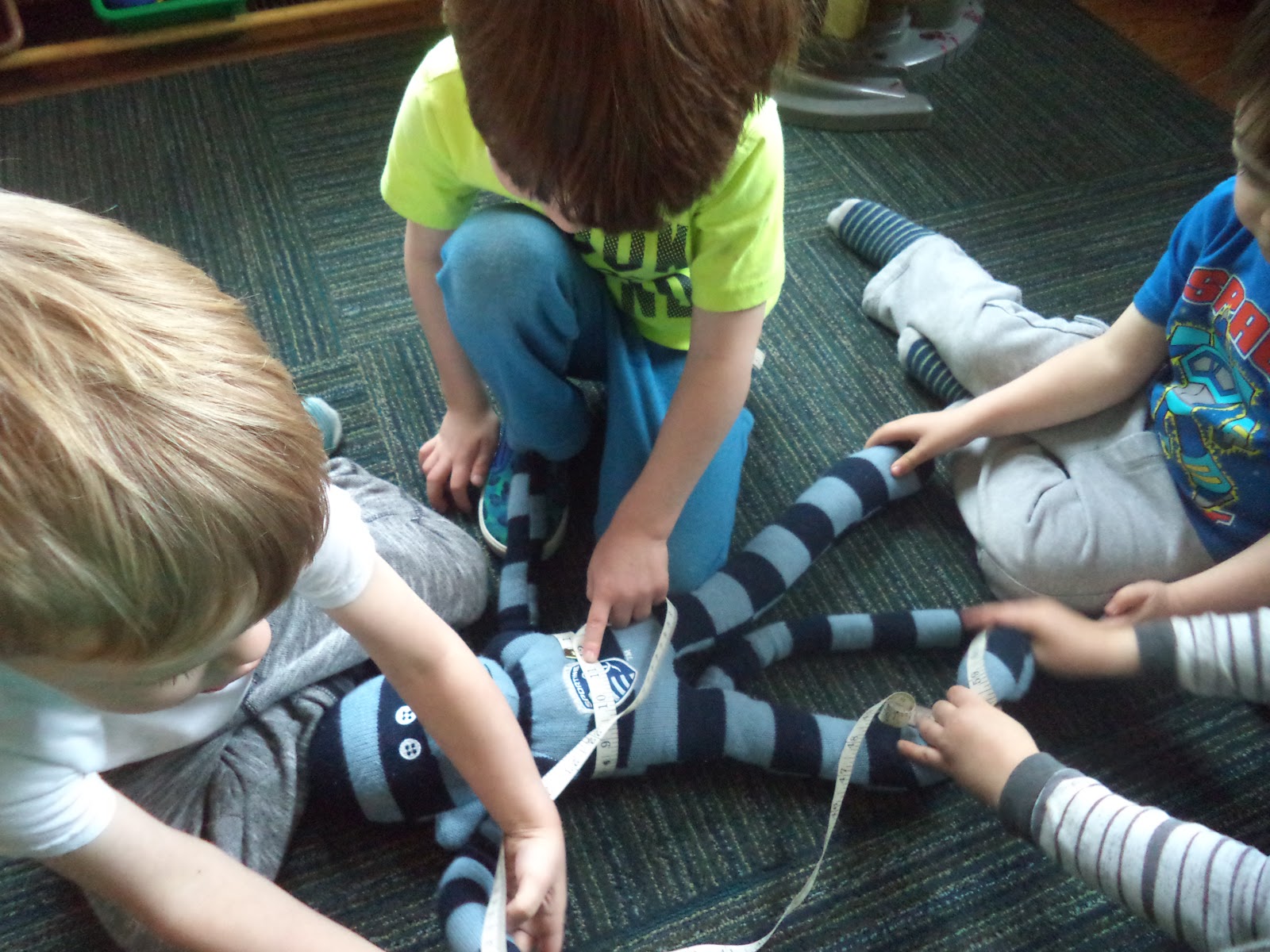
Then we worked on heights.

Width and diameter.

They were allowed to play and do the activity unsupervised after our introductory session.
You can see the level of engagement and curiosity. Make it fun, and they don't even know how much they are learning.






 Posts
Posts

