

Please remember that this is child-led learning through play and movement. No drills, worksheets, etc. I'm going to present them in a series of subjects:
- Language
- Mathematics
- Science
- Social/Community
- Gross Motor
- Fine Motor
- Art
SCIENCE
I feel like much of childhood is living in the scientific method: systematic observation, measurement, and experimentation; and the formulation, testing, and modification of hypotheses.
They observe, they test, they assess, they try something else, and keep evolving their beliefs through data collection and analysis.
Basically, childhood IS living science.
Just as all children are born artists, they are also all born scientists. We do them a grave disservice when we limit their ability to observe and experiment.
What do two year olds learn about science?
Physics
One of the first concepts is gravity. They drop items simply to see them fall. They quickly learn through throwing things up in the air that what goes up will come down.
Force and resistance are learned as they fall, bump into things, and throw things. Even something as low-key as a bead chase teaches gravity, force and motion.

Playing with inclined planes, changing the angles, changing the items rolled down, all work on force, motion and resistance concepts.

As they mature in this concept, they begin to manipulate force and resistance, and to play with forces. They learn if they use more force, they gain more distance. If they use more force, they dig up more sand. If I use more force, they go higher in the swing. If they use more force when pushing their friend, it leads to problems. We explore force and motion a lot with our pulleys and pendulums play. The twos love them.

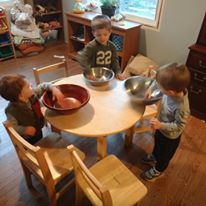
It always fascinates me when they come up with something like this, where the two's started playing with centrifugal force with the large bowls. They even taught a 4 year old something new. Exploring science concepts within play is natural. They got them moving, then they started adding in other bowls, balls, and items to see how it worked. Many small figures went flying across the room, which they thought was a total hoot.
Chemistry
Yes, art teaches chemistry. Color mixing, making play dough, exploring the viscosity of shaving cream, adding herbs into play dough thus changing the feel and smell, is all chemistry related.


Helping to make food teaches a lot of chemistry.
Yeah. This.

States of matter. Dirt going to mud. Solid to liquid. The boys really understand this one.

Bubbles popping and disappearing really works on manipulation of all three states of matter. Learning through play.
Probably discussing and helping with food making is the best introduction to this concept. Observing how cheese melts and becomes gooey, playing in the sensory bin with ice and water, discussing the steam rising on the pasta pot. It's not a set concept at all, but just an introduction through observations that will make sense later.
They are also naturals at experimenting with solutions and mixtures, and exploring viscosity, and our outdoor environment is well suited to that.
Meteorology
Since we are outside a LOT, and we garden, the weather isn't just a circle time blip here. We discuss the weather daily in relation to its importance to US. It's sunny again today, so the ground is too dry, so we need to water the plants. It's cold out, so we need to wear our jackets. It rained, so we need to wear our boots. The clouds are dark and cover the sky, so it looks like it might rain. The frost on the ground means the end to our tomatoes. Watching the wind blowing the leaves off the trees and feeling it against their bodies is a physical and visceral immersion into weather.
Biology & ecology
We discuss how our animals need food, water, and shelter just like us. The children here are never allowed to chase any animal. The wild bunnies and squirrels will often come fairly close for observation. The kitty patiently teaches the two's how to be gentle and responsible when around animals.

In the spring we incubate eggs and hatch chicks, that end up in my farm's coop making eggs for us to eat. It is an awesome lesson in many biology concepts. We study an egg theme and life cycle theme.

2016 we had ducks, instead. The two year olds were FASCINATED. For children that are usually go, go, go, they would stand or sit around the duck enclosure for up to an hour, just watching them.

We also have tadpoles from the farm pond every spring.

While the two's aren't able to understand deserts, mountains, and other biomes not within their realm of reference, they can understand that different parts of our outdoor environment provide different living conditions for different plants and animals.
They know that some bugs live under the bug boards where it is moist and shady. They know that some bugs, different ones, live on our squash plants in the sun. They understand that the squirrels live in the trees and the bunnies on the ground.
I can, however, create artificial biomes to introduce some expanded diversity of creatures and environments.

Physiology & anatomy
I start teaching body parts as soon as they can talk. It's one of the first rounds of vocabulary they get down. At two, we move on to more advanced body parts, and bodily functions. We talk about healthy foods and how certain foods help us to do certain things. They begin to learn about their muscles, heart, five senses, that they are growing, how they can get sick, and how to take care of their bodies.
Entemology & bugs
We have a very diverse outdoor environment. We have access to a wide variety of bugs, and the children are encouraged to explore them. Worms. They LOVE the worms and know where to dig them up. They also know they have to put them back where they got them so they can go back to their worm family.

Botany & mycology
We have a large organic garden. The two's help start plants, assist with garden chores, harvest, and even prep items like cherries for eating or freezing.

We also have a very diverse plant and tree population. The children are encouraged to explore the flowers, leaves, herbs, and fruit within the environment with all their senses.
Data collection and interpretation
A LOT of this is going on within them, as they assess, interpret, re-direct, assess, interpret, etc. They are just two, but we still talk about how many we planted, how many we harvested, if we have more pumpkins or more carrots today. We talk about why there are more rolly pollies under the board today than yesterday. We talk about how it is hotter today than yesterday. We talk about why the worms like to live in the leaves, but not in the sand.
Astronomy
Not much, but the two's can find the moon if it's out, tell you if it is a circle or crescent moon, and we talk about how the moon changes and moves over us. They know about stars and we talk about the sun being a star. We talk about living on a ball called earth and that it is a planet.
Geology & archaeology
Again, not much, but I have collected rocks from my travels that they can wet down and see the stratification and coloring. We have limestone with fossils laying around. We also have rock collections I've bought. We talk about dirt, rocks, stuff in rocks, and sand being smashed up rock.
They learn that there is interesting stuff down below the grass and dirt to explore.
Summary
Children are natural scientists. Their understanding of scientific concepts comes, in a large part, fluidly from exploring a dynamic environment. The problem is when the environment is sterile. When children are spending days in an unnatural environment, on playgrounds full of only mulch with metal and plastic play structures, without even a stick to dig with, their scientific learning is stunted. Environments need to be engaging to all the senses with unlimited opportunities to explore scientific concepts.
I can, however, create artificial biomes to introduce some expanded diversity of creatures and environments.
Physiology & anatomy
I start teaching body parts as soon as they can talk. It's one of the first rounds of vocabulary they get down. At two, we move on to more advanced body parts, and bodily functions. We talk about healthy foods and how certain foods help us to do certain things. They begin to learn about their muscles, heart, five senses, that they are growing, how they can get sick, and how to take care of their bodies.
Entemology & bugs
We have a very diverse outdoor environment. We have access to a wide variety of bugs, and the children are encouraged to explore them. Worms. They LOVE the worms and know where to dig them up. They also know they have to put them back where they got them so they can go back to their worm family.
Botany & mycology
We have a large organic garden. The two's help start plants, assist with garden chores, harvest, and even prep items like cherries for eating or freezing.
We also have a very diverse plant and tree population. The children are encouraged to explore the flowers, leaves, herbs, and fruit within the environment with all their senses.
Data collection and interpretation
A LOT of this is going on within them, as they assess, interpret, re-direct, assess, interpret, etc. They are just two, but we still talk about how many we planted, how many we harvested, if we have more pumpkins or more carrots today. We talk about why there are more rolly pollies under the board today than yesterday. We talk about how it is hotter today than yesterday. We talk about why the worms like to live in the leaves, but not in the sand.
Astronomy
Not much, but the two's can find the moon if it's out, tell you if it is a circle or crescent moon, and we talk about how the moon changes and moves over us. They know about stars and we talk about the sun being a star. We talk about living on a ball called earth and that it is a planet.
Geology & archaeology
Again, not much, but I have collected rocks from my travels that they can wet down and see the stratification and coloring. We have limestone with fossils laying around. We also have rock collections I've bought. We talk about dirt, rocks, stuff in rocks, and sand being smashed up rock.
They learn that there is interesting stuff down below the grass and dirt to explore.
Summary
Children are natural scientists. Their understanding of scientific concepts comes, in a large part, fluidly from exploring a dynamic environment. The problem is when the environment is sterile. When children are spending days in an unnatural environment, on playgrounds full of only mulch with metal and plastic play structures, without even a stick to dig with, their scientific learning is stunted. Environments need to be engaging to all the senses with unlimited opportunities to explore scientific concepts.




 Posts
Posts

