Showing posts with label Curriculum. Show all posts

Thursday, February 19, 2015

3 Sizes of Teaching Big Concepts to Little People

scaffold learning for preschoolers big visuals to small visuals

There is often talk about scaffolding learning along the learning path, but I don't hear about scaffolding the learning EXPERIENCE of a specific concept.

My philosophy is that young learners learn best when concepts are presented in three levels. It's like a movie. On the big screen in a theatre, it's an experience. You see the details and how everything works together. It's big and loud and holds your attention. 

If you see it on your big flat screen TV, whether 80 inch or 32 inch, then while it may be entertaining, it's something you watch, rather than experience. You may enjoy it, but if you have to grab a bite, you pause it and don't feel you've lost anything.

Watching it on the iPad, yeah, you may pause it multiple times. You can't see all the details, and you don't really care. It's not an experience, it's a time filler. It's something entertaining to do and if you pause it multiple times, then you are fine with it.

Unfortunately, most learning starts and ends at the iPad viewing stage. 

There's a reason we go back to the theater to watch the good movies. We crave the EXPERIENCE.

Make it BIG
Whenever I teach a new concept we always start out BIG. 
As big as we can get it. 
As interactive as we can get it. 
As fun as possible.

preschool interactive number line

For instance when we began number line work, we laid it out on the floor in tape. The children placed the numbers. Then we stepped it off. Then they hopped it. Then they hopped addition and subtraction. They worked as teams to provide equations to the person jumping. 

I taught it, they learned it, then they played with it. After about a week of playing with it, they had it pretty much down. Obviously they were simply scaffolding to a higher level and new format of addition and subtraction, but it was vital to their understanding to begin with it BIG.

Shake it DOWN.
Once the children have a concept down in BIG format, then we start gradually shaking it down. Just as you get a better movie experience from an 80 inch screen rather than a 32 inch, the size of the learning experience needed depends on the level of detail and interaction necessary to continue the learning path. Each child is different in this requirement. 

We drew number lines in the sand box and had sand toys jump the equations. We moved it down to drawing number lines on the chalk board and white board. Eventually we moved it down to drawing them on the lap boards and writing equations.


Mr. G wanted to measure everyone one day, so we did. We graphed it on the number line and worked the less than and more than aspect between their heights, along with graph interpretation stuff.

Take it SMALL.
Small is worksheets. Small is independent work. Small is reinforcement of mastery, not learning.

If learning the concept has been fun, and they have it mastered, then they WANT to "play" with it on worksheets. 


Even with our worksheets, they are dynamic and interactive. Above all, they are a FREE CHOICE activity, not a requirement. The children roll a die for the two numbers writing them in. If the second number is less than the first, they have the choice of doing addition or subtraction.  

Since they can do one of these in about two minutes with a 6 sided die, I'm making a new one that will use a 12 sided die.

So this is how we've done number lines, but we do the same with other math concepts, and it's also how we do reading:

Big is actions and manipulation as a group.


Shaking it down with activities, big books, and group reads.

language blends activity

Taking it small.
Miss A - 4 years
BIG hands on exploration in a fun, playful learning experience is a much better introduction to big concepts for little children than going straight to small work. By the time they get to the small work, they should already be very familiar with the plot, characters and setting of the concept. Having seen it as the big picture, the small one will make sense.
Tags: teaching, daycare, preschool, pre-k, reading, math, classroom, early elementary, homeschooling, homeschool, curriculum

Friday, October 31, 2014

Busy Bags - Advanced PreK/Elementary


My pre-k students, ages 4 1/2 - 5 1/2 years old, do not nap, but the younger ones do. The pre-k's formerly went into the preschool room, but they have SOOOooooo lost privilege due to inappropriate conduct. 

So now, they are stuck doing quiet activities within my direct sight. 

I do not want this time to be wasted, and I need them engaged so that boredom doesn't nudge them towards more inappropriate behavior.

These children are gifted and/or advanced for their age, so the classic preschool busy bags just won't cut it. I want busy bags that:
  • Hold a (fairly) unique activity 
  • Work a specific skill set at multiple levels
  • Have more than one mode of play
  • or Be dynamic, each play being different 
  • Are appealing visually and through play
  • Can be contained within about a 1 square foot area
  • Fit easily within a quart sized Ziploc
  • Do not require adult assistance beyond initial instruction
They have access to file folder games that use laminated manipulatives. I wanted the buys bags to be different.


So far, they LOVE them! They would play with them other parts of the day, but are only allowed to during nap time.


Each one works fine motor skills, so I did not list that under SKILLS. Most also work logic/reasoning, but...I'm kinda partial to that one.


Here's the ones we have so far and those pending. Each one is explained, in order, below.
  1. Alligator Chomp
  2. Build and Add
  3. Butterfly Symmetry
  4. Card Facts
  5. Color Links
  6. Fish and Chips
  7. Frozen Flakes 
  8. Geo Board
  9. Pumpkin Faces (seasonal)
  10. Puzzle
  11. Race to Odd & Even 
  12. Ribbon Weaving
  13. Silly Sentences Punctuation
  14. Sounds & Count 
  15. Stick Figures
  16. Write the Facts
  17. Tanagrams
In the works, I'll add to post when completed:
  • Animal Habitats
  • I Know Instruments
  • Food Group Gulp
  • Fraction Fun
  • Musical Notation
  • Types of Terrain
ALLIGATOR CHOMP
Includes: Craft foam alligator, numbers 2-10 playing cards
Instructions: Children children place 2 cards down and place the alligator greater than or less than to CHOMP the bigger number. Used cards are placed in a discard pile and new ones drawn. Advanced: use 2 cards added or subtracted for each side.
Notes: This may seem rather easy, but they like it, and it teaches a new skill. I have more advanced versions in mind for the future.
Skills: Visual quantity identification, greater than/lesser than, 1-1 correspondence counting, logic/reasoning


BUILD and ADD
Includes: 11 each of 2 colors of unit blocks, laminated activity cards, dry erase marker
Instructions: Follow instructions for building, add, write the sum in the box Advanced: write the number that comes before and the number that comes after on either side of the box.
Notes: This was a free download that I can't find. If I do I'll add the link, but you can definitely see how it's done. This is a little easy for these children, but it's good practice for writing their numbers.
Skills: 1-1 correspondence counting, logic/reasoning, word problems, writing, math vocabulary


BUTTERFLY SYMMETRY
Includes: 1 cream felt play mat, pattern cards, felt pattern pieces
Instructions: Choose a card, place it in the middle of the felt mat, use the pattern pieces to mirror the design on the card.
Notes: There is a free download for this activity, but I decided to make my own so I could change out the pieces or increase the complexity to keep it interesting.
Skills: Symmetry, logic/reasoning, visual/spatial, observation, geometry


CARD FACTS  
Includes: 2 sets of cards 1-10, laminated addition/subtraction card, dry erase marker
Instructions: Choose 2 cards, if doing subtraction place the higher number card on the left, place them above the add/subtract card, write the equation Advanced: use 2 cards added together to create each number.
Skills: Number identification, writing, 1-1 correspondance counting, creating and solving equations


COLOR LINKS
Includes: 1 set of color cards, 1 set of color links
Instructions: Choose a card, collect and button that link, choose another card, and add that link to the other one. Advanced: put the cards in alphabetical order prior to putting the links together.
Notes: It may seem rather easy, but keeping the links going in the correct direction is more difficult than you'd think.
Skills: Color words, color identification, logic/reasoning

FISH & CHIPS
Includes: 6 each of 3 colors of poker chips, pattern cards
Instructions: Choose a card, create that pattern, extend that pattern until you run out of chips
Notes: These go from the simple AB pattern to AABBCC. These kids are whizzes at this, but it's good reinforcement.
Skills: Patterning, logic/reasoning


FROZEN FLAKES
Includes: 2 game boards, 1 die, 6 each of two colors of chips
Instructions: 1-2 player, roll the die and cover the number rolled, if the number is already covered, lose that turn. Advanced: use 2 die and you have create a double, add, or subtract.
Notes: Yeah, not that challenging, but they love it, so it keeps them BUSY. For the younger ones we place the die in a small plastic container with a lid to keep it contained. Free download from Activity Mom.
Skills: 1-1 correspondence counting, number vs. quantity, number identification, taking turns


GEO BOARD

Includes: 1 geo board, 2-3 of each size of rubber band
Instructions: Have fun
Notes: I purposefully placed just a couple of each size/color rubber bands into here. When they have access to a LOT of rubber bands, they just go nuts with them and start tossing them about. Fewer resources make them more precious, and the children have to work harder to create interesting designs. I was going to include cards for them to match, but right now they enjoy just creating their own designs. Cards may come later. There are a ton of them out there.
Skills: geometry, grid manipulation, logic/reasoning, creative expression, architecture


PUMPKIN FACES (seasonal)
Includes: Pumpkin face cards, pumpkin face mat, pumpkin face pieces
Instructions: Pull a card and make a matching face. These range from easy to hard.
Notes: Harder than it may look, as the pieces often need to be flipped and rotated
Skills: Logic/reasoning, geometry, visual/spatial, observation


PUZZLE
Includes: 1 puzzle
Instructions: Put it together
Notes: Changed out regularly, harder puzzles have a picture included, but all their harder puzzles are now missing pieces, thus the busy bags...
Skills: logic/reasoning, visual/spatial

RACE TO ODD & EVEN
Includes: 1 play mat, odd and even number cards
Instructions: Choose a card, place it on the appropriate odd or even side. First side to be completed WINS! Advanced: Put the numbers in numerical order when done.
Notes: They truly treat this as a race with one side winning. I can change the cards out frequently to keep it interesting and advancing. It is self-correcting. To hinge the two sides, I laminate them separately and use heavy duty packing tape on the back side of the seam.
Skills: Odd/even, logic/reasoning, number recognition.


RIBBON WEAVING
Includes: 1 cream felt play mat, pattern cards, felt pattern pieces
Instructions: Choose a card, place it in the middle of the felt mat, use the pattern pieces to mirror the design on the card. Advanced: Create rainbow order.
Notes: A seemingly simple activity, but it works a lot of higher-thinking skills
Skills: creative expression, logic/reasoning, patterning, sensory stimulation


SILLY SENTENCES PUNCTUATION
Includes: 1 cream felt play mat, pattern cards, felt pattern pieces
Instructions: Choose a card, place it in the middle of the felt mat, use the pattern pieces to mirror the design on the card. Advanced: Some sentences are questionable between an exclamation point and period, leaving it open to their reasoning.
Notes: I think they like this better because they helped create the silly sentences.  
Skills: Reading, grammar, punctuation, logic/reasoning


SOUNDS & COUNT
Includes: 1 set of cards, red/green/blue clothespins
Instructions: Choose a card, place a green clothespin on the beginning sound, a red clothespin on the ending sound (if applicable), and a blue clothespin on the number of items in the picture Advanced: when I make these cards, I increase the difficulty by putting very similar sounds on the same card, making them work a little harder for it.
Notes: We have sets of these cards for all our themes. The newer themes include beginning sound, ending sound and number. These are changed out monthly at minimum. It takes a good amount of clothes pins. This amount only does half of the cards, then they have to take them all off to do the other half. I just put a dot on these ones with sharpies, but they aren't hard to paint.
Skills: Phonics/letter, 1-1 correspondence counting, number/quantity, logic/reasoning, observation, visual/spatial


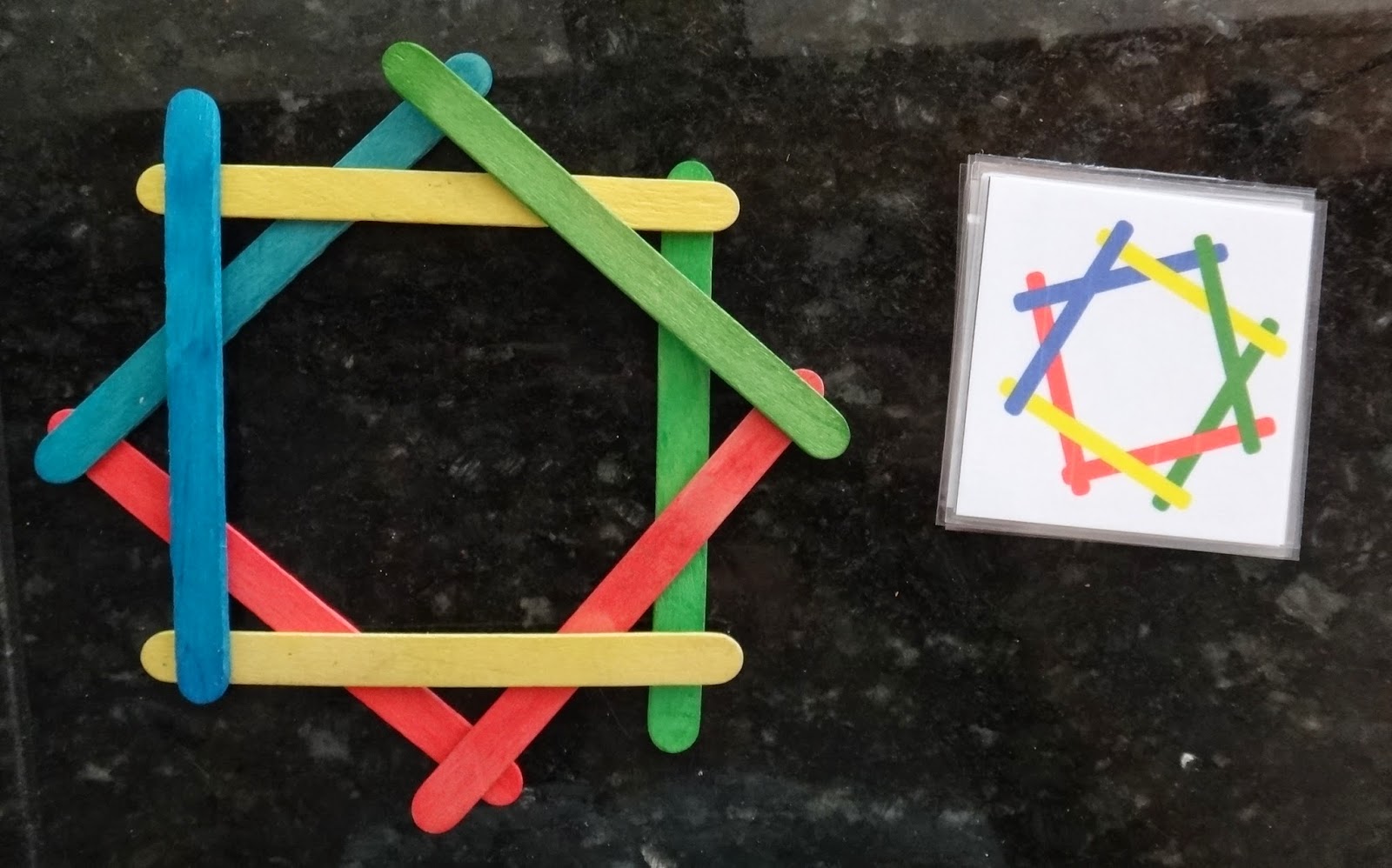
STICK FIGURES
Includes: 2 each of 4 colors of craft sticks, design cards
Instructions: Choose a card, create the design, or create your own design
Notes: The cards range in difficulty from fairly easy to very difficult. Even I find this one challenging if trying to get all the over/unders correct.
Skills: Logic/reasoning, observation, visual/spatial, trial/error, patterns, geometry


TANAGRAMS 
Includes: Set of uppercase tanagram cards, tanagram blocks to create all the cards
Instructions: Choose a card, re-create with tanagram blocks, or create your own design Advanced: make your own cards without the shape indicators, or just black/white.
Notes: The tanagram cards are a free download. I printed them out with the multiple page option on my printer so that they were smaller. I wanted these children to create FROM the cards, not ON the cards. Since the blocks have a tendency to drift off, I put the quantities needed on the front of the bag for easy inventory and re-stocking. There are a lot of free tanagram cards out there.
Skills: Geometry, visual/spatial, logic/reasoning, symmetry, counting, creative expression


WRITE THE FACTS
Includes: 1-12 bead circles, laminated addition/subtraction fact writing card, dry erase marker
Instructions: Choose a bead circle, move some of the beads to each side, write the fact. Advanced: write all the facts in the family.
Notes: The child can do as many or as few facts as they wish with a single circle before moving on to another. The circles are made with pipe cleaners cut in half and hot glued into the wooden bead after putting on the pony beads. I tried to make them colorful. The number is written on with sharpie.
Skills: Fact families, addition/subtraction, observation, logic/reasoning


In there right now, I also have a number writing cheat card, since we haven't been working on writing for very long, and they want to write RIGHT.


I also have a couple of seasonal I Spy books in there.


Busy Bags are not ALL they do during naptime. They also read books, and magazines, 


do educational apps on the iPad,


and color, among other activities.


But most importantly, 
they are QUIET so the little ones can get their rest.


Tags: gifted, advanced, homeschool, homeschooling, daycare, child care, preschool, pre-k, elementary, early, child, children, math, science, language, literacy, 
Follow Connie -'s board Sensory on Pinterest.