Showing posts with label preschool. Show all posts

Tuesday, December 4, 2018

Christmas Sensory Bin Checklist


I try to add to our Christmas sensory bin each year. Frankly, they spend the majority of their time filling and dumping the rice. 


The 2s love the sensory exploration, 


and the 4 and ups get more into the dramatic play  and artistic aspect.


 I'm not indicating the type of material. While I love items that are real and wood, I'm not going to put real candy canes in a sensory bin rather than plastic or wood. I know what will happen. Gross. Wood has a heft to it that isn't always welcome. The children like the small plastic ornaments. They are cheap and come in a variety of sensory-rich textures and patterns. 


You can also get creative. Gingerbread salt dough can be cut thick and, when dried thoroughly, it can make some very sturdy little gingerbread men for the sensory table. You can find a picture of a decorated fireplace or Santa through Google, print out and Modge Podge to blocks you already have in use. The children's favorite funnel is the top of a 2 liter soda bottle cut off. Almost no cost for these types of items.

Keep in mind ages and stages. A sensory bin for under 3s is much different from one for over 4s. Choking hazards MUST be minimized for any child, regardless of age, that is still putting items into his/her mouth. Or, direct supervision at all times from an adult is required.

I store my sensory bin items in large, air-tight containers and re-use the items each year for a month. The investment in time and money is well spent. If you don't anticipate this type of long-term need, then use what you have available or invest in just a few items from your dollar store.

I use under-bed storage containers for my sensory bins. These are a good size for 2-4 and, with a tight squeeze, up to 6 children. We usually use them on the SANITIZED train table, since it has a nice lip edge to keep everything contained. 

The children also wash their hands prior to sensory bin use to keep materials clean and germs from spreading in this high-contact activity. Good sanitation is especially important as the cold and flu season hits around now, along with a lot of shopping and visiting of friends, family and parent work places. Never know what is lingering around during the holiday season. 

I have a small dustpan and hand sweep set from the dollar store that I can gather any stray filler with and, since the surface is sterilized, I can plop it back into the bin so there is little waste. 

Every item has a sensory component, but they are also intended for some other aspect as well.

I also try to add items that can be
  • Sorted
  • Paired
  • Counted to 10 or 20
  • Used with a magnet
  • Stacked
  • Inserted into something else
  • Flowed through something else
  • Manipulating light in some way
  • Wrapped around something else
  • Smelled
Not sure what they were counting earlier, but there was a heated debate as to whether there were 17 or 18. I asked them to simply recount together.


3yo exhibiting a vertical schema, lining up items in a row

On to the checklist...

Here are the categories I like to cover in each sensory bin with some options listed. Make it your own. Add as few or as many items, as simple or complex, as you desire or need for the children in you care. It can also be themed down to gingerbread people, Christmas trees, Santa, stars, etc. 

𞸆 Filler needs to be something they can scoop and pour [pick one]:
  • Green, red or white rice
  • Green, red or white rice sand
  • Green or red colored macaroni
  • Lentils
  • White beans
*If your program is against using food items, then shredded paper, kinetic sand, or some other filler can be used. However, the viscosity and flow-ability of the items I listed, is much more conducive to the fine and gross motor activity I am mainly looking to obtain from this activity.

𞸆 Secondary filler something they can manipulate [pick one]:
  • Batting for snow
  • Styrofoam for snow
  • Cotton balls for snow
  • Tinsel
  • Green and/or red shredded paper
Figures for dramatic play
𞸆 Santa
𞸆 Sleigh
𞸆 Elves
𞸆 Christmas house
𞸆 Reindeer
𞸆 Snowpeople
𞸆 Styrofoam balls & toothpicks to make snowpeople
𞸆 Christmas trees
𞸆 Mini nutcrackers
𞸆 Gingerbread people
𞸆 Carolers

Themed Other items for artistic manipulation
𞸆 Pinecones
𞸆 Christmas ornaments
𞸆 Garland
𞸆 Light string
𞸆 Bell
𞸆 Jingle bells
𞸆 Stars
𞸆 Snowflakes
𞸆 Candy canes
𞸆 Bows
𞸆 Mini wreaths
𞸆 Felt shapes to decorate trees and wreaths
𞸆 Mini stockings
𞸆 Small canvas "Santa" bags
𞸆 Small toys for bags and stockings
𞸆 Black stones for lumps of coal
𞸆 Block painted up as fireplace
𞸆 Poinsettia silk flowers
𞸆 Holly silk flowers
𞸆 Mini presents
𞸆 Mini snowman hats
𞸆 Green feather "Grinch fur"
𞸆 Mini drums
𞸆 Gingerbread house(s)
𞸆 Themed buttons like snowmen, gingerbread men, etc.
𞸆 Themed erasers
𞸆 Themed confetti
𞸆 Themed fabric pieces
𞸆 Cinnamon sticks
𞸆 Christmas cookie cutters
𞸆 Pretend Christmas cookies/candy
𞸆 Icicles

Non-themed Other:
Red, green, white, gold or silver:
𞸆 Pom poms and/or balls
𞸆 String or yarn
𞸆 Straw pieces
𞸆 Pipe cleaners
𞸆 Buttons, beads
𞸆 Fabric pieces
𞸆 Plastic gems
𞸆 Glass gems
𞸆 Feathers
𞸆 Red or green craft sticks
𞸆 Red and green milk jug lids
𞸆 Silver juice lids as ornaments or cookie trays

We use the same box of accessory/manipulative items for every sensory bin. I may change out colors if I have them available, but in general, it is the same items out all the time.

Accessories:
𞸆 Tongs
𞸆 Scoops
𞸆 Measuring cups
𞸆 Funnels
𞸆 Tubes
𞸆 Mini rake
𞸆 Mini shovel
𞸆 Sifter
𞸆 Magnifying glass
𞸆 Magnet wand
𞸆 Buckets
𞸆 Cups/containers
𞸆 Small pitcher
𞸆 Egg cups
𞸆 Yogurt cups
𞸆 Kid chopsticks
𞸆 Kid tweezers
𞸆 Ruler
𞸆 Flashlight


Printable checklist:
https://docs.google.com/document/d/e/2PACX-1vRsd_uEreXZqdFdZv_KA2zWlxK__PhPkJi8BVMVAO7Mjudb-adRHu974eaUYLRoQtAtdsgZzQvf8J3i/pub

Note that this post has been added to, so the printable checklist will NOT have absolutely every item included in this blog post. I hope to keep adding to this post list, so please feel free to offer your suggestions!

The small LED flashlight I attached to the bin with a retractable lanyard. We have other flashlights, but this one is specific to the sensory table. It is a huge hit.


Coloring rice for the sensory bin is really easy. It is:
1 Cup rice
1 Teaspoon vinegar
Food dye to the intensity of color you wish

Combine the vinegar and food dye, add that and rice to a plastic bag. Mix and coat the rice well. Spread out on cookie sheets to dry. On sunny days I do this outside in someplace protected from wildlife. It can be done just by letting air dry on paper towels, or it can be put in a 200 degree oven until dry. Check it every 15 minutes and stir to prevent clumping.  

My green rice was made many years ago and the color has faded a bit over time. All I would have to do to refresh it is to color it again. This green was done with regular grocery store liquid food dye, but for more intense colors and more variety, I use the Wilton gel colors. You just HAVE to make sure the coloring gets absorbed and thoroughly dried before the children use it when using the gel colors, as it could dye their hands and clothing otherwise.

Sensory bins are "play" with some AMAZING learning inherently built within the activity. It is developmentally appropriate for the under 8 age group, and enjoyed by any age.

Skills:
  • Fine motor
  • Gross motor
  • Logic/reasoning
  • Creativity
  • Numeracy
  • Cause/effect
Sensory bins can be as elaborate or as simple, as costly or as inexpensive, as your program requires. Yes, they can be a bit messy, but they are SO worth the time training the children in proper use, and the clean up required, to integrate them into your environment.

Follow Connie -'s board Sensory on Pinterest.

homeschool, teaching, parenting, special needs, holiday, math, language, manipulatives, Montessori, Reggio, Waldorf, loose parts, 

Friday, August 31, 2018

Art Smart - Mondrian


Activity for ages 4+ with good scissor experience.

We are stepping beyond scribbles, smears and tossed-on collages and adding some product into our process art.  

Wednesdays are our cut and paste days. 

Often preschool teachers cut out the shapes themselves, give the students a review of Mondrian pieces and put some up as "inspiration" and then provide a piece of paper and glue. 

To me, this strips away the skill inherent: cutting, and the process: creativity. It becomes purely product, trying to replicate Mondrian's creativity with pieces skillfully cut by the teacher.

To make this a process piece, I simply give the following directions:

  1. Black is to be cut into strips
  2. Red and yellow are to be cut into squares
"How big should they be?" 

"However big you want them to be."
I provided 2 sheets of black and 2 half sheets each of yellow and red for 4 children. [The 3yo isn't up to cutting shapes, so he was just cutting.]


Once THEY feel they have cut as much as they desire, then I bring out the paper.
      3. Put your cut pieces on your paper how you want them

Then I bring out the glue.
      4. Glue your pieces where you put them


So this is still a process piece with just a bit of direction. As you can see, there is still plenty of room for creativity and interpretation. One did it portrait and two did it landscape. One didn't use any red. One made a road. It is still black lines and colored squares. 

They worked very diligently and were very proud of these pieces. Not bad at all for 4-year-olds.

Next week, when this activity is not fresh, we will observe and discuss Mondrian. They will be able to relate to the works after doing this activity, but they will have lost any intense emotional attachment to their own art and should not feel any inferiority or desire to change it in light of the new information. 


Tags: child care, daycare, preschool, pre-k, teaching, homeschool, fine motor,

Tuesday, March 27, 2018

Essential Preschool Math Skills


Even though I have training in curriculum, it still took me awhile to figure out the different types of math concepts that I needed to be integrating into my teaching, how, and when. I hope this will help others who are teaching or homeschooling preschool. 

One of my former students placed in the top 2% internationally in Math Olympiad. This is why...[in addition to her just being exceptionally smart!]

The main math skills I will cover here pertain to numeracy and are:
  • Pattern recognition & sorting/classification
  • Subitizing/quantification
  • One-to-one correspondence counting
  • Rote counting
  • Counting on
  • Grid counting
  • Scatter counting
Note that on this list is NOT learning number names. This goes with my functional learning method. Knowing the name of a number 1 is not functional. It is vocabulary. Knowing the order or quantity for the number 1 allows for functional mathematical ability. The children all learn that a 1 is called a one, but incidentally, not as a focus of teaching.

This post goes to the next level from my Teaching 2's Math post which was a level up from my Learning Math From Birth. You may also want to read my post Early Math is as Important as Early Literacy

Math, especially, needs to be hands-on learning through play and manipulation in the early years. We are currently on our EGG unit, which is math intensive. This allows you to see some ideas on how to integrate the skill learning into a unit or theme.

These children, 2-3 years old, know their basic colors and can count to 10 in order to do the activities.

PATTERN RECOGNITION & SORTING/CLASSIFICATION

I put these skills together because they are complimentary skills. They both are observation and interpretation of where things belong. If a child can't sort/classify, then they can't complete a pattern activity, and sorting and classification are patterning activities. 


The ability to recognize patterns is considered the NUMBER ONE key indicator for future math success. I start this in infancy, patting out song rhythms on their back or with their feet to music playing along. It builds that ability to begin linking patterns to their world. I use repetitive patterns, audio, physical or visual, for most of my infant and early toddler learning play, specifically to enhance this ability. 

It works. My preschoolers can sort, categorize, and pattern forward and backward much earlier and better than their peers who have not had this early exposure. 

Activity: The children create their own pattern and then extend it out in either direction until they run out of eggs.


Patterning is not just a preschool skill activity. There are patterns everywhere - in the seasons, in our daily schedule, even our daily routines. It allows children to be able to tell time in a general way even as infants. It leads to understanding quantities of time such as weeks, months, years. It allows them to know that we always wash our hands before eating or brush our teeth before going to bed. Those are patterns. There are patterns in nature, music, and daily life. As they enter the preschool era, we work more hands-on and intentionally with creating and manipulating physical patterns.

Activity: The children gather eggs as fast as they can, then sort their eggs by color. For younger children, I might have colored bowls or color circles to assist. We are working on grid formations, so that is why theirs are sorted like this.


Sorting and categorization are naturally occurring. They know farm animals from zoo animals. Red cars are sorted from yellow cars. Blue blocks are suddenly preferred and everything is made up only of blue blocks. As we advance, opportunities are created for more advanced sorting and categorization on more than one trait. Red/green/purple circles that are also small/medium/large. Then throw in a few blue squares of the sizes and see how they handle that. 

SUBITIZING/QUANTIFICATION

This is the ability to instantly recognize quantities. It starts as soon as you begin asking a child if they want MORE. More/less, big/small and their counterparts are all quantifications that toddlers learn. Around three they are learning to recognize a quantity of at least 1-3 objects as being that amount just by looking at it. This is an important mathematical, observation and spatial skill that is often overlooked. The only way to enhance this skill is to give children a ton of opportunities to practice it in grid formation and scatter groups. "Look, you have 3 blocks lined up!" "I see you have 3 cars in your hands." "Do you want 2 or 3 pieces?" and have the groups of 2 and 3 laid out for them to see.

Activity: Bring me 2 eggs the SAME color. Bring me 2 PAIRS of eggs. 2 eggs + 2 eggs is how many all together? Bring me 3 DIFFERENT color eggs. 


Dice play in later preschool and pre-k really works this skill.

However, quantification BEGINS by getting them comfortable with assessing quantities. This is smaller/larger, more/less, smaller/bigger, shorter/taller.  


It also carries over to categorization/sorting and patterning. Being able to tell a specific quantity, first comes from being able to assess the quantity.

ONE TO ONE CORRESPONDENCE COUNTING

While rote counting to 100 wins the accolades, the whole purpose of math is to count THINGS. Even as infants, I have their little fingers touching bunnies in a book as we count them and everything else we can one-to-one correspond. We count, with fingers touching the items we are counting, multiple times a day from the first day they arrive. It is ingrained.

This ability leads to accurate counting, an ability to practice subitizing/quantification on their own, and an ability to do equations much earlier. 

Activity: Once sorted by color, children count how many of each color they have. Then the eggs are combined and again counted by color for the group. Subitizing is encouraged on individual small quantities. Quantity comparisons of same/equal, more, less, how many more, how many less, etc. can be performed.


ROTE COUNTING

Rote counting is the ability to count in numerical order. Seems simple, but it is more difficult and important that children understand that the order has permanence. Numbers occur in order. Always. I have a 2-year-old that just counted to 13. He then skipped up to 15, 16, 17, 19, 20. Still in order, even though he skipped a couple, showing that he has that concept understood. 

We count here multiple times a day, at least once a day to 100. With toddlers, we do 1-2-3 as the focus, and do it multiple times a day until they get it. When they have that down, then I work to 5, then 10, then 11, then 13, then 16, then 20. Then we learn to count by 10's before moving on to counting to 100. Eleven is the hardest because they hear 1-10 SO much from parents and in the shows they watch [AT HOME.] I try not to do that here, which is why we do various counts throughout the day and week.

Rote counting and one-to-one correspondence must be mastered to some degree before other math and science skills can be mastered.

It is so ingrained here, that I just caught this one counting the stripes on his socks as he laid down for nap. It's just what we do. 


Activity: Incubating eggs takes 21 days, exactly the number we are working on for rote counting. 11-19 are the most difficult numbers to master, and this gives us the opportunity to count those on a daily basis for 21 days. We count how many days the chicks need to develop, how many days have passed, and how many day until they hatch. Working rote counting and number recognition. 


This is an example of how number recognition happens without it being a main objective. The objective is counting.

COUNTING ON

This is the beginning of addition and future understanding of equations. It is an extension of rote counting and one-to-one correspondence. You have 3 items and another two are added, you can continue on from 3 to count 4, 5. This is NOT an easy skill to master. They want to go back and now count the whole group, until it clicks. This takes a lot of exposure and practice, but a child that can subitize/quantify then count on has a higher level of numeracy and mathematical understanding from which to scaffold.

Activity: When doing 10-frame counting, try to get them to begin counting after subitizing a smaller amount. Also when doing fact families of lower numbers. Here we are doing fact families of 5, and I ask them to subitize and count on from the smallest quantity. This requires direct instruction. This is an activity they can do independently, to a quantity they are familiar with manipulating. The older ones will automatically go to 10-frame.


GRID COUNTING

The current math [Common Core circa 2018] is almost entirely based on 10. Ten frames are used exhaustively. So what used to be just an easier way to line up and count items, now becomes a focused effort to get preschoolers to line items into ten frame organization, which is a grid. 


Understanding rows and columns, creating and reading charts, is actually very easy for even young preschoolers to master. I begin by using the actual items and eventually move it to a white board. Once they reach school, the same concept will be used on endless worksheets [sigh.] 

Additionally, if preschoolers get the concept of grid layouts early, multiplication and division makes absolute sense to preschoolers, and often they figure it out on their own. It also helps with the concept of skip counting that they will need to master in elementary school.

Grid counting here begins when I line up items for a toddler or early preschooler to rote count easily using one-to-one correspondence. I do make certain that they count vertically as well as horizontally, such as stacked blocks. These are some former pre-k students doing the same at a higher level. As play. Their ability to read and interpret graphs was amazing.


It also helps with addition and subtraction as I can split objects into linear groups to show fact families and the permanence of the count.

SCATTER COUNTING

Scatter counting is figuring out a methodology of counting a scattered group of objects. It's pretty difficult. Different children do it differently. Whatever works for them. Left-right, top-bottom, or physically moving items from an uncounted grouping to a counted grouping. I show them all the ways and let them figure out what works best for themselves. This takes a lot of exposure and practice. They begin as toddlers as I hold their fingers and we count flowers in a book, worms on the ground, freckles on a face, etc. 

Since mine learn it in conjunction with rote counting and one-to-one correspondence counting, they pick it up fairly easily. The main issue is getting them to slow down and pay attention enough to be accurate. Even if I just observe them doing it in play on their own, if they do it wrong, I have them do it over again until they get it correct. This is one skill that needs accuracy reinforced.


Activity: Place items in a bowl so that linear or grid formation is not possible then have them count the items. Different colors, especially in easily subitized quantities, is easier than all different colors or all one color. This is an activity they can do independently.

These are the skills that make other skills possible - time, measurement, geometry beyond simple shapes, fractions, etc. 

These are the skills that I want, at minimum, for my preschool graduates to have mastered.


However, start them young and you'll be surprised what they can achieve...

Even at 3.75 years of age, my preschoolers are able to reach beyond these preschool-level skills. We have been spending a lot of focus on measuring recently, which they love. 

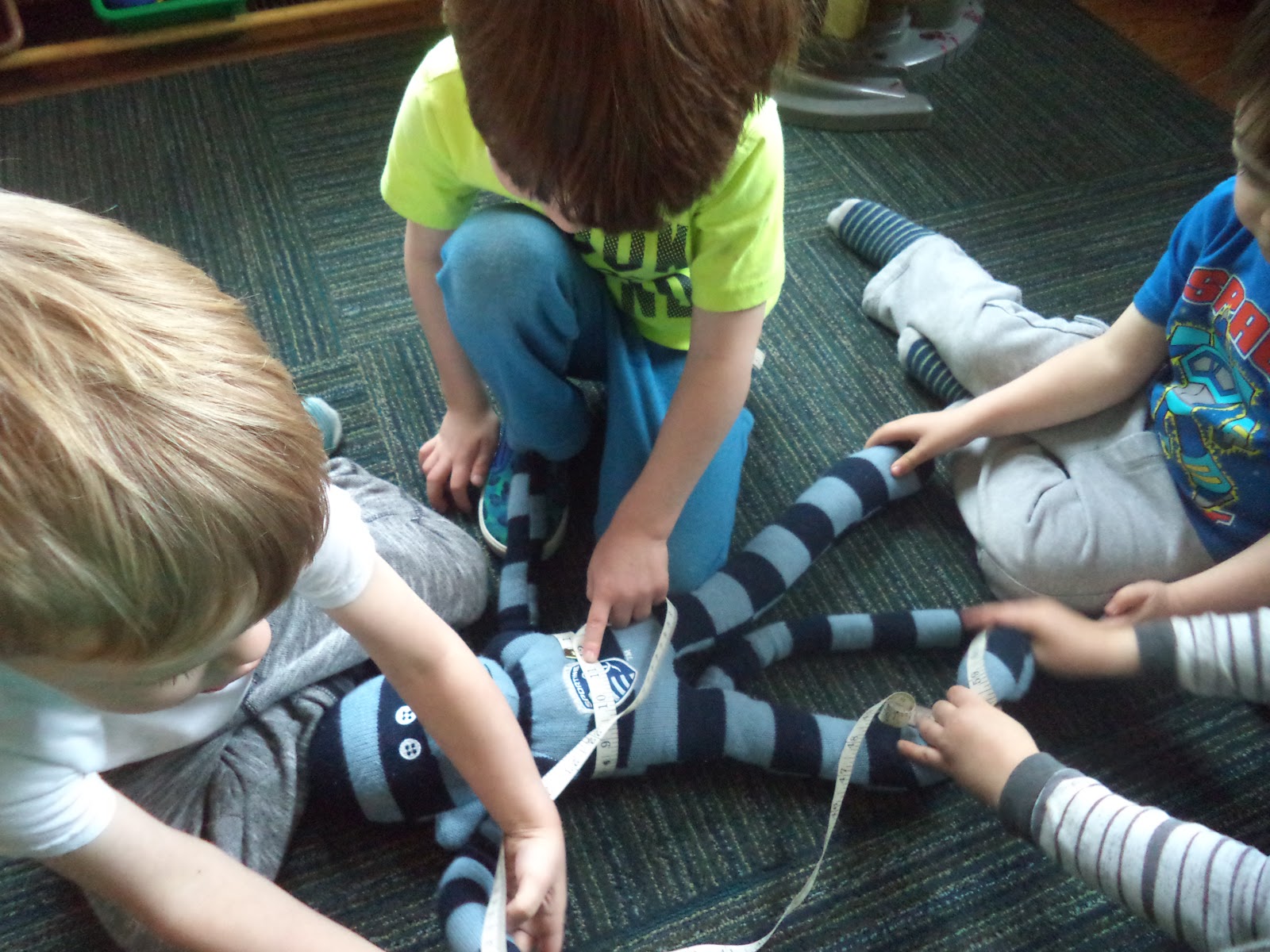
For this unit, we started with 3 different sizes of eggs. We discussed how they were the size of a duck, goose and ostrich egg. We discussed how the goose-size blue egg could be small, medium or large depending on which other egg(s) it was compared to in size. We then started to measure. The main objective was to learn about circumference. 

We started with measuring the eggs.


Then ourselves.


Then special visitor sock monkey couldn't be left out.


Then we worked on heights.


Width and diameter.


Once again, measuring was the goal, but number recognition, number order, and quantity comparisons were integrated. 

They were allowed to play and do the activity unsupervised after our introductory session.

You can see the level of engagement and curiosity. Make it fun, and they don't even know how much they are learning.

Friday, December 15, 2017

Functional Learning vs. Rote Teaching


Our education system likes to teach. A lesson + an activity = you should know this and be assessed on it. Learning is not like that. Learning is incremental scaffolding through discovery and processing over time.

There is a huge difference between knowing something and being able to USE information in a continuous learning process. Some information floats around and is picked up as a type of appetizer, nice but not filling and while it serves a purpose, it is not a foundation. Some information is the meat and potatoes that other, important, learning builds upon.

I had a client dad ask a few months ago about his son's ability to identify numbers. "He doesn't seem to know what a 7 looks like." 

I kinda blew him off, saying something about his child not needing to know that and I don't teach it. 

That conversation sat uncomfortably with me for the rest of the evening and night and I got back to him the next morning.

I had a similar conversation with a mother a few weeks ago. They were at Thanksgiving and her sons' cousin, who is a few weeks older, could identify all of his ABC's. "So, how is [my son] doing on his letter recognition?"

Again, I don't teach that.

This time, however, I was prepared with the better explanation I had given the dad the day after I kinda blew him off with a non-answer.


I explained:

Most preschools teach letter identification, and usually only uppercase letters. They also teach number identification to 10 and a set of primary color names. 

Here, I teach functionality. Your child may not be able to identify a 7 as a seven, but he can do one-to-one correspondence counting, even in a scatter group and COUNT to seven. He can COUNT to 20, possibly with some errors, in any manner required. He can simply look at a group of four items and know it is a quantity of four. He can count, with some ability, imperfectly, to 100. At 3 1/2 years old. A person can count without knowing number names. We are working on counting and quantification.

Your child may not be able to label an A as an A, but he can say that both upper AND lowercase Aa's say "ah." Uppercase recognition, when 90% of reading is lowercase letters, has very little functionality. If a person never, ever, learned letter names, they could still learn to read if they knew phonics. I am working on them reading.

Your child, at 3 1/2, can also identify around 12 shapes and colors, and I never stood in front of them and held a lesson and "taught" them anything.

I didn't even get into the fact that these children can pattern [#1 indicator of future math success], sort, graph, etc., which most other preschools are not even attempting to expose their students.


These children have been exposed to, and picked up through environmental, functional, exposure, LIVING experience, these SKILLS. There is no letter of the week, color of the day, flash cards, or expectation of memorization here. 

"Can you hand me that WHITE towel, please?"

"Do you want the BLUE or the PURPLE cup?"

"How many kids are here today?"

"How many cars do you have?"


"We are having eggs for lunch, how do you think we would spell EGGS? Let's sound it out. Eh, yep, gg, yep, ssss. Yeah. In this word, eggs has two g's, so it would be E-G-G-S. Eh, g, s. Eggs."

"Which one is your cubby? How do you know? Yes, it's your color, but it also has your name on it. Let's sound it out."

"We have to put your name on your art so I know who it belongs to. How do we spell your name? Let's sound it out."


They all pick up the letter and number names by kindergarten, but knowing their phonics and counting methods means that they are learning numeracy and literacy far earlier than their traditionally "taught" counterpart preschoolers. 

BECAUSE: 
  • Their learning has meaning. 
  • It has functionality. 
  • It is important to THEM. 
Graduate of mine who placed in the top 2%
INTERNATIONALLY in Math Olympiad
They may not be able to do a dog and pony show for the relatives, but they can do important WORK. 

This is why my kiddos historically leave here for kindergarten reading and doing math at a 2nd grade level. 

I think that the ability to read or DO math, is much more important than rote memorization of letter and number names. It's worked so far. Very well.


Knowledge is only powerful if you can USE IT.