Showing posts with label Development. Show all posts

Wednesday, July 17, 2019

Siblings Blessing or Burden


A conversation with a client this week:
"How did he do with having his baby brother here today?"
"Fine." 
"I was afraid he would try to do too much. He's very responsible with him and likes to help out." 
"I let him know right off that the baby was MY job and MY responsibility and that if I needed him to help out as teacher's helper, which is his job this week, that I would let him know. He went merrily off to play."

You may think that siblings are a gift of one to another. That can be true. However, they are often a burden and that burden is created by adults.

One of the best gifts you can give an older child is to say about their younger sibling:


"He is NOT your job. 
He is NOT your responsibility."

I have heard so often, "Take care of your baby brother!" as a parent leaves. Seriously, that is the last thing they say as they walk out through the door. A 3 or 4 year old child is left with that as their parent's final farewell. 


It is a massive burden. 

It strips away your older child's childhood.

Children do naughty things. Children get hurt. Children get hungry or sad or frustrated and cry. As adults we know we can't make a child's life perfect for them, but a young child has no clue and just gets anxious, frustrated, fearful and depressed when they understand the futility and POWERLESSNESS of the position they have been tasked with by their parent.


It is not a good thing for either child. 

1. It teaches the older child to lie. If it is his responsibility, then he will do anything to make sure the younger sibling doesn't get into trouble. This means lying about what happens, usually blaming another, innocent, child.

2. The older child will do anything to make the younger child happy. That often means assisting them in participating in something physical the older child is doing, which can be dangerous or inappropriate for the younger one. The helping can take the form of lifting the child or in other ways manhandling the child that could cause harm, or placing them higher or on more precarious places than a younger child should be accessing. 


By getting into physical positions with help, the younger child doesn't build the necessary skills to do so independently safely, and by not getting there himself, he lacks any knowledge of how to get out or down, let alone safely. Helping a child do anything physical is always a bad idea. They need to get there on their own, with some coaching, not physical manipulation. 


3. Also in making the younger child happy, the older one may sneak foods, steal toys from others, harm other children to allow their younger sibling to have an undeserved turn at an activity and in many way undermine the foundations of a good community. 

The older sibling wouldn't be doing this without the weight of responsibility, so it is turning a perfectly good child into one who is doing not good things, and developing not good habits. 

The younger sibling, on the other hand, is learning that she can get what she wants whenever she wants, doesn't have to wait, how to bully, and getting spoiled.


This week:

"[Mr. H], that is NOT her toy. Just because she wants it doesn't mean she gets it. It is not your job to make your sister happy, but it IS your job to follow the rules and be a nice person. Please give that back to him."

4. The older sibling spends so much time worrying and care taking over the younger child that they lose the ability to just play, be with their friends, and relax. They are constantly on the lookout for the younger one, and constantly intervening whenever anything goes even a bit sideways. 


The younger sibling doesn't learn proper coping mechanisms, patience, and social norms. Gaps can emerge in their development when the younger one is pushed by the older one into participating at a higher level before ready. The younger one isn't allowed to develop at their natural pace.


Yesterday:

Mr. R to his friends: "I can't play right now, I need to get [baby brother] calmed down."


Me across the room: "He is NOT your responsibility. He's mine. He's fine. His bottle is almost ready. Go play."

5. When things go wrong, and they will go wrong, the older sibling feels responsible. He wasn't watching close enough, he wasn't near enough, he wasn't good enough to keep the younger sibling from getting hurt, either physically or emotionally. 


Couple that with a parent or adult that immediately demands harshly of the older sibling, "What happened?" It makes that burden even weightier. The proper response is to take care of the younger one, reassure the older one, and casually ask the older one if he saw what happened without a harsh grilling.

6. I have seen parents punish an older child for what a younger one did. Why? "You are old enough you should have stopped him or at least come and told me what he was doing!" Again, making the older child responsible, rather than acknowledging their own lack of parental supervision. 


It isn't fair to rely on a 3-6 year old to supervise an infant - 5 year old. There are plenty of videos on Youtube showing what children can get up to when left unsupervised. GOOD KIDS. For just a few minutes. Be the adult. Supervise your own children or hire someone else to do it. Take parental responsibility and don't lay it in any way in your older child's direction.


I, my brother and mom
I know many adults who hold resentment, and even trauma, due to a burdensome responsibility for their sibling(s) placed upon them by the adults in their lives. It can not only alter and even eliminate a happy, content childhood, it can change a person for life. 

I have a friend whose little brother died from a drug overdose when they were teens. She still blames herself nearly 50 years later for not being able to intervene enough to save him. She was tasked with taking care of her brother from an early age.

Give your child the gift of a sibling, not the burden.
parenting, parents, pre-k, sister, brother, sibling rivalry, development, child care, childcare, daycare, preschool, toddlers

Sunday, March 10, 2019

Children and Boredom


I received this question from one of the people I am mentoring:

"How can I create lessons so that the children won't be bored?"

It got me thinking about children and boredom, because the two just don't mix.

All human beings are born with an unlimited capacity and drive for exploration and learning. Infants use all their senses to explore anything and everything with which they come into contact.

So what happens? Why do children get bored? Why does it seem to be more of a problem these days?


I can tell you exactly why children get bored:


They aren't allowed to entertain themselves. Babies should be held and interacted with as much as possible in the early months. Often, though, babies continue to be held, contained and entertained most of their waking time when they should be exploring on their own. Babies today are held, placed into stationary contraptions or placed into safe areas with limited, non-rotating toys. Babies don't need baby toys, they need exploration opportunities. Give a baby a whisk and even at 4 months old their eyes light up because it is something NEW and to them, extraordinary. That word EXTRA-ordinary. It can be an ordinary object, but to a baby or child, anything new is extraordinary. From 6 months on, children need to be down, freely exploring new and varied materials, textures and environments, building and utilizing skills.


They aren't allowed to do individual exploration. So often today children are told what to do, where to go. They aren't allowed to venture forth to check out the world on their own. I had a conversation with a mom who was very irritated that her one year old kept moving the backdoor back and forth one day while she had it open. She couldn't get the little one to stop. I asked why she wanted the child to stop. She didn't have a good answer, she just felt it was not appropriate behavior. I explained how moving the door back and forth shifted light patterns, shifted any breeze patterns coming through the screen door, had heft for gross motor control practice, probably created noise changes as he could hear outside and inside noises differently, he was learning about arcs and physics. SO MUCH LEARNING at play, with a mother demanding that he stop.

They aren't allowed to play as they wish with items. "That's not how we play with cars." "That's not a toy." "No, here's how you do it." "Stack the blocks up high." You wouldn't think saying something like "Stack the blocks up high," would be a bad thing, but it imposes our own idea of what is to be done with the blocks, rather than the child's. Maybe she wants to line them up, or use them as pretend food, or carry them in a purse. So often we want adults and teacher playing with children, but too often the play is then directed by the adult and their narrow in-the-box view of how play should go. Children don't just "think outside of the box," to them, there is no box. WE adults create the boxes for them. WE limit their imagination. WE limit their ability to play and explore. By suggesting how a child should play, our powerful influence through how they wish to please and imitate us, eliminates immeasurable ways that THEY may have chosen to play. 


They are told no. It's a freakin' spatula. Let the kid play with it. Before taking an item from a child, really assess if it is necessary to do so, or if you are simply making a knee-jerk reaction because you don't see it as a "toy." We need to get out of the idea that children need toys and into the idea that children need to explore anything and everything around them that is safe to do so. So your toddler loves the Tupperware. Let him play with it. It will wash. Create a home where your child will only hear NO if a situation is unsafe, meaning where she will harm something valuable, herself, another person or living thing.

We do for them rather than teach them. Maria Montessori said, "Never do for a child what he can do for himself." I live by that. Even the two year old here is folding towels, sweeping, helping to dress herself, etc. The goal is to raise competent, resourceful, polite human beings. We do them no service when we don't allow them opportunities to practice and gain skills as soon as they are ready. When we shut down a child's emerging independence because we are too impatient, too time-crunched, we tell them, "You can't do it." "You can't do it well enough." "This doesn't matter." "Your needs are not as important as my needs." You find children try less hard. They try to do fewer things. They give up quicker. They begin to more and more look to the adults in their lives for what they SHOULD be doing, HOW to do it and WHEN. See where this is going?


We instill unnecessary fear. "Get down from there before you get hurt." One of the worst things an adult can do is to save a child. Instead, they should teach the child how to get out of the situation on his/her own. If it happened with your back turned once, more than likely it will happen again. Giving skills rather than help is a much better approach. Rather than helping a child gain skills to be competent, we tell them they are NOT competent and not to do something. This is more true with girls, but it is true as well with boys, especially in our helicopter parenting world. We shut children down, not allowing exploring, risking, learning, allowing them to find their own limits, to learn the skills necessary, to set goals, grow and accomplish. Children in fear will not attempt new things, even simple ones, either completely or at least not without hesitation. Children living with a sense of bravery will assess risks, make a determination, and proceed with knowledge, experience, and skills. They will seek help in their endeavors as necessary, and be willing to face failure.

LOVE this:


We don't embrace failure. Failure = First Attempt In Learning. From the beginning children are taught the "right" way to do things. If they don't do it the "right" way, they are corrected at least, put down at worst. The one thing we have majorly forgotten is the importance of praising EFFORT. Effort will get children farther in life than anything else, but we praise perfection over trying. So they fear trying because they fear not being able to do it perfectly. While some children are natural perfectionists, in general, this need to be the best, to be the smartest, to be perfect, is instilled by adults. The freedom to fail is one of the greatest gifts we can give to children. 

We don't give them time. Children are expected to conform to adult schedules. It's time for this, so let's go. No matter what children are doing, they are expected to abandon it without fuss to be moved to the next "important" activity as deemed by the adults in their lives. They aren't allowed to immerse themselves, without any type of time limit, in exploration. That sense of impending loss hovers over them constantly as they play. We put their toys away, their activity away, when the time is up. There is no leaving it for the next day, no chance to come back with a new perspective to tweak and re-do. There is little chance to fully explore, to their heart's content, materials and experiences. 


We expect them to play with toys with a purpose. The toy phone is a phone. You push the buttons on the phone. You listen to the sounds it makes. You pretend to use the phone. This takes almost no imagination and there is almost no exploration past about a minute of initial introduction. It is what it is, it does what it does. Unstructured toys such as blocks, can be ANYTHING. They can be animals, people, food, etc. Their only purpose is what the child makes of them. These are the toys they need. 


We don't provide free outdoor time in a true outdoor space. Children are outside at home in manicured yards. Most child care facilities have large climbers with mulch underneath. Period. Children aren't finding pine cones, bugs, digging in the dirt and carrying buckets of stuff from one place to another. They aren't allowed to use sticks as magic wands, swords, markers, dolls. They can't go barefoot to feel the grass, rocks, mud. "Don't touch that!" "Don't get dirty." Even when outside, we tell children very often that the outside is NOT a place for exploration, when it is the ULTIMATE place for exploration. 
Children today spend less time outdoors than any other generation, devoting only four to seven minutes to unstructured outdoor play per day while spending an average of seven and a half hours in front of electronic media. [source]

They don't do art, they do crafts. How often do children bring home these perfect crafts that look identical to everyone else's in the class? This isn't art. This isn't imagination and exploration. This is doing what you are told, with the expectation of perfection. Give a child a lump of clay and they can spend an hour with it, if they have experience and feel comfortable in being a true ARTIST. They should be allowed to explore materials, their viscosity, their malleability, their weight and other properties. THEN can they create their own masterpieces with them. When we have children do pre-determined crafts, we box up their innate artistic genius. 


They aren't exposed to a variety of music. Kids songs are great, but children are born with musical ability. Exposing them to zydeco, Indian flute music, Asian music, classical, blues & jazz, not only gives them a greater musical perspective, it lets them find their own musical passion. Dancing, making music and listening to music are all another form of exploration that many children are severely stunted in doing.

They are given electronics as a quick solution. Rather than having a child make a mess or having to assist them in exploration, it is much easier to just plop them in front of an iPad or TV. When they claim to be bored, an easy solution is to provide electronics. Electronics for children benefit adults, not children. Children need to be using their imaginations and exploring their real world, not escaping into a fantasy one.


They buy in, like adults, to the concept that education = learning. That it takes a teacher to teach in an academic setting to learn. Actually, most learning takes place through children's observations and experimentation in everyday life. But children usually don't research, practice or experiment anymore on their own. They don't identify a passion and immerse within it. They don't push to learn things not taught in school. They simply wait around until someone tells them it is time to practice, time to learn, what to learn, what to practice. I remember studying botany over the summer, on my own, and my brothers wondering why I would have my nose in a book and off doing experiments when I didn't HAVE TO. The thing about passions, is that the HAVE TO is internal, not external. Children need to find internal motivation to increase their knowledge and skills without being ordered about to do so. This type of learning, is what sticks. When children have a passion, all other learning gains purpose and meaning. When I child develops a passion for trains, suddenly reading becomes a necessary skill, math had a purpose to count the cars on the track, and so many other taught skills suddenly become important and relevant. Things that were once boring, are now fascinating. There is suddenly not enough time in the day to learn and do all the things the child can come up with to perform.
My Mr. H was at his grandma's one day and she told me that he played outside, by himself, all day. Happily. She thanked me for that. 

One of the boys was in time out last week and played with a string on his sock the entire time. He continued to do it when he came out of time out.

I had a 6 year old boy come as a drop-in one day last summer. He entered my 1/2 acre natural backyard and immediately said, "I'm bored.' He stood around, asking to go in, until we did so. He had no clue how to play and explore. Once inside, he wanted to watch TV. He couldn't see a place filled with exploration opportunities. 

It is amazing that older children that I get in have to be TAUGHT how to play. They don't know how. They can't break past the tight constraints put upon them since infancy in how they explore. They don't have the capacity to rely on their own imagination and abilities. They need to be told what to do, how to do it, when, where, why. They have not lost, but been stripped, of their innate curiosity. 

This is why children are bored. A bored child is not natural. Play is how they learn, much more so than academics.

You notice the overlying reason children are bored? 

Unnecessary or limiting adult intervention in every aspect of their ability to play, explore. learn and entertain themselves, from infancy.

I find this very, very sad.
parenting, day care, child care, daycare, boys, girls, classroom, parenting, pre-k, kindergarten, elementary, learning, development, preschool, language, math, science, psychology

Sunday, March 3, 2019

Red Shirting Kindergarten


If you aren't familiar with the term, RED SHIRTING is a term used in college sports where a freshman is part of the team, trains with the team, but doesn't play. They are given a year to mature their skills before entering the fray. 

This term has become applied to the choice to allow young 5 year olds [as of the kindergarten cut-off age], children an extra year of maturity prior to entering kindergarten. 

This is more important for young 5 boys, those who turn 5 only a few months prior to the school cut-off date. In the U.S.A., this is almost universally right around September 1.

When the practice first started, it was used by affluent families to give their child an advantage in academics and sports. Now, with the pushing down of academic skills to developmentally in-appropriate levels in schools, the removal of recesses and free play time, and the requirements of sitting still and paying attention for far longer than is age appropriate, it is becoming a necessity for children born close to the cut-off date. 

When the K-12 education model was developed in 1847, life expectancy was 37 years. That is double now, but we are pushing academic expectations down and eliminating childhood freedom to develop normally. Children actually have MORE time available to develop, grow and learn, but we are pushing them to do academics that aren't even developmentally appropriate. 

Much of the internet hits on this topic are connected to a 60 Minutes pieces from 2012 and the book Outliers [2008, Gladwell.] If researching, please use CURRENT information. Since the introduction of Common Core Standards in 2009, which pushed required skill sets below developmentally appropriate practice [DAP], redshirting, especially for boys, has become not only more common, but necessary.
What seems to be the biggest reason that parents choose to delay their kids' enrollment into kindergarten?
It really does seem to be emotional development. In the data you can see, clearly, that this happens most for boys who are born in the summertime to highly educated parents. They want [their kids] to be able to walk tall into a classroom, advocate for themselves, be an active participant in their learning.

Dr. Suzanna Jones in her dissertation, Academic Redshirting: Perceived Life Satisfaction of Adolescent Males, found that:

On the Life Satisfaction Scale, redshirted students showed significantly higher levels of life satisfaction than those who had not been redshirted. The feelings described by subjects in the interviews offered substantial evidence that redshirted students were happy with the decision their parents made, and those who were not [redshirted] wished they had been. Although this was a small study, it suggests that parents who opt to redshirt their children may be setting them up for a generally more satisfying life later on.
Interviews with parents offered similar insights: “The parents of the redshirted students all said they would do it again, no questions asked,” Jones reports. “When I asked: If you had another child today born in the summer, what would you do? Automatically (they said): ‘We would redshirt.’ No considerations whatsoever. The non-redshirted group, seven of the ten said that they would redshirt the next time. Without consideration of anything—how they’re doing at school—they would just automatically, summer boy, we would redshirt.” 
One of my client's talked to her pediatrician last week about whether or not she should send her son to kindergarten next year. Her pediatrician, based solely upon her son's birthday and nothing else, said, "Absolutely not!" They discussed it further and her pediatrician said one thing that really stuck out to both of us, "The consequences may not show up until 6th grade." 

It's still rare, but there's been a troubling rise in suicide by children younger than 12.
...medical professionals and researchers have noted alarming increases in the last decade – deaths more than doubled from 2008 to 2016 – and rising numbers of young children visiting emergency rooms for suicidal thoughts and attempts. [source]
Another client's pediatrician: "If you can keep him out another year, I would strongly advise it."

In a blog post it reads, "Our pediatrician told me that if we have a child born AFTER March, we should wait to send them (the cut-off here is September 1st)."

Why? Because boys are entering school, being compared to girls who naturally show about an extra year of emotional and social advancement, along with the ability sit still, pay attention and follow directions. Girls with ADHD are usually not diagnosed, because even they have this ability to conform. When boys are not DEVELOPMENTALLY CAPABLE of performing at a similar level, they are termed bad, wrong, a problem. They are being labeled as LESS THAN from the moment they step into a school system. 
In some school districts, by the fifth grade 28% of boys had been diagnosed with ADHD. In other communities, being young for one’s grade increased the chances of being prescribed stimulants 20-fold.
This is even more relevant when you consider the link found between ADHD and increased suicidal thoughts and actions. 
The reasons for the increases are unclear. Few researchers have examined suicide before age 10, so little is known about suicidal thinking and behavior in young children.
 But as they look more closely, themes are beginning to emerge. Attention deficit hyperactivity disorder, which can make impulsive youth still more impulsive, was a common characteristic found in a 2016 study by researchers from Nationwide Children's Hospital in Columbus
The reason many countries do not being formal education until age 7 is because at that age nearly EVERY child, can be successful as they enter Piaget's concrete operational stage of development. The younger the child is at the time of entering school, the farther away they are from this very critical cognitive developmental advancement. 
Research has largely shown that the effects of redshirting on academics are positive, with older students likely to score higher on standardized tests than their younger classmates. One recent study by Northwestern University’s David Figlio indicated that later school entry was associated with higher rates of college attendance and graduation, as well as a lower likelihood of incarceration.
I currently have 3 July birthday boys in care who will turn 5 this summer. Two of the parents are having a debate about sending or not sending this fall. One set of parents knew from the time their boy was born that they would redshirt. 

Academically, I believe two of the three would be fine. While they are all exceptionally smart, the youngest one has more trouble listening to and following directions and processing stepped incremental instruction. He works better with back-stepped "big picture" instruction, which is not done in public schools. All the boys, however, are not able to control their emotions, still throw tantrums, have difficulty focusing and sitting still for any length of time. They have a VERY difficult time when they are not interested in the subject or activity, have been forcefully transitioned from a desired activity, or are anticipating the next one. 

Normal little boys, right?

YES!

However, in kindergarten these aspects of boyhood are NOT OKAY. 

In a study by John Hopkins University:
Notably, social-emotional readiness in kindergarten was a significant predictor of grade retention even after controlling for student scores on the other readiness domains of the MMSR, such as language and literacy development, cognition and general knowledge, and physical development and health.
It turns out that, by the fourth grade, students who entered kindergarten behind in social-emotional skills (the “Not Ready” group) were:
  • up to 80 percent more likely to have been retained;
  • up to 80 percent more likely to require special education services; and
  • up to seven times more likely to be suspended or expelled at least once.
The researchers also found that the most consistent characteristic associated with all three of these outcomes was being a male student.
One of the key elements of a successful student is how well their Executive Function has matured. Executive functions are "a set of skills that are essential for school achievement." They include:
  • Organizing, setting priorities and starting tasks
  • Focusing, shifting or sustaining attention and thinking flexibly
  • Regulating alertness and staying on task
  • Managing frustration and keeping emotions in check
  • Using working memory and recalling information
  • Self-monitoring and controlling impulses 
If a child doesn't have good executive function, at any age, they will have many more issues with behavior and academic skills. Executive function continues to mature into adulthood until about the age of 25. Girls' executive function usually matures earlier than boys'. 

When determining whether or not to redshirt your child, consider how well your child can perform the 6 steps the brain typically works through with good executive function skills when given an assignment/task:

1. Analyze a task. Figure out what needs to be done.
2. Plan how to handle the task.
3. Get organized. Break down the plan into a series of steps.
4. Figure out how much time is needed to carry out the plan, and set aside the time.
5. Make adjustments as needed
6. Finish the task in the time allotted.


An additional year of age also means an extra year of executive function maturity, which can lead to fewer behavioral problems and greater academic success, which leads, generally, to a more happy child.


We think of a kindergarten class as having a homogeneous group of same-aged, same-development kiddos. That's not true. Here's a table of birthday months [number in red] with ages, and developmental ages, that could be in a kindergarten class, last column. Consider that girls naturally have about an extra year-equivalent of "maturity," so this shows where girls would START off in comparison to the younger boys, at the purple line. Kindergarten girls would not normally act younger than that first purple line in their ability to conform to expectations within a class setting. The purple range also shows where redshirting boys would generally fall if held back.  


So in the first month of kindergarten, the class students can range from an immature boy with an August birthday who has a developmental maturity of 4, to a girl with a September birthday who turns 6 right after kindergarten starts, who has a developmental maturity of 7. 

These two children are being compared. 

By keeping the boy out for another year, redshirting him, at the start of kindergarten he is now just turned 6, developmentally 5, being compared to a girl who is developmentally 7. Still not a fair comparison, but the boy is significantly more likely to be successful. 

Redshirting actually levels the playing field academically between girls and boys.
New ‘Redshirting’ Study Reveals That Boys Are Held Back More Than Girls — and It’s Actually Helping to Close an Achievement Gap Between the Genders
That gender disparity produces the important effect of dampening achievement gaps favoring girls over boys. Cook finds that if the third-grade tests controlled for differences in age, the existing difference in scores between white boys and girls would be 11 percent greater.
Every child is different. The last boys I sent off to kindergarten were twins 5 years 8 months. One still had a LOT of trouble sitting still, paying attention, getting his assignments done on time and correctly. The other one has flourished. 
Using data from the North Carolina Education Research Data Center, [Duke professor Philip Cook] traced the birth dates, kindergarten entry years, and academic performance of thousands of North Carolina students born between November 2003 and August 2004. Overall, about 6.7 percent of children in the state began school late...The mean effect of an extra year of age is positive, and striking.
Here's a quick chart to use as a non-scientific reference. If your child, boy especially, falls into a birthday month in the red zone, it would be a good idea to talk to your pediatrician, school administrator and research CURRENT studies on this topic. 


I just read a blog post from a woman who was strongly encouraged to redshirt her August birthday daughter by the school personnel. She didn't. She defended her choice and said her daughter thrived - academically. However, her daughter couldn't keep up physically and had trouble socially. They eventually took her out to homeschool. 

From a highschool friend who is an elementary reading teacher:

...I totally agree. If it’s an option to NOT send them, I think developmentally that is the best option. We continue to push these little ones to do more and know more at younger and younger ages, yet many are just not ready for the structured setting that school now demands. In my current district kinder students don’t nap and many are exhausted by the end of the day. I am a reading teacher and when I test students the first thing I look at is their birthday. I know that the summer birthday kids can’t just overcome the year gap that the September birthday kids have. The Sept kids were probably walking and developing many skills when the summer birthday kid was just being born. No easy way to make up that time.

On a personal note... My son has a July 17 birthday and is now 24. I have regretted sending him since about 2nd or 3rd grade. He is smart, he graduated 8th in his class of 180 kids. Intelligence was never a concern. But his maturity just wasn’t the same as other kids his age. By 3rd grade there was no holding him back [option], plus academics wasn’t an issue. I remember him saying he couldn’t believe when he didn’t get 2 recesses any longer. Fast forward to high school and he wasn’t able to drive for quite some time because of his age and the bus wasn’t very cool in high school. All the school dances his freshman year he couldn’t drive to so we had to take him, again not too cool. He did great academically in high school but socially he was awkward and always behind all of his friends which was a difficult time. Fast forward to college and he just wasn’t ready for that independence. He went close to home his freshman year and we were very involved because he was home a lot so he was successful. His 2nd year not so much. He went 3 hours away and struggled with balancing his free time and his school work. He was finally old enough to be independent and didn’t know how to balance everything. He is 24 and has struggled to figure out what he wants to be when he grows up. He has an associates degree and went through a line apprenticeship. He worked in the line field for 2 years and decided he wanted to go back in school. I am praying we are on the last leg of this journey but it’s been a long time coming. Graduating at 17 and going away to college shortly after that is just hard for kids. I truly believe you can’t throw a barely 5 year old in a kindergarten classroom and expect they will preform like the kids who are 6 or turning 6 soon. They need time to grow and develop. I know it’s not an easy decision but I experienced it personally and it’s been hard. [My son's] preschool teacher told us he would be bored if we didn’t start him, so we listened. I always wished we would have went with our gut feeling of not starting him until the following year.

D. M. former kindergarten teacher:

At least June through Aug. [birthdays]. I kept my Aug BD daughter back a year. Best thing I ever did!! A friend who is a reading teacher did with both kids. The other friend who taught kindergarten did with both of hers too.

Careful though. It’s not totally across the board. When I taught kindergarten I did come across a few who were ready both cognitively and emotionally.

Generally it’s usually much better to wait!!

C. M. child care provider:

My son will be 5 September 5th. He will go to Kindergarten at 6. Academically he is ready now, emotionally he is not.

The most common reason to NOT redshirt a child? Money. Even knowing their child would benefit from an additional year before kindergarten, many families simply can't afford an additional year of child care, or choose to put their money in another direction. Often, they believe that the choice is not really all that important in the long run.

It is.
tags: parents, parenting, kindergarten, school, pre-school, child development, delayed entry, 

Thursday, December 3, 2015

Why We Pillow Fight


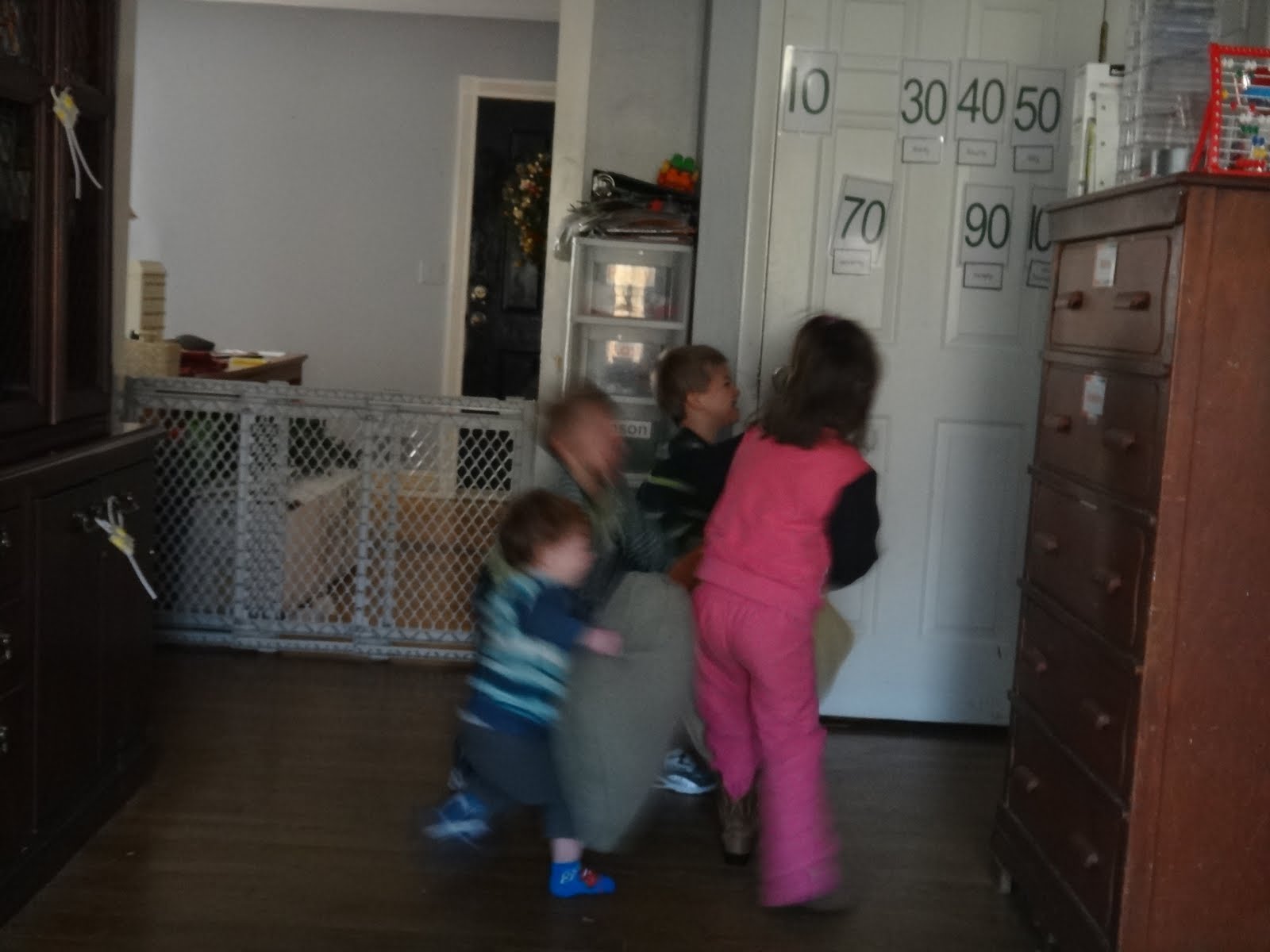
While we are a play and movement-based school, and spend as much time in physical activity and outside play as possible, there is an element of physical interaction that MUST come into play, for children to fully develop their proprioception sense. 

This is an excellent article, that I strongly recommend for all parents, care givers and teachers. Here is an excerpt: 
"Due to the busy schedules of today, children often don’t have hours to explore the outdoors, to help with the outside chores, or even do small jobs that require manual labor. Therefore, many children don’t have the same opportunities to fully develop and fine-tune the senses in the joints and muscles. As a result, more and more children are starting to have trouble regulating how much force to use when pushing and pulling and even interacting with the objects and people around them.
 This is why we are seeing children hit with too much force during a game of tag. Their senses are not quite working right – all because they are not engaged in an adequate amount of active play and movement on a regular basis." Valerie Strauss, The Washington Post 
We work on spatial skills, orientation skills, gross motor skills, etc. But there are few activities better than a pillow fight to get children really understanding the concept of physical force, in a safe manner. Pool noodle fights are another, but those are less interactive. They are, of course, well supervised, though I try not to interfere unless absolutely necessary. 

Note that these children are well versed in democratic decision making among themselves, and that our environment is based upon respect and caring for one another. Here, it could never be a melee.

What happens:
  • They learn how to hit. It is not easy for a preschooler to manipulate a pillow for accuracy and force at the same time.

  • They learn balance. Excellent balance. Building core strength. 
  • They learn how to duck and cover and to GET HIT. Super important.
  • They learn how to fall during interactions. Sometimes they all go down in a tangle. 

  • They learn how to get back up, disentangling without hurting one another or themselves. 
  • They learn that rules are necessary and how to create them. "STOP! Hey, I have a ponytail in and it hurts when you hit me on it. Don't do that. Okay?" "Okay!"

  • They get INSTANT feedback. "HEY! Not so hard!" "You nearly made me go into the cabinet. Be more careful!" 
  • They learn to counter force with a similar level of force. This is an amazing study. It is rare for a child to meet another child's force with significantly greater force. It usually escalates at a very prescribed pace.
  • They learn to be very aware of multiple environmental issues...little ones, walls, corners, door knobs, etc. and to react accordingly, regulating their force and direction.


"This is even more proof that delaying physical contact in sports is very risky. So many football leagues, hockey leagues and the like have jumped on the band wagon of delaying body contact. I am talking about tackling and body checking, and other legal and essential parts of the sports, until kids are older.
 The idea behind it is to wait until they have a better handle on their bodies and the sport before engaging in the physical contact aspects. Thus preventing injury at younger and older ages. It is having the reverse outcome. The players have not had the gradual introduction to the body contact over the years, and now when they are bigger, faster, and stronger they are thrust into it. They don’t know how to hit, they don’t know how to avoid, anticipate a hit and they don’t know how to fall. They also have anger issues, as they are now being hit, and hurt and don’t know how to mentally and emotionally handle it. When I say hurt, I don’t mean injured, but just the obvious pain of being taken down.
Like any other form of over protection, it is short term and only serves to make the parents feel better. The parents feel better because at that exact moment they prevented their snowflake from adversity, and yes potential injury. What they never see, is that they are actually creating a problem. Being that their snowflake is now ill equipped to handle the sports natural progression. Just like in life." - Comment by Warren

That's why we TEACH it here. 

Thursday, January 8, 2015

Lying Is Not Intentional Until Age 8


Lying occurs in children in every culture of the world. By age 4, 90% of children have the ability to lie.  

At their first tweaking of the truth, usually around the age of 4but as early as 2, we want to brand children as liars. Which is rather ironic, given the prevalence of lying in adults:


Most people lie in everyday conversation when they are trying to appear likable and competent.
The study found that 60 percent of people lied at least once during a 10-minute conversation and told an average of two to three lies.
"People tell a considerable number of lies in everyday conversation. It was a very surprising result. We didn't expect lying to be such a common part of daily life," Feldman said.
However, lying is not cognitively active until the age of 8! This is when a child has entered Piaget's Concrete Operational Stage of cognitive development and has developed inductive reasoning. 

Until the age of 7-8, lying is simply wishful thinking/story telling. The child does not have control over it. They do it because they truly want it to be the way they say, to keep out of trouble, or to make you or another adult happy. They will also alter their thought processes so that they ACTUALLY BELIEVE that is what happened. Once again, you can not punish a child for something they have no control over. 

Lying is NOT LYING until the brain goes through its massive maturation process around age 8. At that point children gain the abilities not only to distinguish between reality and make-believe, but also to control their responses through conscious choice.  

Lying is an important development milestone:
That’s because lying is an integral part of developing what psychologists call a “theory of mind.” Briefly, theory of mind is the ability to attribute mental states—beliefs, intents, desires, pretending, knowledge, etc.—to oneself and others and to understand that others have beliefs, desires and intentions that are different from one's own.
At age 4-6 you can begin to start your child questioning their statements, such as "Is that real or make-believe?" "Is that what really happened, or what you WISH had happened?" 

However, there does need to be an appropriate response to inappropriate behavior. 

  • "There are crayon marks on the wall, so the crayons have to be in time-out for a week." (denied writing on wall) 
  • "Your friend is crying because you were not a nice friend, so you have to go into time-out." (denied pushing/hitting/taking toy, but you know it happened) 
  • Story telling, "I have a pet lion," should simply be encouraged. "Really, what color is he? Does he eat a lot of meat?" 
  • Imaginary friends, etc. should be thoughtfully encouraged as your child explores their emerging imagination and learns the intricacies of using it in all it's many facets 
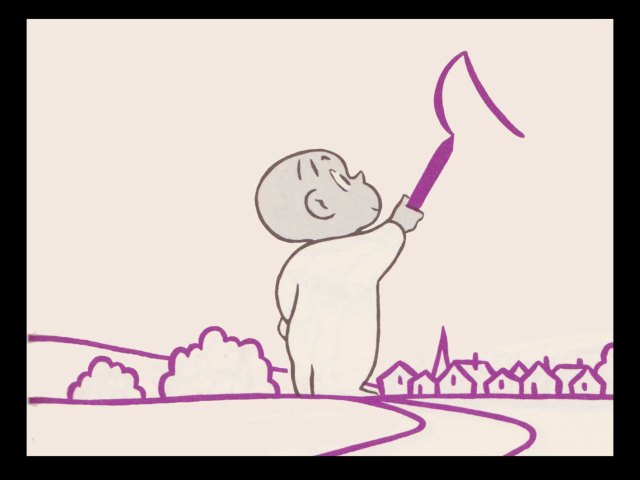
Harold and the Purple Crayon
by Crockett Johnson

Adults view lying in stark black and white; while until age 8, STORYTELLING is very vivid and colorful for your child, with little to no delineation between reality and make-believe. 

A child should not be punished for things they have little to no control over. Even if they KNOW they are telling a fib, they may not be capable of NOT doing so. 

I have observed, many times, adults yelling at a 4 -5 year old, or jerking them around saying, "Don't LIE to me!" when the child is too young to even have a grasp on the concept. 

This is also a common thread on child care provider discussion forums. Parents and caregivers who do not have a good background in child development, having unrealistic expectations of a child's ability and intent regarding lying.

Children are often driven to lie through confrontation. A calm discussion and more open-ended questions can produce better outcomes, along with praise for telling the truth and helping to determine their own discipline. Children are usually harsher on themselves. 

Adults also need to be very aware of the example they are setting for the child, and any tendency they may have to prompt their child to lie. "Don't tell mom that I let you eat that!" "Don't tell grandma that daddy isn't really sick." 


Example is the greatest educator.


This also means that we need to take what a child says with a good dose of skepticism. They can say things that are untrue, not realizing the consequences. For instance, getting a sibling or friend into trouble by placing blame elsewhere. Or, extrapolating something they heard on TV to a real-life situation that could not only cause confusion, but concern.

Does this mean we allow them to be little hellions and get away with it? Of course not. But while we are molding future adults, we can't forget the child that is before us. The CHILD needs gentle guidance and instruction onto the correct path, not forced entry onto the highway. 

This is an area that adults have a tendency to over react and immediately think the child is going to be a degenerate, lying, self-absorbed, manipulative, criminal, amoral adult because they told their first or fifth fib. 

In actuality, it just shows that the kid is smart enough to think up how to get or stay out of trouble, and get or do what they want. Smart and imaginative isn't bad.

Lying is complex and takes advantage of advanced skills

  • Cognitive advancement - to determine that a lie is called for and has a potential for gain of some kind 
  • Cost/benefit analysis - if I get caught; do I really need to do it
  • Inhibitory control - to be able to think up an effective lie on the spot
  • Creativity - to be able to determine if it is believable or appropriate to the situation
  • Working memory - to remember the details of the truth and lie when questioned
  • Social adroitness - understanding people, situations, and how they should or can respondknowledge of rules & consequences

In my previous post regarding assessments, I failed to mention that one of the first indicators to me of a child's level of intelligence, is how early they first lie.
The smarter they are, the earlier they lie. 
The smarter they are, the better they lie. 

It is our responsibility to teach them how to use those qualities for good rather than evil, without squelching that creative and independent spark. 
Tags: lying, lies, liar, preschool, child care, daycare, homeschool, homeschooling, ethics, morality, child development, business, kids, kid, make believe,