Showing posts with label Preschoolers. Show all posts

Tuesday, June 26, 2018

Discipline Through Observations


"Kind of a mess in here, isn't it gentlemen?"

Discipline literally means "to teach." It is not only learning to follow rules, which so many adults focus upon. It is also teaching children to CHOOSE to follow the rules, to choose to work with their community members to better situations, to choose to be responsible for their behavior and their actions, to choose to not follow friends who are making bad choices, and to have the internal motivation to make correct choices even when no one is looking. 

This is another low-key method to use in your discipline strategy, that greatly enhances the above aspects in children's behavior.

It again works best with clear and consistent rules and expectations. If a child knows exactly what is expected, then they also know exactly what is going wrong. 

The key aspect of this method is that it places the responsibility for knowing the rules and expectations, choosing to follow the rules and expectations, and correcting their behavior, ON THE CHILD. It is not a top-down demand for obedience, it is an observation that requires the child to own their behavior and make different/appropriate choices. 

It promotes internal motivation, self-reliance, resiliency, responsibility, autonomy, work ethic, leadership, teamwork, community...Yes, 3-4 year olds. 

Demands simply require compliance. Demands place the problem on your shoulders. Demands tell children to do things they should already be doing.

I use it in a 3-step process:

1. "Do I hear someone running inside? I hope not There is no running inside. Someone could get hurt and I don't like my friends to get hurt."

2. "Did I just hear someone running inside AGAIN? People who run inside will have to go into time out."

3. "[Mr. L] time out for running."

Examples:

"Did I hear someone spitting? [blowing raspberries] I hope not, there is no spitting. That's how people spread germs and children get sick. No one likes to be sick."


Mr. R: "[Mr. La], don't do that. It's nasty."

"I wish we could go outside, but the floor is all full of toys. We can't even safely get to the door. We have to take care of our responsibilities first. Responsible children don't leave messes on the floor for others to trip over and get hurt."


Mr. L: "[Mr. H] and I'll pick up the block area. You guys pick up the play area so we can go outside."

"We can't have story time until people take care of their responsibilities." [I circle my finger around the table area, where children have abandoned activities]


Mr. H: "I'll put mine away. [Mr. La] you need to put your activity away so we can have stories!
I have no problem rewarding and promoting compliance. I always offer high praise. The person who chooses to pick up will get the choice of story. The person who picks up others' messes will get a few chocolate chips. These random rewards just help to reinforce that good behavior, good choices, have their benefits.

We currently have a "Responsibilities First" agenda going on here and at home, so they hear that word repetitiously, and know what it means.

When you are not telling a specific child to do a specific thing, then the group as a whole has to decide who is responsible, what changes need to be made, and who will perform in what manner. 

There is an underlying request for action, and an underlying reward or threat of discipline for making their next behavior CHOICE. 

It is a choice. If it is not a choice, then I would make a clear demand: "Time to pick up. Let's get to it." "We're going outside. Pick up now." 

Choice of good behavior, teaches SO much more than demand, that I try to use this method as often as possible. It also tells me a lot about each child as to how they respond to these observations. 
Tags: child care, daycare, preschool, parenting, discipline, toddlers, preschoolers

Discipline with Discussions


This is a very calm and methodical method to use in discipline. It works if rules and expectations are clear and consistent, as they should be. Always.

What is a "discussion" and how does it impact discipline?

So just now I had a child complaining about another child taking a toy. Both boys are about to turn 4.


STEP 1 is a warning discussion: 

"[Mr. H], do we need to have a discussion about your behavior?"
Mr. H stands and looks at me, side-eyeing his activity, "No!"
"Do you know how you should be behaving and what you should be doing?"
"Yes!"
"Then I want to see that happening."
"Okay..."
Goes back to his activity.

Why it works:
When I talk to a child, I look them in they eye. They are expected to stand and look me in the eye, which takes them away, momentarily, from their activity. The rule here is that a child has possession of items as long as they are actively engaged with that item. Once they are not actively engaged with an item, then they lose possession and the item becomes available to others. So with this "discussion" I took him out of active play and made him concerned for his possession. It reminds him of what step 2 entails if he doesn't change his wayward path.


STEP 2 is a full-on discussion about his behavior 

At this point, we discuss what he did inappropriately, what he should have done instead, and how he plans to respond in a similar situation in the future. It ends with a warning of a time-out consequence if the behavior is repeated. This discussion takes place away from the other children and play areas, removing the child from active possession of any items. 

Why it works:

  • It reiterates the rules and expectations in place.
  • It tells the child what TO DO, and creates within them an appropriate plan of behavior.
  • It makes them indirectly lose possession of their activity, just as a time-out would, without segregation and direct discipline.
  • It is a second-step, higher-level consequence to their continued bad choices.
  • It gives them a specific future consequence if the behavior is repeated, placing the choice in the child's realm of responsibility.


These guys spend a lot of time in toy jail. Bad dinos.

What a full-on discussion looks like:

Sometimes, as with Mr. L in the pic above, discussions take place because clarification of rules and expectations is necessary. 

Mr. L is also almost 4. Rule broken: Taking toys from your friends.

Me: "Why can't he play with that toy?"
"I don't want him to."
"Were you still playing with it?"
"No."
"So he could play with it?"
"I didn't want him to."
"Then what do you need to do if you want to keep a toy safe?"
"I don't know."
"You need to put them in a safe spot. Where are the safe spots"?"
"On the counter."
"Yes, or in your cubby or you can hand it to me and ask me to put it on the dresser. If you ASK me to put something there, then you can also ASK me to get it down when you are ready to play with it again." [It also acts as toy jail.]
"But I wanted [Mr. H] to have it."
"Then you walk it over to him, ask him if he wants to play with it, and hand it to him. Leaving it lying on the floor makes it okay for ANYONE to play with it, and it is no longer your decision who gets to do so."
"Okay."
"So, since the toy is causing problems, its going up for the rest of the day."
"Okay."
"Now, where are the safe spots to keep toys you want to keep for yourself?"
"Counter, my cubby, or give it to you."
"Yes."
"And if you want to give a toy to a friend, how would you do that?"
"Go give it to him."
"Yes, and if he doesn't want it, then you put it away in the play area."
"Okay."


I will re-visit this discussion later in the day and once again the next day to ensure understanding. If it is something that needs to be reinforced to the entire group, I will do so in a group setting.
Tags: parenting, child care, daycare, preschool, discipline, toddlers, preschoolers, 3 year old, 4 year old, rules, expectations

Thursday, January 8, 2015

Lying Is Not Intentional Until Age 8


Lying occurs in children in every culture of the world. By age 4, 90% of children have the ability to lie.  

At their first tweaking of the truth, usually around the age of 4, but as early as 2, we want to brand children as liars. Which is rather ironic, given the prevalence of lying in adults:


Most people lie in everyday conversation when they are trying to appear likable and competent.
The study found that 60 percent of people lied at least once during a 10-minute conversation and told an average of two to three lies.
"People tell a considerable number of lies in everyday conversation. It was a very surprising result. We didn't expect lying to be such a common part of daily life," Feldman said.
However, lying is not cognitively active until the age of 8! This is when a child has entered Piaget's Concrete Operational Stage of cognitive development and has developed inductive reasoning. 

Until the age of 7-8, lying is simply wishful thinking/story telling. The child does not have control over it. They do it because they truly want it to be the way they say, to keep out of trouble, or to make you or another adult happy. They will also alter their thought processes so that they ACTUALLY BELIEVE that is what happened. Once again, you can not punish a child for something they have no control over. 

Lying is NOT LYING until the brain goes through its massive maturation process around age 8. At that point children gain the abilities not only to distinguish between reality and make-believe, but also to control their responses through conscious choice.  

Lying is an important development milestone:
That’s because lying is an integral part of developing what psychologists call a “theory of mind.” Briefly, theory of mind is the ability to attribute mental states—beliefs, intents, desires, pretending, knowledge, etc.—to oneself and others and to understand that others have beliefs, desires and intentions that are different from one's own.
At age 4-6 you can begin to start your child questioning their statements, such as "Is that real or make-believe?" "Is that what really happened, or what you WISH had happened?" 

However, there does need to be an appropriate response to inappropriate behavior. 

  • "There are crayon marks on the wall, so the crayons have to be in time-out for a week." (denied writing on wall) 
  • "Your friend is crying because you were not a nice friend, so you have to go into time-out." (denied pushing/hitting/taking toy, but you know it happened) 
  • Story telling, "I have a pet lion," should simply be encouraged. "Really, what color is he? Does he eat a lot of meat?" 
  • Imaginary friends, etc. should be thoughtfully encouraged as your child explores their emerging imagination and learns the intricacies of using it in all it's many facets 
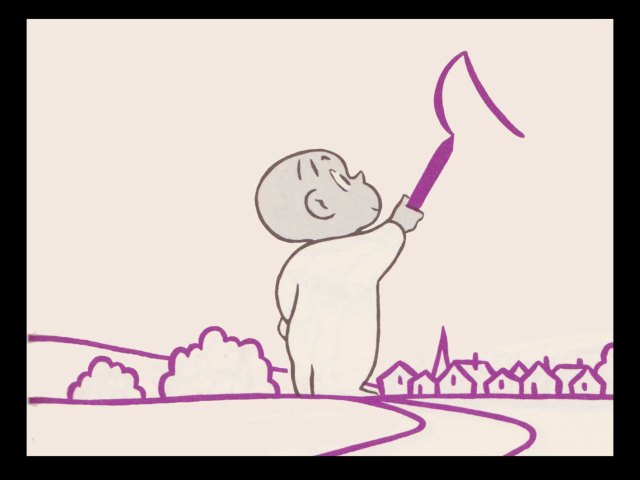
Harold and the Purple Crayon
by Crockett Johnson

Adults view lying in stark black and white; while until age 8, STORYTELLING is very vivid and colorful for your child, with little to no delineation between reality and make-believe. 

A child should not be punished for things they have little to no control over. Even if they KNOW they are telling a fib, they may not be capable of NOT doing so. 

I have observed, many times, adults yelling at a 4 -5 year old, or jerking them around saying, "Don't LIE to me!" when the child is too young to even have a grasp on the concept. 

This is also a common thread on child care provider discussion forums. Parents and caregivers who do not have a good background in child development, having unrealistic expectations of a child's ability and intent regarding lying.

Children are often driven to lie through confrontation. A calm discussion and more open-ended questions can produce better outcomes, along with praise for telling the truth and helping to determine their own discipline. Children are usually harsher on themselves. 

Adults also need to be very aware of the example they are setting for the child, and any tendency they may have to prompt their child to lie. "Don't tell mom that I let you eat that!" "Don't tell grandma that daddy isn't really sick." 


Example is the greatest educator.


This also means that we need to take what a child says with a good dose of skepticism. They can say things that are untrue, not realizing the consequences. For instance, getting a sibling or friend into trouble by placing blame elsewhere. Or, extrapolating something they heard on TV to a real-life situation that could not only cause confusion, but concern.

Does this mean we allow them to be little hellions and get away with it? Of course not. But while we are molding future adults, we can't forget the child that is before us. The CHILD needs gentle guidance and instruction onto the correct path, not forced entry onto the highway. 

This is an area that adults have a tendency to over react and immediately think the child is going to be a degenerate, lying, self-absorbed, manipulative, criminal, amoral adult because they told their first or fifth fib. 

In actuality, it just shows that the kid is smart enough to think up how to get or stay out of trouble, and get or do what they want. Smart and imaginative isn't bad.

Lying is complex and takes advantage of advanced skills: 

  • Cognitive advancement - to determine that a lie is called for and has a potential for gain of some kind 
  • Cost/benefit analysis - if I get caught; do I really need to do it
  • Inhibitory control - to be able to think up an effective lie on the spot
  • Creativity - to be able to determine if it is believable or appropriate to the situation
  • Working memory - to remember the details of the truth and lie when questioned
  • Social adroitness - understanding people, situations, and how they should or can respond, knowledge of rules & consequences

In my previous post regarding assessments, I failed to mention that one of the first indicators to me of a child's level of intelligence, is how early they first lie.
The smarter they are, the earlier they lie. 
The smarter they are, the better they lie. 

It is our responsibility to teach them how to use those qualities for good rather than evil, without squelching that creative and independent spark. 
Tags: lying, lies, liar, preschool, child care, daycare, homeschool, homeschooling, ethics, morality, child development, business, kids, kid, make believe, 

Tuesday, December 30, 2014

Monday Journaling for Preschool


When talking about assessments, I mentioned that we do journaling every Monday. I start this as soon as they are old enough to hold and manipulate a crayon, without eating the majority of it.

We are now using this journaling page that I created, and have available FREE in my TPT store.
Preschool Journaling Page
As mentioned also in the writing post, I assess these using a couple of matrices that I keep handy.

This one from Heidi at Heidi's Songs...

And this Drawing Development in Children chart beautiful illustrated by Susan Donley.


To see how important it is to do this regularly, and the progression you can observe, here is the art work of Mr. G over the last 3 1/2 years.


 8/30/11 First Journal Page 16 months

3/19/12 First Journal Description - "It's a bicycle." 23 months


 9/4/12 Less scribbling and more intentional drawing. 
2 years 5 months


 3/18/13 Progression to Lines 3 years


 4/10/13 Progression to Intentional Circles 3 years

Note that progression from lines to circles for this child occurred within a few weeks. If we didn't journal every Monday, I would have missed that rapid leap.


 7/15/13 Adding Letters to Drawings 3 years 3 months

Notice that movement into letter formation happened within 3 months of intentional line and circle drawing. Drawing is a natural extension into writing.


12/2/13 Extensive journal entries begin at the same time as the first identifiable figure is drawn. 3 years 8 months.

"He went to his house and he was cold when he was walking. Then he arrived to his home. He was walking long ago."


1/13/14 Some times the simplest of drawings can have the most intense meanings. 3 years 9 months. 

"Me and Cora [his dog]. She is helping me with cleaning my room. She is licking me because she loves me."

 1/20/14 Progression of drawing from just figures to object representations. 3 years 9 months. 

"These are the stairs I am walking up. Mommy is gone. The dog is licking me on Christmas Eve. This is the stockings. Cora is kissing me with licking me and daddy let me carry her upstairs. I feel happy."


5/12/14 Adding in environmental components such as sky. 
4 years 1 month. 

"Me and Blake and one of our wheelbarrows and my daddy. I'm hugging daddy."

12/29/14 Combination of skills utilized for random drawing. Practicing. 4 years 8 months. The older they get, the more specific the detail and the more they add in life experiences their parents may wish would stay unrepresented.  

"Triangle, square, trapezoid and a BIG G. Two Ps and two Rs. A man with X shirts holding a beer cup with beer inside."

LOL

When I send the children off to kindergarten, I send their binders home. I love looking back over the years and remembering the excitement I experienced every time I noticed something new, moving, or amazing in their journaling. It's always a joy to hear their stories.
Tags: homeschooling, writing, fine motor, cognitive, development, developmentally appropriate, drawing, writing, journal, journaling, speech, language, literacy, reading, grammar, teaching, theme, unit, art, hand eye coordination, crossing the midline, kindergarten, prek, pre k, child care, daycare

Wednesday, December 11, 2013

Toddler & Preschooler Responsibility

"Someone is slacking!
Who's responsibility is this?" 

Yes, I'm talking to 2-4 year olds. And YES, someone will step up and take responsibility and take care of the issue. They will live up to the expectation.


I was talking with two other childcare providers over Thanksgiving and they were both complaining about the children in their care never picking up and making horrible messes. 

They didn't like hearing that I don't really have an issue with that.

Here:
  • Everyone is expected to pick up after themselves as soon as they are able to stand up, it is taught from the moment they can SIT up
 
  • Everything has a place, but that "place" is fairly large/general so close counts
  • For items that cross activity areas such as stuffies & figures, there are homes in each area 
  • We pick up throughout the day, before any major activity transition, so it seldom gets overwhelming
  • Certain areas, such as blocks, are allowed to remain intact no matter how messy if the child[ren] will be continuing/expanding play
  • If you don't know, ask. If you need help, ask. Otherwise, 

JUST DO IT!

  • Slackers will lose privilege and have to sit out the next activity, after all, if you are too tired to pick up, then you are also too tired to do an activity
  • Super workers get acknowledged and rewarded
  • Doing someone else's job, upon my request, gets super rewarded and mentioned to your parents
  • Effort is always more important than results
  • If I have to pick up anything that is not MY mess, then it will go into the basement until I feel like going down and getting it...someday
When we DO make horrible messes, which we do regularly:
  • We work in teams
  • We work in zones
  • When one zone is completed, that team goes to the next one to help out
  • Big kids LEAD little kids, but don't do the work for them
  • We sing, race, or do it as a game
While I'm not a huge Barney fan, we do use this song, only we say "Pick Up" rather than clean up.


Responsibility begins to be demanded by children around the age of two, "ME DO IT!!"

However, parents and care givers often give in to these demands with a sigh and eye roll, assist to the point of taking over, or simply negate the request due to time demands or the child's lack of ability. Message: 


"You are incompetent and not worth my time to teach."

Often parents "assist" a child far beyond the time when they gain competency. Again, various reasons from not wanting them to grow up, time constraints, the child's competency, a lack of patience with their efforts, or a need for the child to be compliant with parental requests, interfere with their child's independence. 

I can't begin to count the number of times I've heard a child WHINE to their parent, "Mommy PLEEEEASE put my shoes on. I can't do it."

That's when I sigh and do an eye roll. The same child has put their socks and shoes on multiple times throughout the day.

If they take any item of clothing off here over the age of 2, then they better be able to put it on, or it is staying off until it becomes NECESSARY for it to go back on. Otherwise, it becomes a game that I am not interested in playing. 

That's not to say that we don't work learning how to take our clothes on and off, just at appropriate times.


"I can't do it!"

"It's okay if you can't do it, but it's not okay to not TRY.
TRY and then if you really can't, I'll help you out.
Besides, I need to see what you are doing wrong
before I can teach you how to do it right."

 Parents are often NOT good about promoting responsibility throughout childhood.

"Miss Connie, do I need to wait for my friends to get here before folding towels?"
"Nope. Go for it, buddy."


  "[Miss N] is helping me! She's handing me the towels so I can fold them."
Here, the children help me fold towels, put away groceries, clean and do a variety of tasks, get out and put away their own bedding & cots, dress themselves, put their dirty dishes on the counter next to the sink, put their items away appropriately, push their sleeves up and get in line to wash their hands; all without any coercion, threats or yelling, simply through routine and expectation and the occasional clapping sequence to let them know that we are entering or in a transition and they need to perform accordingly.


Miss H 2 years
We have a jobs chart that gets rotated every Monday for the children age 3 and up. Since this is a home child care, we usually have 3-5 preschoolers at any given time.
  • Kitchen Helper: sets the tables, passes out drinks and plates
  • Teacher's Helper: fetches, grabs, holds, and does special projects
  • Cleaning Helper: dusts, vacuums, wipes down, supervises pick up times, assigns pick up tasks/teams/zones, and holds last responsibility for having everything put away
Mr. G 3 years
This is a Eureka lightweight upright.
1/2 the weight of the average vac.
In the fully down position, the telescoping handle
is perfect for the littles.
  • Outside Helper: Helping keep the outside areas picked up, playing games with the little ones

Printable for pencil glyph is available for FREE at my TPT store. It also makes cute task cards or word wall. They are sized to fit next to 8 1/2 inch name cards in a 14 1/2 inch wide pocket chart, available currently 12/2013 at Dollar Tree and Target for $1.
Pencil Glyph, Helper Cards

Each preschooler also has a toddler Biddy Buddy that they assist as needed. The little ones know that their preschooler is there to help them, but only if they ask and only so far. 


This all promotes:
  • Responsibility for self and others
  • Leadership & mentorship
  • Sense of pride/accomplishment/self-worth
  • Life skills
  • Independence
  • Self-reliance
  • Community
  • Ability to source & request assistance
No CRYING over spilled milk
but a lot of learning...
"I spilled my milk."
"So what do you need to do?"
"Clean it up."
"Yep."
"[Miss N] took the cap off her sippy and spilled it all over!!"
"Then the Kitchen Helper and/or her Buddy need to show her how to clean it up."
"YOU'RE kitchen helper [pointing to child] and I'm her buddy [pointing to self.]  I'll get TWO towels and we'll show her how."
Notice that I purposefully didn't mention names, assign tasks, give instructions, etc. I simply stated the responsibility. The goal of responsibility is for them to figure it out themselves who is responsible, what their job entails and to determine and source the needed resources.

If they don't do the job completely, then it's my responsibility to step in and TEACH them how to do the job correctly. But usually, if needed, the other children will help to ensure that all the steps are followed and the job is done well.


I make enough of my OWN messes I have to deal with.
FFGs, busy bags, snowball sight words, curriculum, books to sort, etc...
"When I'm all done I have to pick up every piece of the train set since I put it all the way in the kitchen and you don't like us to have toys in the kitchen. You might trip and get hurt," Mr. G came and informed me most solemnly today after constructing for awhile during nap time. 
Guess he wanted me to know he was on top of it.


If there is a basket full of clean towels sitting around when they arrive, they simply start folding when they feel like it. I don't have to say anything. All of them will eventually get folded and put away during the day. 


If I have cleaned toys and they are sitting around in a bin, again, they will eventually be put away where they belong without me having to say a word. 


The expectation exists, and children will live up to your reasonable expectations.
Tags: parenting, parents, toddlers, children, kids, responsibilities, chores, expectations, abilities, preschooler, preschoolers, childcare, child, care, daycare, age, stage, development