Showing posts with label Circle Time. Show all posts

Tuesday, October 24, 2023

Circle Time Circus


I was observing this morning, and once again am concerned about the desire to sit small children in a circle for circle time. It's done all over the world on the daily. That does not mean it is good ECE practice. 

Why does this concern me?

I've mentioned in the past that this type of circle time usually has a lot of classroom management entanglement. One teacher does the activity and another teacher, or two, are constantly correcting children into sitting properly and staying quiet. It often looks like a 3 Stooges skit, Whack-a-Mole, or herding cats.

The goal, is supposedly the learning activity. 

However, the actual lessons are the skills of:

  • Staying in place
  • Staying in crisscross applesauce
  • Staying quiet unless appropriate
  • Paying attention to the teacher
  • Not looking around
  • Not interacting with your friends

These are all REALLY hard skills to master for small children, let alone comply with all of them at once for an extended period of time. 

When you consider attention span to be 1 minute per age under 5, the expectation of a child under 5 to sit still, in position, and quiet, for much longer than that minute per age, is not developmentally appropriate practice.

Having to work so hard at the basic physical skills, means that most of the children do not have the extra attention to send towards the learning activity. It may catch their interest every so often, but they do not have the attention to focus. Retention is nearly non-existent. 

And as I've tried to reinforce, if they aren't moving, their brains aren't working optimally. So if a child is focused and paying attention, with all the wiggles distraction around her, coupled with minimal engagement, her retention of information, ability to analyze and compare the new information to old, is as nearly nonexistent as the child doing everything BUT paying attention.

The constant correction to sit in the right place, in the right manner, saying only the right things at the right times to the right people, for much longer than is developmentally appropriate, means the child feels frustration and failure. If kept far longer at the task than is comfortable, it can lead to anger, defiance, stress, anxiety, and physically acting out such as hitting a friend. Then, the child is really reprimanded and admonished for behavior that the child was pushed into by the adults.

So, the activity is pure frustration to both teachers and children, and of almost no value. And yet, centers and providers keep doing it.

When does circle time and other large group activities usually occur? As one of the first activities of the morning. This does not set up the day well. Circle time is actually a detriment to the rest of the day in many ways. Classroom management is already in play, tensions are high on all sides, the attempted "fun" was not had, the attempted learning was not accomplished. The bright potential of the day has been dimmed early. 

If it isn't working, why does it keep being done? Habit. Boxed curriculum. Expectation. Often it's the only "teaching" time provided. Easy routine. Sorry to say it, but lazy or in-experienced teaching. 

What to do differently

  • Keep it short. Break up something like circle time into small bite-size segments and sprinkle them throughout the day.
  • Don't expect young children to sit still, it's not natural for them.
  • Don't expect young children to sit quietly and wait a turn for more than a couple of minutes. 
  • Make sure as many children as possible can participate at once.
  • Differentiate instruction for different attention spans, interests, or capabilities. Not all children have to participate in all activities at all times. 
  • Teach the same lessons through play or day. Count the blocks, ask for the red car, spell their name out together as you get something from their cubby. That individualized instruction will stick much better in a receptive mind.
  • Make it free-choice to join or leave. 
Children learn so much by just being in the presence of information. They pick up what interests them when they are in the right mind-set to pick it up. Through repetition and exposure, they will pick it up even without direct formal instruction. I've taught a lot of skills from just singing a little ditty about it throughout the day. Children are drawn to music and you'd be surprised what giving them an ear worm can accomplish.

We need to set children, and teachers, up for success. Traditional instruction often puts children and teachers as adversaries rather than a team. That needs to change. No child should ever feel less-than because teachers are asking him to perform at a developmentally IN-appropriate level.

Monday, July 14, 2014

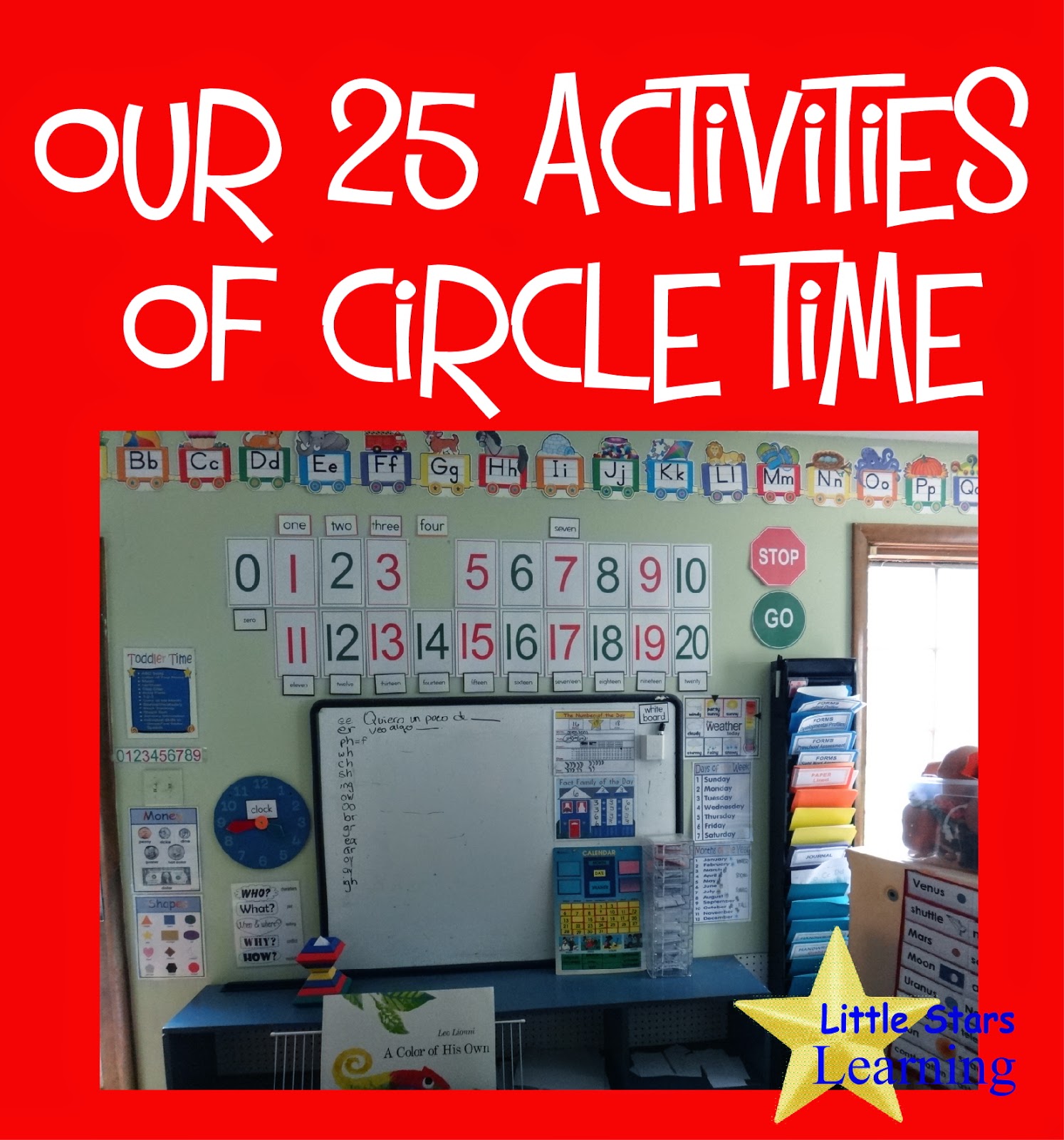
Our 25 Activities of Circle Time

Many providers have been asking about Circle Time routines. Ours is pretty involved, but we do NOT do everything every day. It depends upon the skill sets we are working upon and the progression of my students. 


If the weather has been the same for the last week, then it's just redundant to keep repeating it. I'd rather wait until the weather is interesting and discuss it in depth for 1/2 an hour.

Since this is primarily a Reggio based program, everything is interactive and most of it is done standing up. Learning is best reinforced through a holistic seeing, hearing, speaking and moving approach. 

This post is regarding what I am currently doing with children 2 1/2 through 5 years old. When I have younger children, they are with us or near us during circle time, depending upon their interest and abilities.

Since the littles get bored faster, we start with their level and progress, allowing them to wander off as they will and rejoin if they hear something that catches their attention. The children are INVITED to join me, it is totally their choice. As long as they are within hearing distance, they absorb everything even if they aren't directly participating. Every once in a while, I've started circle time all by myself, but soon had some friends join in the fun.

My teaching philosophy is that if a child is not paying attention and participating in an activity, either:
  1. They already have it mastered and it no longer holds their attention.
  2. They are not developmentally ready for the activity or skill and attempting to synthesize the information at this time is overwhelming.
  3. I'm doing something wrong. Either I or the activity are not joyful, playful and animated enough to invite them into participating.
They get down the songs and chants very young, without understanding the meaning of the information. However, when they are developmentally ready to understand, the light switch clicks and they already have that information available to utilize. 

If you think a 2 year old can't memorize extraordinarily well, ask one to sing any song from Frozen. It just takes making it into something they WANT to memorize.

I'll go into each and how we do it, but here's the list:
  1. Pledge of Allegiance
  2. Welcome, Monday Speech
  3. ABC song with visuals
  4. Counting 0-20 chant English & Spanish
  5. Names songs
  6. Colors/shapes English & Spanish
  7. Positional Relationships visual or interactive
  8. Days of the Week song
  9. Months of the Year song
  10. Seasons chant 
  11. Calendar 
  12. Weather discussion
  13. Manners song
  14. Odd/Even chant
  15. Skip Counting chant
  16. Money chant
  17. Diagraphs & blends review
  18. Spanish introduction/review
  19. Number of the Day & Fact Family of the Day visual & discussion
          Curriculum/Theme Transition: 
  • Topic discussion
  • Vocabulary introduction
  • Word Wall & Sentence Wall
  • Song/fingerplay/movement
  • Story [Finally sitting down]
  • Story Comprehension discussion
 1.   Pledge of Allegiance

When we do the pledge, we do it first thing. This gives the stragglers a trigger to join us.

When I found out they won't do the Pledge of Allegiance in school, I stopped doing it daily. I still feel it's important to know, so we discuss it and learn it on Flag Day, 4th of July, President's Day, Veteran's Day, Memorial Day, etc. when it has some relevancy.


2.   Welcome and Monday Speech

I formally welcome the children and we have a brief discussion about the days activities. Usually we jump right in, but this is the welcome song I use when we need to get everyone settled in:
Good Morning to you,
We're all in our places
With bright smiling faces,
And this is the way
We start our school day.
On Mondays, we also do speech. Each child gets up and tells us something. It can be a make-believe story, something about their weekend or home life, show and tell about a toy they brought, a song they want to sing, etc. This teaches speech skills, and more importantly, audience skills of paying attention, being kind, asking relevant questions, listening skills, patience, turn taking, etc. One of the best things I added to our circle time!

3.   ABC Song with visuals

We have this ABC border. I'd love to have it at kid height, but we lack wall space. I'm rather glad we have the windows instead, though. So, I use a yardstick and point to each one as we sing the song. 


I also have an ABC visual that I cut out of the book "Alphabet Rescue" to use.


If we are working on a particular letter, then I'll go back to that one and do a repeat and phonics review on it. This is NOT how we learn our letters, it's simply a review and another opportunity for them to pick up on a letter they may just be getting down. We do use 2 different songs. The traditional one to the Twinkle Twinkle Little Star tune, and this one...


4.   Counting 0-20 chant in English & Spanish

We bend forward and clap 0-9. On 9, we say it long and slowly raise our hands up then say 10 loud and dance around. We do the same on 11-19, raising our hands up on 19 and saying 20 loud and dancing. When the older children count to 100, they always draw out their response on 9 as they've been taught. This provides them with a window of thinking for the next 10, which they need in the beginning.


Guess which number the littles are currently working upon?


5.   Names Songs

One of the MOST important things we do as a group. Even the 1-year-olds can differentiate the names of all the students. They learn to identify names as pictorial references and then we decompose them down to letters through these songs. These letters are then recomposed into spelling names, which leads into spelling words. 

Sounds complicated, and it is, but it is a huge bump in learning to read. This we DO do regularly. Once they have down their first name, we add their last name as a second verse. This is also a great speech component since they stand up in front of everyone and point to the letters of their name as their name song is sung by all. 

This is one of the main ways they learn their first letter identification. I teach uppercase, lowercase and phonics simultaneously. 

The names are sung in a simple sing-song tone depending on how many letters are in the name. For instance:

B.e.n. spells be-en, spells be-en.
B.e.n. spells be-en. Spells Be-en!

E.m.ma spells Emma, spells Emma.
E.m.ma spells Emma, spells Emma!

J.a.cob spells Jacob, spells Jacob.
J.a.cob spells Jacob, spells Jacob!

Hun.ter spells Hunter, spells Hunter.
Hun.ter spells Hunter, spells Hunter!

Jes.sica spells Jessica, spells Jessica.
Jes.sica spells Jessica, spells Jessica!

6. Colors/Shapes in English & Spanish

We learn these in so many other ways, but every once in a while it's a good review to just run through the 12 shapes and 12 colors as a group. 


7.   Positional Relationships Visual or Interactive

While they learn this more through experience, every once in a while it's good to just go through them all. I will take a picture and ask positional questions, such as:
  • What is TO THE RIGHT of the house?
  • What is BELOW the car?
  • What is NEXT TO the tree?
or I'll have everyone get a toy and give them directions, such as:
  • Put the ball BEHIND you.
  • Put the ball ABOVE you. 
  • Put the ball ON your shoulder.
  • Put the ball UNDER your foot. 
I will also use this as an opportunity to teach body parts in Spanish.

8.   Days of the Week Song


This is sung to the tune of "My Darling Clementine."
Sunday, Monday,
Tuesday, Wednesday,
Thursday, Friday, Saturday
These are the days of the-e wee-eek
and today is __________.
Today is _________
Today is _________
Today is _________ all the day
Yesterday was __________,
and tomorrow will be __________.
Here is a YouTube video of the tune, but we change up the last verse to add the "Today is...." 


9.   Months of the Year Song


This is sung to the tune of "Ten Little Indians."
January, February, March and April
May. June. July and August.
September, October, November December
THESE are the months of the year.


l0.   Seasons Chant
Winter, Spring, Summer, Fall
These are the seasons one and all!
ll.   Calendar

We don't do much with the calendar until the last preschool year before kindergarten, simply because it needs to be done every day, and we just aren't that committed to academic routine.  

We have a nice big magnetic one, but the littles like to pop off the magnets and take off with them to the great void of I'll-never-find-it-again-until-I-move. So, we only put them on if we are working on the calendar as a group.


I have this smaller magnetic one, and with the bigs being pre-k now, we will be using it regularly this year. 


12.  Weather

We garden here. We are outside a LOT. Most of our weather instruction is relevant and important. We'll do a graph of daily weather, chart temperatures and rainfall, and discuss any bad weather that comes around and its effect on the climate and our situations. But sometimes, at circle time, I'll throw out questions about the weather, cloud formations, temperature, weather predictions, etc. I think it would be cute to have a little dress up weather bear or similar, but frankly, we have more important things to do. 

I found this wonderful free graphic. Unfortunately, once downloaded, it was in a very low resolution and was highly pixilated, so I simply re-created it for our use, as she had from an unknown original source, so that it looked as good as intended.  


13. Manners Song

Sometimes they need a reminder... 
First we say, "Please,"
Then we say, "Thank you,"
Then we say, "You're welcome," to the person who said, "Thank you,"
And that's how we use our MANNERS!
Done in just a sing-song voice.

14. Odd/Even Chant

All the teaching materials I produce have the even numbers in green for "GO, yes it can be divided by 2!" and red for odd numbers, "STOP, no, it can NOT be divided by 2!" So even as they first learn their numbers, they begin to see the red vs. green numbers and will remember that later on when we begin odd/even.
Zero, two, four, six, eight
Even numbers are really GREAT!
One, three, five, seven, nine,
Odd numbers are pretty FINE!

15.  Skip Counting Chant

Pretty much the same as our counting chant. We just clap on each number and dance about on 100. We start with skip counting by 10s, then 5s, then 2s, with our number visuals. OR, we'll put the numbers on the floor and take turns hopping on them as we count as a group.


16.  Money Chant

Chart visual. 
A penny
A nickle
A dime
A quarter
A half-dollar
A DOLLAR, DOLLAR, DOLLAR!

17.  Diagraphs & Blends Review

Any digraphs or blends that we are working on, especially any that a child is having trouble with, go written on the white board and we'll review them during circle time until I feel they are mastered. Sometimes we just run through all of them I've put up for a while. 

Each one has a specific phrase and movement to it. For instance, 

With finger to mouth and shoulders bunched. "EEEEEEK, I SEEK to KEEP CREEPy stuff away!"  

Slapping hand over arm with a look of astonishment. "OW! HOW did a COW give me an OWie?"  


18.  Spanish Introduction/Review

This is taught mostly in the environment, but new phrases or review can be integrated into circle time.


19.  Number of the Day/Fact Family of the Day

Our number of the day chart is wonderful and thorough. The children get a kick out of having me draw a ton of little funny pictures. Unfortunately, they always pick a number like 98! We do this as a group, but they can use it as an independent table activity as well. 

I have one that only goes to 20, but this group is working on 100+, so we are using this one currently.

The fact family chart is a good visual for discussion about addition and subtraction units. The children get to pick two numbers between 1 and 9 for this one.


THEME/CURRICULUM ITEMS
We don't always have a theme, depending upon the skill sets we are working upon and the time of the year, but when we do, my curriculum is comprehensive and we WILL cover everything listed below. While this is usually considered an extension of our circle time, it borders into our curriculum time as well. If there is no theme, then we may or may not do these during circle time, but they will be covered at some point within the day.

20. Topic Discussion

The topic discussion may or may not come first. Some times the story is so relevant that I need to read it first prior to discussion. If not, then we will talk about the topic first. For instance during our SPACE theme, one of the weeks was regarding the solar system. Our daily topics were:
  • Monday - Solar system 
  • Tuesday - 11 planets
  • Wednesday - Sun & stars
  • Thursday - Planet Earth
  • Friday - Moons
2l.  Vocabulary Introduction

This usually goes along with the story and topic discussion. If I feel that there are specific terms that need to be addressed for good understanding during either of those, then I'll make a point of having a vocabulary introduction.

22.  Word Wall and Sentence Wall

For each theme we have a word wall and sentence wall. For the littles, this is a vocabulary and visual activity, for the bigs, it is a spelling and relationship activity. 


23.  Song/fingerplay/movement

For each day of a theme there is a song, a fine motor and gross motor activity, related to the daily topic. For instance for the daily topic of Sun & Stars, we sang "Mr. Sun," did a finger play called Sun and Moon, and a gross motor movement of the Earth going around the sun.

24.  Story

Since all of above is done standing up and moving, they are usually pretty ready to grab a floor pillow and plop down for the story of the day as a group. For the Sun & Stars topic, we read "Going Around the Sun" by Berkes.


25.  Story Comprehension

Using a dialogic approach to story time, we cover vocabulary and I ask age-appropriate questions of the children during and after story time. This builds logic/reasoning and sequencing skills, along with many other skills

For the bigs, who are reading well, we are now in a pre-k mode and have gotten more formal in our comprehension discussion. The littles are asked similar questions, but in a less formal way and with the expectation of simple answers without analysis, categorizing or labeling. 


After circle & theme fun stuff, they have the option of free play, table time activities/manipulatives, or starting our actual school time. They usually choose school, which will include a language, mathematics, science/logic/reasoning and art component related to the theme topic and the daily skill set. 

You may also be interested in:


Follow Connie -'s board Classroom on Pinterest. Tags: circle time, circle, preschool, pre-k, homeschool, daycare, child, care, morning, routine, schedule, learning, education, kindergarten, time, 
Tags: circle time, preschool, daycare, child care, child, care, teaching, toddler, 

Monday, July 8, 2013

Number of the Day

In previous posts I have noted how I teach early number recognition and our progression to 2-digit numbers. 

After just a few weeks of formal introduction, 2-digit numbers quickly became 3-digit numbers. So, since number RECOGNITION was no longer an issue, I felt it was time to introduce them to number REPRESENTATION. 

3 posters/journal pages at TPT $1.50

I created posters for numbers 0-10, one for 0-20, and this one for 0-100, that we are using.  

The children have had some slight introduction to ten frames and number lines prior to this. Tally marks were new. I simply said they stood for their four fingers and their crossing thumb, which they know to equal five.


We are BARELY starting skip counting, so the tally marks are more for a visual representation than a skip counting activity at this point. However, doing this every day, they are picking it up pretty quickly. 

As they get better at counting by 5s, we'll be able to step up telling time, so I am taking note of their progress in this skill for other reasons. 
Tags: math, counting, number, numbers, recognition, representation, preschool, pre-k, kindergarten, 1st, 2nd, grade, first, grade, homeschool, number line, tally marks, math journal, math center, poster, center, circle time, 

Wednesday, May 8, 2013

Wire Shelf as Big Book Holder


We do a LOT of movement activities during book readings. While I try to do the movements and hold the book at the same time, I have found that if I clap my one free hand against my leg, then the children will as well, even if they KNOW they should clap properly. Usually I prop it on my feet so my hands are free, but that doesn't work so well if we need to stomp, etc. So a book holder was an absolute must when I revamped the circle time/school area. 

I have a wonderful, HUGE, easel. Unfortunately, it has a little bitty ledge that simply will not hold my big books onto it, or any book that won't lie perfectly flat. It also takes up a huge chunk of real estate that I simply can't spare here. I've been racking my creativity trying to come up with some type of book holder that would


  • Hold the book, even it was a little ungainly/floppy
  • Not have a lip so high that it was difficult to turn the pages without tearing them on the bottom unless I lifted the book up for each page turn
  • Could also be used for normal sized books
  • Wasn't intrusive into the area
  • Was safe if the children tried to climb on it
  • Didn't have sharp edges
  • Would be at a good kid eye-level if they were sitting on the floor

I finally came across this PERFECT solution. Even more perfect, because it was almost FREE, since I already had the shelf and just had to buy the holders.


It holds our big books wonderfully!


It holds the regular-sized books just as well.


This is great because it not only takes up zero real estate, it acts as a barrier to anything I don't want the littler ones to get into readily. It easily lifts up for access the stuff stored behind.


I intended to make a metal or wooden arm that I could fold down from the inside of the cabinet to prop the shelf out at an angle, but I've found that my storage containers provide the perfect angle by pushing the bottom edge out 3 1/2 inches from the shelf. I just prop one behind it when it's time to read. 


Since it only sticks out about an inch on the bottom edge when fully vertical, it doesn't seem to get in the way at all if the children are doing activities on the counter or working on the white board. 


This shelf is approximately 16 inches long. I used a touch of super glue in each of the end caps to make sure they wouldn't pop off to become choking hazards for the littler ones.


I was looking for metal C pipe clamp holders such as this one, but Home Depot didn't have any small enough, though I know they make them. We have some SOMEWHERE at the farm, but I couldn't find them.


Which ended up being a good thing, because I much prefer the ones I got. They are called P Type Rubber Lined Hose Clips Pipe Clamp and Home Depot carries them in the electrical supplies area. They have a soft rubber surround, but a strong metal core. I put them in with some large hefty screws, I believe they are #10s. These shelves are real wood, not particle board. If using particle board shelves, you may want to add an angle bracket or a solid wood piece to secure into.


Tags: reading, read, book, holder, easel, center, circle time, circle, read aloud, storytime, story, time, teaching, preschool, child, care, daycare, pre-k, kindergarten

Thursday, April 18, 2013

Higher Numbers & Preschoolers


This is usually a kindergarten or late pre-k concept to introduce. We began really working on 30+ numbers last week, since they had DOWN 0-20. These children are advanced learners, and have been working addition, subtraction, multiplication, division and quantity concepts of 0-20 for some time. This is a child-led, teacher-facilitated, learning through play and movement school. The children let me know what they want to learn, and it is my job to facilitate that learning and make it fun and interesting.  

They have also been working on 21-30. Usually, counting up to 30 as we do jumping jacks together. We are also working on time, where they are really using 30, and now will need to know up to 60. They love money, add nickels and pennies, but need the higher numbers to go farther. They play restaurant and want to be able to count the money. Correctly. They are frustrated with the lack of knowledge that is currently holding THESE children back from learning what THEY want to know.


As a casual intro, we watched a few YouTube videos that went to 100 over the last few weeks. These are the best two, by far. I really like that they both make a break on the tens, just as we do when we count it. I also like that The Big Numbers Song also shows the words with the numbers. Good cadence and decent graphics in both.

Thumbnail
We watched our Leap Frog Math Circus video, and I reinforced some of the concepts as we watched. 


We also read our big book of Chicka Chicka 1-2-3, and on the back pages counted out the entire 0-100, something we had not been doing because the attention/interest hadn't been there. We do a lot of movements with our book readings, so this is always a favorite book, but now I could see that they were paying more attention to the 10s units as we read, as well as the counting to 100. If they even THOUGHT I would skip over the 100 counting, I got called on it. Often they insisted that I do it more than once, and asked to have specific numbers pointed out.

Miss H 3 3/4

After carefully observing the children to see if they had any interest in going farther with it, if the concept kept their attention, if they asked questions, or asked for more of the same...all the signs said, "YES!"

So last week I introduced them to our hundred pocket chart and we clapped out counting by 10's twice. I wasn't sure how well it was going over, so I decided on Friday that I would scale it back to 21-60, basically working on learning 30's, 40's and 50's numbers. 

Miss A  turned 3 last week

We started having a number of the day, and yesterday's was 53. Today I wrote a new one on the board and Miss H [the oldest at 3 3/4 years] said, "That's 84." I just looked at her for a few moments. "Actually, it's 48. 84 would look like this...because we always do the first number first. [We've been working on ordinal count as well.] But good try." So, I guess they get the concept more than I thought and are again pushing my teaching.
53     48

Since all of my teaching is movement based, we always do a movement chant for our number of the day. For 53 it was, "See, see, what do we see, our number for the day is FIFTY-THREE!!!" Today's was, "Great, great, isn't it great, our number for the day is FORTY-EIGHT!!!" 

Once they get down number recognition, which they pretty much have, surprisingly, then we'll move on to tally marks, ten frames and other units of measure to begin equating the numbers to measurements, as we have with 0-20. Still...all through play and movement. For instance, our tally marks will be made with sticks, play kitchen utensils, or playdoh snakes, and ten frames will be made with Legos, blocks, or toys.  


Today we did the hundred chart again, and the children all took three random cards out of the chart, I mixed them up, then handed them out to put back into it. 
 
Worked on 3+3+3 and 3X3 while we were at it.

What is great about this is that the quantity is small enough that each child can remember the ones they took out. If a child can't figure out where the card goes, then the child that removed it can usually show where it belongs...peer assistance/teaching & reinforcement of learning. If a child wants to participate, but isn't at a higher level, then I give them cards that are within their skill or challenge range, or have the children go in turns so that the less-skilled child goes last when only her/his empty spots on the entire board are left available, to make it less difficult.


Gradually I will increase the number of cards pulled by each child, until eventually I'll just throw all 100 out and let them go at it.

Speaking of ordinal count, I guess that's been going over pretty well also. Mr. G today was in the bathroom and told me, "Pants up second, panties up first!" Can you tell he's the only boy here and has a sister?! Panties it is!

I'm a "throw it at the wall and see if it sticks" kind of teacher. Sometimes I'm really not sure what all is sticking in their busy little brains, but usually they surprise the heck out of me with what they grab onto, mull over, and throw back out asking for more.


Our 2-digit number of the day chants for numbers ending in:

Teens Careen, careen, it likes to careen, our number of the day _____teen!!!

[Jerk body all around]

1 Fun, fun, let's have some fun, our number of the day is _____-ONE!!!
[Punch the air and dance around]

2 Boo, hoo, don't boo-hoo, our number of the day is _____-TWO!!!
[Pretend to cry, rub under eyes]

3 See, see, what do we see, our number of the day is _____-THREE!!!
[Put hand above eyes or make binocular hands in front of eyes and pretend to look]

4 Sure, sure, YES I'm sure, our number of the day is _____-FOUR!!!
[Nod head]

5 Dive, dive, let's all dive for our number of the day, _____-FIVE!!!
[Pretend to dive down, or dive down hands]

6 Mix, mix, in the mix, is our number of the day _____-SIX!!!
[Hold one arm in a circle like a bowl and pretend to stir with the other one]

7 Kevin, Kevin, who is Kevin? He has our number of the day, _____-SEVEN!!!
[Puzzled expression and hands out...if we HAD a Kevin, I'd actually give him the number to show and make it "...where is Kevin?]

8 Great, great, isn't it great, our number of the day is _____-EIGHT!!!
[Clapping with cheer hands at end]

9 Mine, mine, it's all mine, the number of the day, _____-NINE!!!
[Two thumbs gesturing towards you]
 
Tags: math, counting, circle time, preschool, pre-k, child, care, daycare, learning, numbers, counting, concepts, gifted, homeschool, homeschooling, mathematics, chants, songs, centers, teaching