Friday, November 22, 2013

Thanksgiving Activities for Preschoolers


In addition to our Turkey Paperbag Handprint Sitting  or Puppets craft and our Turkey Handprint Poem craft, we did a lot of other things during our Thanksgiving unit.


The main learning goals were to know something about:
  • Pilgrims
  • Mayflower
  • Plymouth
  • Native Americans importance to survival
  • Squanto and his history
  • 3 sisters planting
  • Reasons for feast
But we also just want to have fun!

GAMES

We have played our Thanksgiving Feast BINGO game.


We played Where's The Turkey Hiding?

"Mr. Turkey, Mr. Turkey 
where are you hiding?
Come out, come out
to be dinner for Thanksgiving!"


I hid the turkey, they looked for the turkey. When they couldn't find him, which I tried to ensure, I gave them clues...
  • KITCHEN - Turkey was hungry so he went for a snack...
  • BEDDING - Turkey was cold and needing something to keep him warm...
  • WRITING - Turkey wanted to write a letter to tell everyone not to eat turkey on Thanksgiving...
  • BLOCKS - Turkey wanted to build a hideout...
  • PILLOWS - Turkey wanted a soft place to rest...
  • DRESS UP - Turkey is looking for a disguise...
  • STUFFIES - Turkey is trying to blend into the crowd...
  • LIBRARY - Turkey is reading up on the best hiding spots...


BOOKS
We read many Thanksgiving stories.


SONGS
We watched some good Thanksgiving Videos. Unfortunately, the best ones on Squanto and the Pilgrims were on Scholastic, and they just shut it down with password protection...


FLANNEL BOARD
One went with the story of the Pilgrim's voyage that I got from Kidssoup a few years ago.


The other I found through Youtube from Shelby Barone.


Mr. Turkey, Mr. Turkey, what do you see?
I see a [black] feather behind me!
[Black] feather, [black] feather, what do you see?
I see an [orange] feather sitting beside me.
[Orange] feather, [orange] feather what do you see?...
...[White] feather, [white] feather what do you see?
I see a colorful turkey all around me.

I did it first, then gave the feathers to the children to put up as the color was said, mixing it up from the prior round. Then we reviewed the colors with the toddlers and then again in Spanish with the preschoolers. I'm making color word labels. We had some, but I have no idea which curriculum unit they are buried in and filed. I also need to find gray felt for the last color needed. Didn't have any.

READING

I came across this blank [most of them are not!] turkey printable for FREE on TPT that I LOVE. I put in some of our kindergarten level sightwords and made a find and color page for the preschoolers. You could also do colors, numbers, letters, addition facts, etc. or make a dice roll game where the children color in the number of circles they roll [which it was intended for]. Very versatile.

I would say the word and see who could find it, then sound out the word, then show the word card as necessary.


This classic poem is available from DLTK and makes a great finger play, gross motor play, or flannel board.


This minibook from DLTK is one we usually make. It is an excellent preschool-level reader. The words are simple: I like corn. I like pie...With large, easily colored graphics if you print the black and white version.


printable children's book

Thanksgiving is always a fun unit and there are so many excellent resources and crafts out there. For more ideas, you may want to check out my Thanksgiving Pinterest board.

Tags: Thanksgiving, holiday, preschool, kindergarten, childcare, child, care, daycare, theme, unit, holiday, craft, activity, activities, learning, educational, math, 

Friday, November 15, 2013

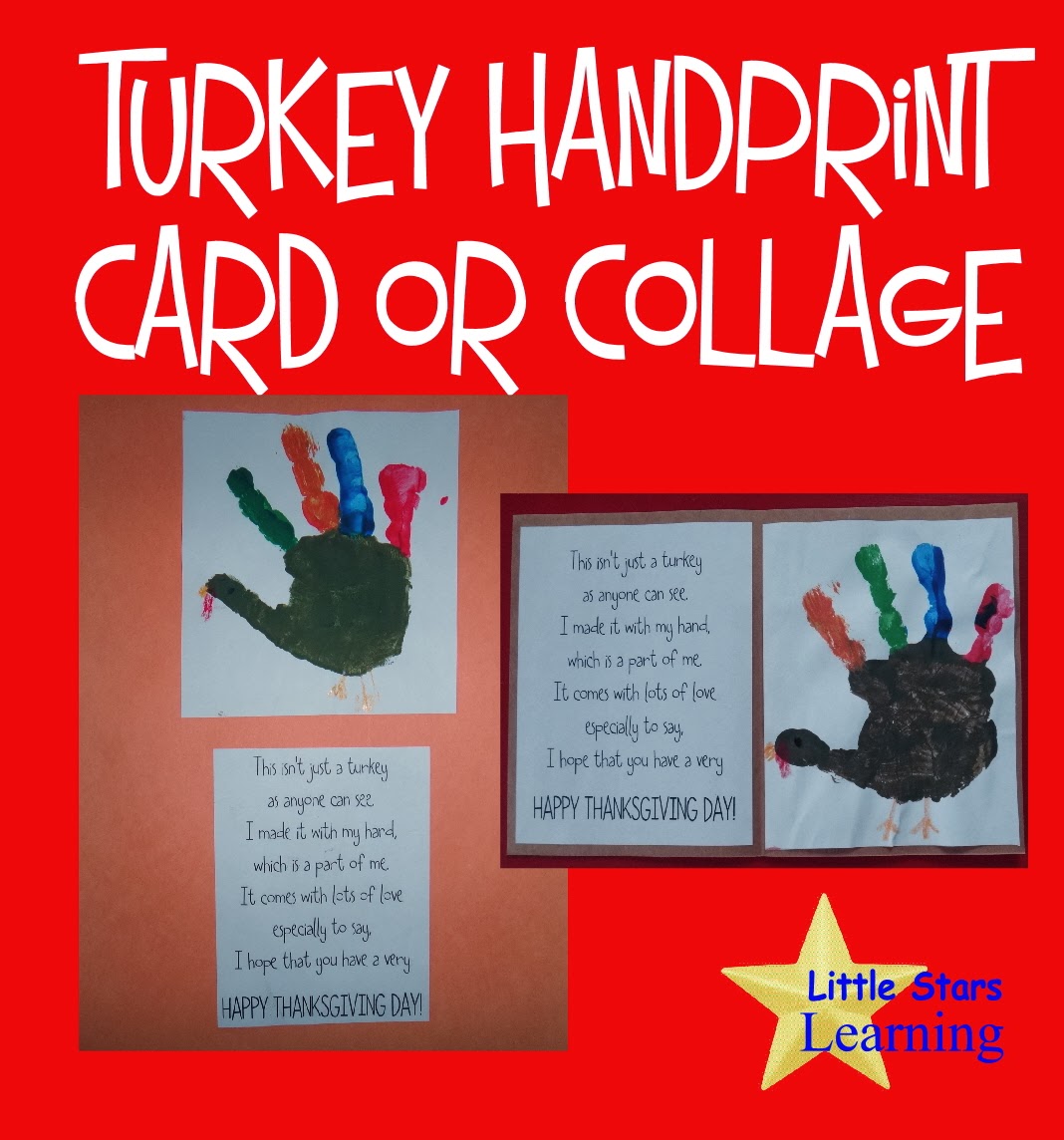
Turkey Handprint Cards with free poetry printable

A CLASSIC
 

The 1/4 page poem is available for FREE at my TPT store.


My son made this one below in kindergarten years ago. As you can see, his turkey didn't fit well upon the card. The teacher used it as a cut and paste opportunity as well.


For my preschoolers, I really wanted just the handprint for posterity's sake. So that's how we do it.


If I have school-age children here during the holiday, with hands larger than a 1/4 sheet of construction paper, then we do it as a collage rather than a card.


SUPPLIES:

1 sheet construction paper, choice of color
1/4 sheet of white construction paper 
1/4 sheet poem

PROCESS:
  • Determine if the child's hand will fit upon the 1/4 sheet of white construction paper, if not, use a whole sheet and cut to size after the turkey is finished.
  • Paint the child's hand, or have them paint it if old enough. Brown on the palm and thumb, child's choice of 4 colors on the fingers, they choose which finger gets which color.
  • Place child's hand carefully on the white paper so the paints do not smear.
  • Press down firmly.
  • Fill in as necessary with paint on any patchy/missed spots, maintaining the handprint lines.
  • Let dry.
  • Have child add orange beak and feet, black eye and red wattle with crayon or marker
  • If necessary, cut to size.
  • Have child add glue or glue stick to perimeter on back of handprint and poem.
  • Help child to position them centered on the colored paper or card. 
  • Add name and year to back.
  • Optional - embellish with Thanksgiving Day stickers, not over the white paper elements
  • For the card, if it is to a particular parent, grandparent, etc., help the child to write it on the front.


Tags: grandparent, parent, family, Thanksgiving, Day, card, craft, art, handprint, poem, poetry, preschool, children, child's, kid's, turkey, paint, printable, free, freebie,  

Tuesday, November 12, 2013

Thanksgiving Paper Bag Puppet or Sitting Turkey

Surprisingly, I didn't have anything like this on my Thanksgiving Pinterest board! [I do now!] So, I just Googled "paper bag turkey puppet" to get an idea of what I wanted to do. I knew I wanted to offer them a choice of puppet or sitting turkey, and ended up using the same craft for both, which I didn't intend. 


Since there were so many ideas, I really can't say that any particular one is what we followed, probably this one from Ramblings of a Crazy Woman is the closest. 

I provided a triangle template for the preschoolers to trace and cut out the beak first. Then I provided two different sized lids for them to do the white and black for the eyes. 

They traced their hands, and I cut them out through the five sheets of construction paper for the tail feathers, and again for the feet. Probably a 5-6 year old could do that themself, but these preschoolers are just now working circles and not able to do the intricate cuts necessary for the hands. 


They chose whether they wanted a puppet or a sitting turkey. The little ones just did the puppet, because I knew they were going to tear them up pretty quickly anyway. 

For the sitting ones, I folded up the bottom of the sack to create a fold line and made a box at the bottom. The children wadded up two sheets of newspaper and stuffed their turkeys, then I stapled the sides for stability and taped the seam. 


At the end, the preschoolers used the scraps from the red to free form their wattles. 


When doing the black on the eyes, I told them that they could place them center, left, right, up or down, but they had to do both eyes the same. I didn't want to make this TOO much a product versus process piece, so I didn't instruct them further than that on placements.

I found it interesting that the toddlers were more concerned with symmetry and placement than the preschoolers.

It's a good opportunity to practice skip counting by 5's, which we will be doing. Crafting with toddlers in the mix doesn't lend itself well to extended teaching in the moment.
Tags: handprint, craft, preschool, pre-k, turkey, Thanksgiving, activity, art, hand, print, shapes, shape, paper, bag, brown, cutting, scissors, tracing, math, skip counting, counting by 5's, 


Thursday, November 7, 2013

Babysitting vs. Teaching - How to Get Parents to Understand

One of the big hurdles for home child care providers, and even centers, is getting parents to understand the value of the service. 


Babysitters come to your home, eat your food, watch your TV, make sure the children are fed, changed, possibly bathed and put to bed. They are usually young, inexperienced, untrained, relatively reliable [you hope], and often let the children play while they are on their phones. A good one will engage with the children for at least a short period of time. Basically, they are a presence to ensure the safety of the child. Their average pay is over $10 per hour for one child nation wide. 
[Great infographic at link.]


Is your tech-savvy babysitter a danger to your child? - She Knows Parenting

Preschool teachers, who have up to 20 children in a class, get paid an average of $20,000, which averages out to gross earnings of $.50 per child per hour. Child care workers get slightly less than that, making an average of $19,300. [Assuming a 40 hour work week, many get paid less and are hired as less than full-time.]
[20,000 dollars /20 children / 2000 hour year = .50] 

Children are at a place of business where they use THEIR resources, color on their walls, wipe snot on their furniture, eat NUTRITIOUS food they provide, and are in a safe & sanitary environment created through effort and money. 


Teachers engage throughout the day with the children, handle their emotional meltdowns, teach them manners and socialization, educate them on activities and the use of materials. They are educated/trained in child development, safe sleep practices, CPR, first aid, and curriculum, or should be, at minimum. 


They are, or SHOULD BE, professionals who can handle themselves and a group of children with a far greater level of patience and understanding than the average person. 


So the question is:

"How does a provider or center distinguish that they are TEACHERS versus babysitters?" 

I believe a professional attitude and environment goes a long way to encourage the distinction. Beyond that, here are my best suggestions, I would love to hear what others would add. 

- Have set curriculum with assessments, observations, outcome goals, etc. Curriculum doesn't have to be set in stone or academically challenging. Even through free play, directed play, or teacher-engaged play, there are SO MANY skills that grow and mature and scaffold to a higher level or other skill set. Creating the environment in which that growth is encouraged and allowed to occur, is the realm of a teacher.


- Identify by program - Reggio, Montessori, Creative Curriculum, Waldorf, etc. Know your facility, its philosophy and where that philosophy originates.


- Identify staff teachers, lead teachers, etc., even if you are in a home or group home environment.


- Have professional policies and practices that are good, solid and clear for payments, parental expectations, procedures and human resources.


- Educate the staff. Pay for teachers to exceed continuing education requirements, promote your educated staff in advertisements and parent correspondence.


- Name the facility to reflect your direction. Have it be a learning center, academy, preschool, etc. rather than a daycare, childcare or center. While the curriculum and teachers may be highly professional, it is unfortunate that daycare, childcare and center all are VIEWED as less than professional and academic.  


- Start as you intend to continue. When first interviewing with parents, stress that education and learning, in a developmentally appropriate way, is the goal of the entire facility, no matter what age is represented. Every staff member should be able to adequately relay that philosophy and the methods used.


- Don't have curriculum just for show. I've observed in some high-end centers that I never saw staff look at or conduct any of the promoted curriculum, or even follow the posted schedule. Often the activities they DID engage in were NOT developmentally appropriate.


- Post curriculum. Even if your curriculum is dynamic, child-initiated, etc. you can post a white board and write down activities throughout the day with learning skills noted, or provide a daily or weekly email with highlights.


- Document learning experiences through video and pictures with the skills represented highlighted for the parents. Even if it is just random play, you can find logic/reasoning, social, language, etc. skills in use and development.


- Know the children, discuss with the parents their strengths and weaknesses and the direction you see them going and why. 


- Allow parents to see the environment. Label centers and activities with the skills they reinforce. 


- Communicate with parents! Have a newsletter, website, blog or FB page where parents can see learning in action across the facility, by teachers, administrators and children. If concerned about privacy and confidentiality, webpages can usually be password protected and FB groups can be closed to only those you allow.


- Encourage parental involvement. Working on colors, numbers, letter of the month/week, etc.? Give parents a take-home sheet listing fun activities for reinforcement at home and in the environment. It gives the children an opportunity to show growth. 


If you want to be viewed as teachers and not babysitters, then it truly begins with believing the difference YOURSELF and living up to that expectation.


We teach others how to treat us.
-
Respect is earned.
Tags: babysitting, versus, teacher, teachers, child, care, daycare, childcare, center, professional, professionalism, toddler, infant, preschool, parent, parents, pre-k, parenting, quality, 

Friday, October 18, 2013

Addition Doubles 0-5 Finger Chant

We have been working on addition and subtraction for a long time now, but these are the first FACTS that we've attempted to begin memorization.


The children helped me come up with this little finger play chant for our 0-5 addition doubles. After just a couple of days they had them down.


Zero plus zero equals zero I know.
One plus one equals two it's true!
Two plus two equals four no more.
Three plus three equals six such tricks!
Four plus four equals eight that's GREAT!
Five plus five equals ten let's do it again...

We hold up the number on each hand then bring them together for the equation and then we have a movement that goes with the last part.

...I know. - point to head
...it's true! - say it convincingly and nod your head
...no more. - wave hands across one another in front of you
...such tricks! - spiral motion with first fingers going up and out
...that's GREAT! - say it loud and raise arms into air
...do it again... - make a rolling motion with hands


We are also working on negation, a number minus itself equals zero. They got that concept down very quick.
tags: math, maths, mathematics, numbers, counting, addition, facts, memorization, doubles, finger, finger play, fingerplay, chant, kindergarten, preschool, fun, education, teaching, homeschooling

Wednesday, October 2, 2013

Foiling Toddler Bin Dumping

While this is a place of PLAY, with few rules and where the children are encouraged to experiment and be inventive, when that curiosity leads to toys a foot deep and necessary items being damaged, then it needs to be controlled.


Once the children reach the preschool stage, then these measures are not necessary. 

Toddlers though...[sigh!]
they are DESTRUCTIVE!

Our toy bins are most often used as:


trains, planes and automobiles...


hats...


or jumping and climbing platforms.
Which unfortunately ruins them...


While these are all worthy activities, there are items SPECIFICALLY in our environment to facilitate these, and we have loose parts play all over outside. SO...


since we can't just put everything out of reach...

BIN UNIT

Initially I tried screwing the bins into the wooden dowels, but the dowels split, and the screws popped through if pulled upon with enough force. 


SO...plan B, which seems to be working wonderfully.

I marked the bins of our main unit  in the middle,
about a 1/2 inch higher and lower than the bar they rest upon,


drilled holes with my largest drill bit


And threaded zip ties through them, attaching at the bottom and cutting off with my wire nippers.


SHELVING BINS

For the shelving bins, I found these plastic baskets at the dollar store, thinking that the children wouldn't be able to stand on them, so they would hold up better. They do. However, this does not keep them from bin dumping them and using them as hats. 

So I again used zip ties, through a screwed in eyelet. The children can easily swing the baskets out to get to their toys, but they can't take off with them. 


They still get the toys all out, but now they have to do it one item at a time, not just up-ending it all at once. Additionally, since they can't take off with them, there is little incentive to remove all the toys unless they are actually PLAYING with them.


I left these ties long so that I can adjust them or remove the bins if needed, without wasting zip ties.

For the large dress up bin, 


I did screw it in, using good sized washers and wood screws to ensure that the plastic wouldn't rip out.


The children still climb in there, but it's a tight fit with the shelf above and they don't do it very often.


SHELVING

I have also found that I have to screw in shelves, because they will clear the shelves [dumping] to remove them from off the brackets to be used as bridges and the shelving unit used as a play house. The peg brackets, unfortunately, are also choking hazards, so it's important that the children can't get to them and remove them. 


I find it easiest to place the shelf in and mark the top and bottom, remove the shelf and pre-drill through the middle of the lines,


then screw in from the outside. This ensures that you hit the middle of the shelf and won't have screw ends poking out or possibly splitting the board.


While it would be idyllic if children would simply play with their toys, I like that my students are smart and inquisitive enough that I need to batten everything down or they WILL deconstruct and invent with anything and everything possible. 

It makes them much more interesting to teach.
Tags: toddler, bins, toys, play room, play, playroom, shelving, storage, daycare, child, care, childcare, preschool, homeschooling, parenting, bedroom, 


Ordinal Count Lesson

I try to work on ordinal counting environmentally, "Who's first? Who's second? Which is [Miss L]?" when standing in line for washing hands, lining up for red rover, etc. 

When playing, I'll say hand me the third block from your left or ask what is the color of the second block.


For younger learners, I still try to maintain left-right convention if the child is still working that concept. For older children, we will expand and show that ordinal count can go either way, or up and down, depending on which side is considered the starting point.

For the little ones, I will line up three items and sing, while helping/having them touch each item when appropriate [working left/right convention, so if you are sitting across from them, go your right/left with their hand(s)]:

First, second, third,
They are in a line
They go first, second, third.
I also line up the little ones in a line and sing it while touching each of them as I sing, replacing their actual names within the song:
[Miss L], [Miss H], [Miss N]
[Miss L], [Miss H], [Miss N]
Are all in a line,
They are first, second, third.
Here, I am saying FIRST, SECOND, THIRD and they are giving me five as I go through the line, then we will change positions and do the same thing. 


For the preschoolers, for the activity today, we lined up 10 food items from the dramatic play area onto our chalkboard table. I asked them to ordinal count the items. I was thinking and not being present yet in the lesson. So of course, they start rote counting. I shake my head and before I can get out an explanation, they started rote counting in Spanish. I started laughing. "Noooo, ORDINAL COUNT is when we do FIRST, SECOND, THIRD."

I could see their confusion clear and they methodically went down the line with no problem.


Then we played, mixing it up. They were allowed to touch, pick up, and move around the objects as we proceeded. We did about 6-8 questions per round.


1st round: Questions such as: 

"[Miss A], can you tell me what item is third?"

2nd round: Questions such as: 
"[Miss H], can you pick an item and tell me what is it's ordinal place?"

3rd round: Questions such as: 
"[Mr. G], can you tell me if the fifth item is a fruit, vegetable, protein or grain?"

Then I added the chalk labels and we did a rapid fire tell me an item and its ordinal position. They all talked over one another, which is always fun, and LOUD.


4th round: Questions such as: 

"[Miss A], which item is to the LEFT of the 7th one?...So what ordinal position is [item]?"
"[Mr. G], which item is second after the banana?...Which ordinal position is it in the WHOLE ROW?"
Tags: math, mathematics, early, ordinal, count, counting, preschool, pre-k, homeschool, toddler, child, care, daycare, teaching, kindergarten