Wednesday, September 28, 2016

Discipline Planning for Problem Behaviors

discipline planning for problem behaviors in children

We have 4 basic rules here:
- Respect others/living beings
- Respect things
- No running inside - walk
- No throwing inside

That's it. This is a child-led program, so they are pretty much free to do whatever they want as long as these basic tenants are adhered to for their activity choices.

When the usual discipline measures are not working to correct a behavior problem, then a discipline plan is often the key to getting it resolved. A discipline plan has similar elements to a curriculum plan, and the scientific process.

Identify the problem. Sometimes, the root problem is not what we are routinely addressing. We are reacting to symptoms, extensions, or outcomes, rather than the core issue.
Identify those involved. Protagonist? Victims? Home issues? ME? What is each one doing to contribute to the situation perpetuating?
Situation. When does it occur? Is it environmentally stimulated? Does it exacerbate at a particular time? 
Review. What has been tried? Why has it failed? What has not yet been tried?
What is the goal? What is the single most important piece of this situation that needs to be addressed? What does the ideal outcome look like?
What can I change or teach that leads to the desired outcome/behavior?
Implement, review, tweak.

OVERVIEW:

I have a young gentleman, with a big heart and joyful personality, who has been unable to keep from running inside. He father told me it is the same at home. This child also has an issue of always needing to be first/in control. So when he ran, the others would run, and he would push them if it seemed possible they would get ahead of him. Running also leads to tripping, and tripping leads to falling. There's a reason for rules.

I had already tried:
  1. Repeating the rule
  2. Explaining the reasons behind the rule
  3. "Taking away his legs" where he had to sit on the floor or at a table and play
  4. Giving him 3 opportunities to choose an acceptable behavior [with above] other than running before time out was initiated
  5. Praising good behavior choices
The issue came to a head when he was basically going into time out within five minutes after getting out, sometimes he would RUN out of time out.

Then he started refusing to go into time out, which is basically the highest form of discipline I can use. Parents can also use segregation to a room, loss of toys/privileges/activities, etc. that are not feasible in a school/care environment at this age to the extent that it can make a difference.

I viewed this as a non-compliance issue. It devolved into a power play. He was going to run, and I was going to put him in time out for it, especially when he started taking out his frustration at the situation on the other children.

Obviously what I was doing was not working, and what he was doing was unacceptable.

I discussed it with the parents viewing this as a comprehensive issue for both family and school.

PLANNING PROCESS:

I could see this issue was not going to go away anytime soon, as I had been dealing with this for weeks, it was increasing, and it needed to be curbed immediately. It was a safety issue. Even if he was doing it at home, I needed a solution NOW for school.

Questions:
  • Why is he running inside after spending a minimum of three hours outside in constant motion? Probably not getting enough high energy activity.
  • What would I have done if he were younger? Environmental changes.
  • What would I do if he were older? Same as I was doing: explain, offer 3 chances to choose the correct behavior, then time out, encouraging good choices.
  • What is the goal? Stop running inside
I tried environmental changes. However, when they are older than two, they have the dexterity to move around obstacles with ease. Any further changes would block emergency paths. It almost seemed to offer more challenge and more incentive for him to run.

Putting him in time out just bottled up and fueled his energy reserves and led to other issues.

Identifying that the goal is not compliance, but to stop running inside, I focused on that. Compliance and the need to be "King of the Hill," are issues, but I always want to focus on one issue at a time, separate from others, the most significant issue first. Significant meaning it impacts other children or their families, and especially if it has any safety concerns.

I always counsel the parents to begin with the end in mind. Rather than focusing on getting a child to STOP doing something, focus on getting them TO DO something else. A positive green light is always better than a negative red light.

While the goal in this case is compliance with the rule to not run, to change the behavior of running inside, what does the goal LOOK LIKE? What do I want to see him DOING, rather than not doing?

The goal: To choose an appropriate behavior when full of wiggles.

Discipline means to teach.
Literally.

What could I teach him that would keep him from choosing to run when his energy kicked in?

What were acceptable behaviors that he could choose from, when walking wasn't cutting it?

SOLUTION:

Jumping, twirling, crawling.
  • Jumping takes enough coordination he couldn't really push others at the same time at his age.
  • Twirling has no leader.
  • Crawling on all fours means that even if pushing ensues, the children are stable, low, and unlikely to be harmed if pushed over, and he would be more likely to make himself unstable in the effort and less likely to act upon that behavior.
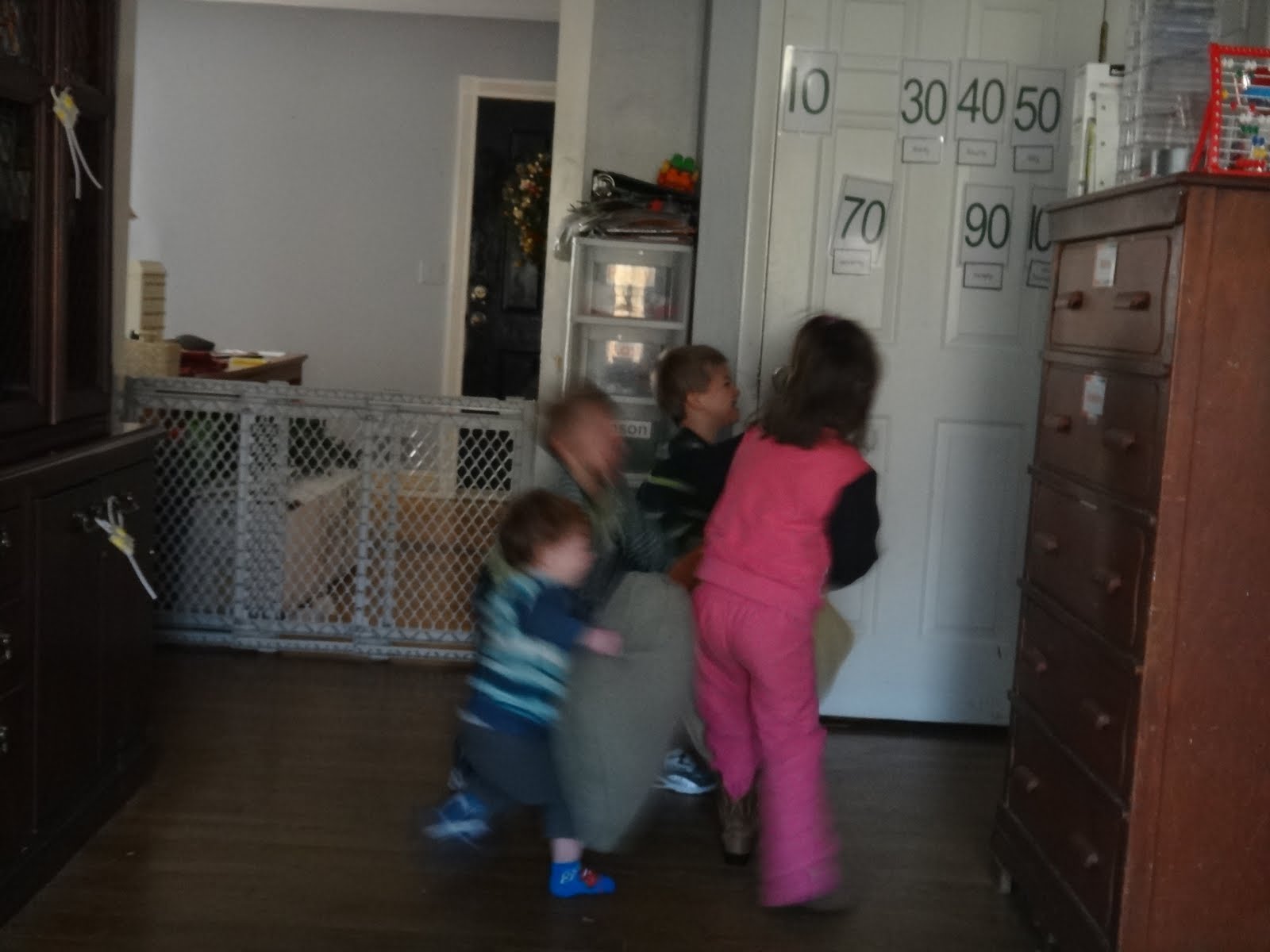
children crawling instead of running

So far it's working. He LOVES jumping, and readily and HAPPILY transitions to it. Hopefully he'll begin to choose that behavior over running. 

Rather than saying "walk," when he/they begin running, I say, "jump, twirl, crawl." 

I'm also having him running more outside to get more of his wiggles out. 


Update. It's been a couple of weeks now, and I see him choosing to jump when his wiggles set in. Even when he gets frustrated, he seems to be cluing his body to jump rather than pushing or hitting out at others. A side benefit I didn't anticipate.

Friday, May 27, 2016

One Smart Cookie


This handsome young man, Mr. G, graduated pre-k from here last August. He was approved for an immediate double grade skip. which his parents chose not to do. He was provided differentiated reading and allowed to do math through Kahn Academy on his iPad. Once a week he went to do research with a 3rd grade class, where he made many friends. Otherwise, he remained with his same age group and flourished socially.

He has been blessed with an amazingly supportive school staff. They recommended that he be tested for the gifted program while still in kindergarten. He passed all testing in the 99th percentile. The highest achievable score. This was 2nd-5th grade gradient scoring tests. He was again offered a grade skip up to 5th grade. All the grades in between were also discussed.

While he is extremely advanced in reading, writing, math, (basically all skills), he retains the innocence of a normal 6 year old and has amazing friendships within his class. Next year, for first grade, he will remain with his class, but he will be doing skills in higher grade classrooms and going to another school once a week for gifted learning experiences. He will be the only first grader, but this young man has NO issue with making friends of all ages. 

He's smart, he's charming, and he has more personality in his little finger than most people do in their lifetime. I am so proud of what Mr. G has accomplished this year and so grateful for a public school staff that has met him and challenged him where he was developmentally and cognitively. His parents have had some tough decisions to make, and they have done so with extreme contemplation, always keeping their child's best interests for both now and in the future at heart. 

His kindergarten experience has been everything I could possible hope for my graduating kiddos.

Monday, May 23, 2016

Math Whiz

Miss Libby, who graduated from here 7 years ago, just received her trophy for Math Olypiad. She scored in the top 2% INTERNATIONALLY in the Math Olympiad among fifth and sixth graders. She is one that was tested for the gifted program at her school a year early, the middle of kindergarten, and was tutored by the librarian in reading because she was so advanced. Congratulations, Libby!!


Monday, May 16, 2016

MINE Toddlers and Possession

mine importance of development toddlers and possession

The concept of possession is one of the most important for children to attain. Our society is based upon respect for our and other's possession of material goods, rights, responsibilities, feelings, etc.

We begin from birth to give them claim to their feelings. "Does your tummy hurt?" "Oh, you're hungry." "Such a sad face."

By a year, we are stating claim to others' possession. "He's sad that you hit him." "Those are mommy's, no touch." "Not yours, give back."

In general, toddler rules of possession go like this:


But at some point, they begin to move beyond their self-centric possession sense, and expand that to others. They can do this much more quickly through:

  • Constant reinforcement of what is theirs 
  • Expectation of understanding and respecting their own possession of feelings, material items, responsibilities
  • Expectation of them respecting others' possession of feelings, material items, responsibilities 


The toddlers are now 22 months old, and are getting down the concept of one another's possession of material things. We begin to work on this area of the concept as soon as they can begin to reach for things they want, around 6 months old. By 12 months, we are telling them things like, "No touch," "Not yours," "Let go," "Give back," and of course, "MINE."

A key moment happened for us last week when two of the toddler boys were both using similarly colored Frisbees. In the past, as in up to a couple days prior, they would basically take whichever Frisbee they came across first, whether or not it was "their" Frisbee. If the other child had laid claim to it for a while and viewed possession, then a fight would ensue. This time, though, as soon as one of them noticed the Frisbee was not "theirs," the child would immediately head off to find the one they were using. A few times, a child would point out the other child's Frisbee to that child. Possession is one thing, RESPECT for other's possession, is at a whole different level of cognitive and emotional development.


importance of toddlers developing concept of possession

The fact that the Frisbees were so close in appearance [to a toddler] was an indication of just how much the concept had sunk in for them, along with a significant increase in observational skills and discrimination skills.

They have now also assigned possession between them to other toys here at school, such as particular cars, push toys, t-ball bats, etc. and will pass over other's to get to "their" toy, or purposefully hand over the toy to the other child, often whether the other child really wants it at that moment or not. 

It helps that each child has a specific color for their dining ware, a specific spot for nap, a sleeping bag that is uniquely colored, a specific spot at the table, a cubby they can reach to keep their stuff separate, etc. By having these solid foundations for what is MINE at school, it gives them a daily grounding in possession from a very early age. 

I do not force sharing. I have other blog posts with links to people with more expertise than I have to tell you why. Many child care/preschool settings do not allow personal items from home. I ENCOURAGE it. The children do NOT have to share their items from home. Why?


To teach respect and the concept of possession.


Theirs is theirs, not yours.


A child may ASK if the owner will nicely share, but they do not have to share. The child needs to RESPECT that it is the owner's toy. If the owner is nice enough to share, then the child needs to treat the toy kindly and give it back, directly to the owner, when through.

Respect for possessions is not just for other people's. The children who bring items from home must keep them in hand [or on their face/head/etc.], in their cubby,  or in a safe spot. 


respecting a childs possession
Even at nap we respect their possession.
We have safe spots for projects, items, etc. such that anyone may place items in the safe spot, but items may only be removed by me, and only to the owner of that item. Children will often find abandoned home toys and place them in a safe spot. The owner then must request the item from me, often receiving a warning about taking responsibility for our possessions, or they will not be allowed to bring anything for a couple days.

I received a text from Mr. R's mom this weekend asking if I made the toddlers claim their messes. He was spilling water, pointing, and saying, "Mine!"

I responded that yes, I do, and I expect them to clean it up as well. Possession and responsibility have many facets, and this is just another one of those.

The concept of possession and respect for possession is just SO important and it amazes me that this is not an actively TAUGHT concept. All children get it, but through passive, normal interactions. I purposefully place children into situations where this concept can be absorbed, developed, reinforced, and practiced. I believe it makes for much more respectful and responsible children, at a much earlier age.


If a child takes something that isn't theirs, breaks something on purpose or through gross neglect, or is disrespectful of other's feelings/possessions/rights, then there needs to be consequences beyond saying, "I'm sorry." "Sorry," doesn't make anything better and it doesn't change behavior or their moral/ethical compass. Reparation and consequences that are directly in line with the disrespect are appropriate, and DO make a difference. 

Eventually.


We hope.

Just because we teach it, just because we practice it, and just because it is ingrained within them from a very early age...doesn't mean I didn't just have two four-year-olds biting one another over an empty toilet paper tube that was somehow loose on the playroom floor. [Ridiculous, unusual behavior that they got into big time trouble over.]

I'm not sure even adults can ever perfect this concept, but we try.

Sunday, February 14, 2016

Cloth Diapers & Child Care

cloth diapers and child care daycare

I hope you enjoyed Jessica's guest post on Cloth Diaper Ins and Outs. This is a follow up from a child care provider's perspective.

TIPS & TRICKS

In general, cloth diapers are pretty much the same as disposables. Same general routine and diapering procedures. There are a few things I keep in mind, however.

I have to store the diapers and liners. Yes you have to store disposables as well, but those stack up neatly or are in plastic sleeves. For cloth, I use an IKEA plastic bin that stores the diapers and a roll of liners. I take the diapers out each morning and place them into the bin and hang the wet bag on the bathroom door.

cloth diapers and child care daycare


I can't wipe with a cloth diaper the same as with a disposable. Most poop can be wiped off with a disposable, but if you do that with a cloth diaper, you get more poop on it than necessary, which you don't want. I keep a roll of toilet paper handy and will use that to remove the majority of the mess prior to using wipes. Otherwise, you will use a dozen plus wipes. I just plop the toilet paper into the toilet, since I change them on a pad on the floor of the bathroom. [State likes for the bathroom stuff to all be in the bathroom, and a pad on the floor saves my back from lifting 2 year olds.]

I need to think more about changing order. I change all of them at the same time, usually. If using gloves, it doesn't really matter, but I don't. I use a plastic bag for the nasties. I turn it inside out to grab the soiled liner off the cloth diaper, so I need to do the cloth diaper child first. Then I do the others and put the soiled disposables into the same bag.

I need to prepare the diaper before taking the other one off. This is basically true of disposables as well. However, pulling a liner off the roll requires two hands. laying out the diaper requires two hands, getting the snaps together takes two hands. If you have squirmy child, things can get messy fast. I always lay out the diaper with liner on top prior to laying the child down on the pad. I can put a disposable on one handed while holding a child in place, not so with a cloth diaper.

I need to be considerate of the parents and place very poopy diapers into a plastic bag. This lets them know that it will need additional attention and not just be tossed into the laundry. The plastic bag goes into the wet bag.

I need to keep in mind that it is against state regulations for me to do any more with a soiled diaper than is absolutely necessary. I can't pull out absorbency inserts, wash out poop, or do anything that could increase contamination of the space.

The parents have to bring the diapers daily. We start out the week with 5. Usually I use 3-4 a day at this point, 20 months old, depending on how late nap goes. They take the soiled ones each evening and bring me a corresponding amount back the next morning in a clean wet bag. I keep one spare in his clothes cubby and have a few disposables as back up.

The parents have to supply diaper rash cream. Most creams will lower the absorbency of the cloth diapers, so they are required to provide one appropriate for the diapers.

MY FAVORITES & NOT SO FAVORITES

Wet Bags: My favorites are the Kanga Care wet bags. They are about three times as roomy as the envelope style. It is SOOOO much easier to get soiled diapers into it. It can hold a days worth easy, along with any soiled clothing. The envelope styles barely hold a days worth of soiled diapers, and it can get messy trying to stuff them into the smaller opening. I would love to have a Kanga Care one for every child, especially when we have wet swimsuits in the summer. 


There's just really no comparison. I'm always happier to see the Kanga Care bags.

Diapers: My favorite, especially for boys, is Bum Genius. Each diaper brand has a different liner/insert configuration. Some have one long liner that is doubled over, some have snap in liners, some have a single pocket liner, etc. Bum Genius have full reach dual pockets, one on each side. What I like about this is that with inserts, you can double the absorbency as they grow older. For boys, I can double up the front liner at nap, when they are usually sleeping on their stomachs over 18 months, and are more likely to pee out because of it, giving me 3 layers of absorbency even without inserts.


why I love Bum Genius diapers


I DO NOT LIKE AT ALL the GroVia brand. They are so much narrower than the other brands and they snap front to back rather than back to front like disposables. The liners are much more narrow, and they have the single doubled over liner, Since I've been using disposables for over 30 years, the backwards snapping alone drives me nuts. It's just...WRONG and irritates me that I have to think while changing a child's diaper, which is one of the most mindless tasks, and a time when I should be spending engaging with the child rather than being forced to THINK about what I'm doing. GroVia is on the right.


I am also not a fan of a coop/no-name brand that has a dark gray inside. They are the only ones I have had two pee-outs from. I no longer use them at nap time. Ever. 

Some more personal opinions: Happy Heiny has only a single liner, but is super absorbent. Smart Bottoms don't seem to hold enough pee for bigger kids. Blueberry Diapers are fine. 

Jessica has mentioned that the ones with the Velcro rather than snaps are easier for the little ones to get open, but that Velcro is pretty darn strong, and I don't mind it at all. I can see where it would be a problem if the diapers were washed with other linty clothing, but I don't mind them. Quick and easy rather than trying to align snaps. They are not as adjustable, so I would imagine the cost would be higher since they would only fit a more limited size range.  

Frankly, the only irritation with cloth diapers has been the GroVia brand of diapers. Otherwise, I have had no issues with using the cloth diapers whatsoever. 

I was very surprised that indeed, he has less diaper rash issues than the ones in disposables. These new "cloth" diapers have great absorbency and the PLO outer fabric holds everything in wonderfully. 

I would HIGHLY recommend them to parents. Providers, cloth diapers are really a non-issue. Cloth friendly is a great marketing tool that costs you nothing. Being cloth friendly is easy peasy. 

They can be expensive to start out with, but you can always make your own! Additional cloth diaper pins on my Baby Crafts Pinterest pinboard.


Follow Little Stars Learning's board Baby Crafts on Pinterest.

Friday, February 12, 2016

Cloth Diaper Ins and Outs

basics of cloth diapers

While I knew they had changed, when I first saw one of the new ones, my reaction was, "Well isn't this slick!" While they are called "cloth diapers," they have SO much more to them than the old fashioned white ones.


My client, Jessica Nollett, has kindly created the following guest blog post to discuss the ins and outs of cloth diapering.

I have added my 2 cents into a follow-up post from a provider's perspective Cloth Diapers & Child Care. [I have my favorites, too! Along with some tips.]

YES, WE CLOTH DIAPER

That look when you tell someone you cloth diaper your child. It’s often one of horror/disbelief, that is quickly covered up by the fakest smile you can imagine, and then followed by comments like “the poop is too much for me,” “just wait till he is older; your tune will change,” or an ominous “Hmmmm.”

Those interactions humor us at this point. My husband and I made the decision together to cloth diaper our children long before our son was born. It wasn’t just because of the environment or the cost savings, but was almost a ‘why wouldn’t we cloth our kids’ thought. From all of our research, we found out we would be saving money if we cloth diapered more than one child (it’s a breakeven on one), and we do care about the environment, but there were other things that we liked: 

  • cloth diaper kids are easier to potty train
  • they tend to potty train sooner
  • diaper rash isn’t as bad with cloth diapers, 
  • and frankly, tell me that a disposable is cuter than this!

If you haven’t seen a cloth diaper like this, let me quickly get you up to speed. Cloth diapers these days are innovative, adorable, and nothing like what they once were. They used to be what you used if you couldn’t afford disposable. Now, they are much more expensive upfront, but you can save over time. The stigma has changed from poor people cloth to rich hippies cloth. 

They are constructed of a PUL (polyurethane laminate) coated fabric shell with snaps or Velcro (hook and loop) that are adjustable in rise (up/down) and waist. On the inside, there is either bamboo, cotton, hemp, or a microfiber system of pads and fabric to absorb everything. On the back of the diaper and leg holes, there are elastic gussets to keep everything inside the diaper. 

THE INs and OUTs

OUR STASH

1) Diapers:

The diapers that work best for our situation are the All-In-Ones (AIO). This means that the absorbent pad is ATTACHED to the rest of the diaper. We do have a decent collection of Pocket Diapers (there is a pocket that you stash the pad into), but it’s a hassle for daycare. At home, we pull that pad out of the pocket after use, but daycares can’t legally do that, so you are left digging through your wet bag, touching wet and dirty diapers. Gross. (Warning: AIO diapers are more expensive, but worth it for us). Some of my favorite brands are Bum Genius, Smart Bottoms, GroVia, Thirsties, and Blueberry


cloth diapers

When diaper shopping, I prefer diapers that are also one size fits most; they are bulky on your baby at first, but become more trim fitting as your child gets older. If money is a factor, I strongly suggest looking at the big picture, and realize if your child wears a diaper 2x per week for 100 weeks, $20 for that diaper is no big deal, BUT there are online coops where you can buy off-brand diapers for less. We have found they aren’t as great as my favorite brands, but they get the job done.

2) Pail:

We use a Dekor diaper pail, and it does a good job. A fancier option is the Ubbi. Both brands offer wet bags if you choose to cloth diaper. Be sure to get two wet bags for the pail, that way one can be in the wash. We also have a regular trash can with a lid/peddle for the wipes.

3) Wet bags:

These are the bags that are lined with a polyurethane laminate (that is also used on the diapers) and are where the diapers are placed after use. We have about 5 of these, and send them daily to daycare full of clean diapers, and the dirty diapers are sent home in the same bag at the end of the day. Wet bags are also great for swimsuits.

4) Liners:

When babies are exclusively breastfed, diapers can be tossed into the washer, poop and all. Once food is introduced, majority of the poop needs to be removed from the diaper before washing. There are lots of ways to do this, but we use flushable liners. They catch the poop, and can be tossed in the toilet with the poop.

5) Rash Creams/Sprays:

Regular rash creams will RUIN the absorbency of your cloth diapers, but there are great alternatives that can be used. Grandma El’s offers a great one for a bad diaper rash, but my favorite is CJ’s Butter (I use the spritz). I like it the best, because it is not just for diaper rash, but can be used for dry skin, bug bites, sun burns, etc.

OUR ROUTINE

Our son (17 months) wears cloth diapers during the day every day (home and daycare), but wears a disposable at night, if we are out and about, and when we are out of town. And honestly, we could do cloth for the last two, but we are lazy. We have a “stash” of 30 diapers, only really use 16-18 of them (because we definitely have favorites), and do a diaper load of laundry 2x per week. As he has gotten older, we use less diapers per day, but definitely need more absorbency than before. When he was younger, we were doing laundry every other day, and then 3x per week after that.

The hardest part about cloth diapering is the laundry. It’s not that it’s difficult, it just takes time, and lots of rinse cycles. While there are special cloth diaper detergents, most people prefer regular powder Tide, and less is more. Too much detergent can affect the absorbency. How you do it: pre-rinse your diapers, wash with detergent, rinse again, and then dry. To speed up drying, invest in wool dryer balls. They are amazing for all of your laundry.

TIPS ON GETTING INTO CLOTH

1) Take a class. We found that our local cloth diaper store (Itsy Bitsy Bums) offered a class on cloth diapering and explained all of the ins and outs of it, for free!

2) Register for diapers. This was great! We got some adorable prints and our friends had fun picking them out.

3) Look for a newborn rental program. Newborn diapers are smaller and are outgrown quickly, so they are not worth the investment. Itsy Bitsy Bums offers a great rental program for the first 12 weeks, for $200, and if you return them for $160 store credit, you can buy lots of cute diapers. You also have the option to return for cash/credit and get $100 back.

4) Build slowly and based on your needs. Your preferences may change and the speed at which your baby goes through diapers will change, so no need to get them all right away.


Thursday, December 3, 2015

Why We Pillow Fight


While we are a play and movement-based school, and spend as much time in physical activity and outside play as possible, there is an element of physical interaction that MUST come into play, for children to fully develop their proprioception sense. 

This is an excellent article, that I strongly recommend for all parents, care givers and teachers. Here is an excerpt: 
"Due to the busy schedules of today, children often don’t have hours to explore the outdoors, to help with the outside chores, or even do small jobs that require manual labor. Therefore, many children don’t have the same opportunities to fully develop and fine-tune the senses in the joints and muscles. As a result, more and more children are starting to have trouble regulating how much force to use when pushing and pulling and even interacting with the objects and people around them.
 This is why we are seeing children hit with too much force during a game of tag. Their senses are not quite working right – all because they are not engaged in an adequate amount of active play and movement on a regular basis." Valerie Strauss, The Washington Post 
We work on spatial skills, orientation skills, gross motor skills, etc. But there are few activities better than a pillow fight to get children really understanding the concept of physical force, in a safe manner. Pool noodle fights are another, but those are less interactive. They are, of course, well supervised, though I try not to interfere unless absolutely necessary. 

Note that these children are well versed in democratic decision making among themselves, and that our environment is based upon respect and caring for one another. Here, it could never be a melee.

What happens:
  • They learn how to hit. It is not easy for a preschooler to manipulate a pillow for accuracy and force at the same time.

  • They learn balance. Excellent balance. Building core strength. 
  • They learn how to duck and cover and to GET HIT. Super important.
  • They learn how to fall during interactions. Sometimes they all go down in a tangle. 

  • They learn how to get back up, disentangling without hurting one another or themselves. 
  • They learn that rules are necessary and how to create them. "STOP! Hey, I have a ponytail in and it hurts when you hit me on it. Don't do that. Okay?" "Okay!"

  • They get INSTANT feedback. "HEY! Not so hard!" "You nearly made me go into the cabinet. Be more careful!" 
  • They learn to counter force with a similar level of force. This is an amazing study. It is rare for a child to meet another child's force with significantly greater force. It usually escalates at a very prescribed pace.
  • They learn to be very aware of multiple environmental issues...little ones, walls, corners, door knobs, etc. and to react accordingly, regulating their force and direction.


"This is even more proof that delaying physical contact in sports is very risky. So many football leagues, hockey leagues and the like have jumped on the band wagon of delaying body contact. I am talking about tackling and body checking, and other legal and essential parts of the sports, until kids are older.
 The idea behind it is to wait until they have a better handle on their bodies and the sport before engaging in the physical contact aspects. Thus preventing injury at younger and older ages. It is having the reverse outcome. The players have not had the gradual introduction to the body contact over the years, and now when they are bigger, faster, and stronger they are thrust into it. They don’t know how to hit, they don’t know how to avoid, anticipate a hit and they don’t know how to fall. They also have anger issues, as they are now being hit, and hurt and don’t know how to mentally and emotionally handle it. When I say hurt, I don’t mean injured, but just the obvious pain of being taken down.
Like any other form of over protection, it is short term and only serves to make the parents feel better. The parents feel better because at that exact moment they prevented their snowflake from adversity, and yes potential injury. What they never see, is that they are actually creating a problem. Being that their snowflake is now ill equipped to handle the sports natural progression. Just like in life." - Comment by Warren

That's why we TEACH it here.