Monday, July 14, 2014

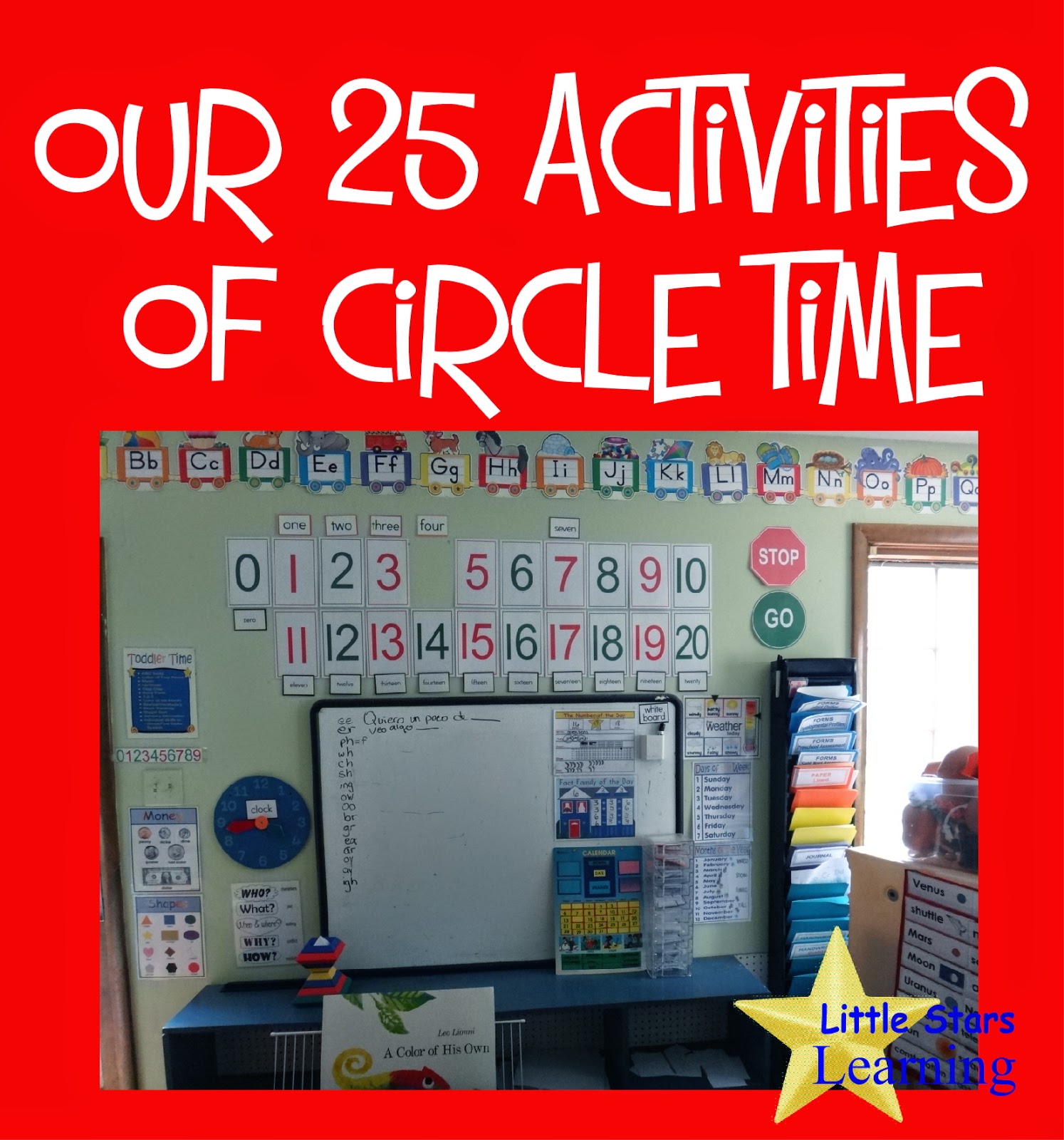
Our 25 Activities of Circle Time

Many providers have been asking about Circle Time routines. Ours is pretty involved, but we do NOT do everything every day. It depends upon the skill sets we are working upon and the progression of my students. 


If the weather has been the same for the last week, then it's just redundant to keep repeating it. I'd rather wait until the weather is interesting and discuss it in depth for 1/2 an hour.

Since this is primarily a Reggio based program, everything is interactive and most of it is done standing up. Learning is best reinforced through a holistic seeing, hearing, speaking and moving approach. 

This post is regarding what I am currently doing with children 2 1/2 through 5 years old. When I have younger children, they are with us or near us during circle time, depending upon their interest and abilities.

Since the littles get bored faster, we start with their level and progress, allowing them to wander off as they will and rejoin if they hear something that catches their attention. The children are INVITED to join me, it is totally their choice. As long as they are within hearing distance, they absorb everything even if they aren't directly participating. Every once in a while, I've started circle time all by myself, but soon had some friends join in the fun.

My teaching philosophy is that if a child is not paying attention and participating in an activity, either:
  1. They already have it mastered and it no longer holds their attention.
  2. They are not developmentally ready for the activity or skill and attempting to synthesize the information at this time is overwhelming.
  3. I'm doing something wrong. Either I or the activity are not joyful, playful and animated enough to invite them into participating.
They get down the songs and chants very young, without understanding the meaning of the information. However, when they are developmentally ready to understand, the light switch clicks and they already have that information available to utilize. 

If you think a 2 year old can't memorize extraordinarily well, ask one to sing any song from Frozen. It just takes making it into something they WANT to memorize.

I'll go into each and how we do it, but here's the list:
  1. Pledge of Allegiance
  2. Welcome, Monday Speech
  3. ABC song with visuals
  4. Counting 0-20 chant English & Spanish
  5. Names songs
  6. Colors/shapes English & Spanish
  7. Positional Relationships visual or interactive
  8. Days of the Week song
  9. Months of the Year song
  10. Seasons chant 
  11. Calendar 
  12. Weather discussion
  13. Manners song
  14. Odd/Even chant
  15. Skip Counting chant
  16. Money chant
  17. Diagraphs & blends review
  18. Spanish introduction/review
  19. Number of the Day & Fact Family of the Day visual & discussion
          Curriculum/Theme Transition: 
  • Topic discussion
  • Vocabulary introduction
  • Word Wall & Sentence Wall
  • Song/fingerplay/movement
  • Story [Finally sitting down]
  • Story Comprehension discussion
 1.   Pledge of Allegiance

When we do the pledge, we do it first thing. This gives the stragglers a trigger to join us.

When I found out they won't do the Pledge of Allegiance in school, I stopped doing it daily. I still feel it's important to know, so we discuss it and learn it on Flag Day, 4th of July, President's Day, Veteran's Day, Memorial Day, etc. when it has some relevancy.


2.   Welcome and Monday Speech

I formally welcome the children and we have a brief discussion about the days activities. Usually we jump right in, but this is the welcome song I use when we need to get everyone settled in:
Good Morning to you,
We're all in our places
With bright smiling faces,
And this is the way
We start our school day.
On Mondays, we also do speech. Each child gets up and tells us something. It can be a make-believe story, something about their weekend or home life, show and tell about a toy they brought, a song they want to sing, etc. This teaches speech skills, and more importantly, audience skills of paying attention, being kind, asking relevant questions, listening skills, patience, turn taking, etc. One of the best things I added to our circle time!

3.   ABC Song with visuals

We have this ABC border. I'd love to have it at kid height, but we lack wall space. I'm rather glad we have the windows instead, though. So, I use a yardstick and point to each one as we sing the song. 


I also have an ABC visual that I cut out of the book "Alphabet Rescue" to use.


If we are working on a particular letter, then I'll go back to that one and do a repeat and phonics review on it. This is NOT how we learn our letters, it's simply a review and another opportunity for them to pick up on a letter they may just be getting down. We do use 2 different songs. The traditional one to the Twinkle Twinkle Little Star tune, and this one...


4.   Counting 0-20 chant in English & Spanish

We bend forward and clap 0-9. On 9, we say it long and slowly raise our hands up then say 10 loud and dance around. We do the same on 11-19, raising our hands up on 19 and saying 20 loud and dancing. When the older children count to 100, they always draw out their response on 9 as they've been taught. This provides them with a window of thinking for the next 10, which they need in the beginning.


Guess which number the littles are currently working upon?


5.   Names Songs

One of the MOST important things we do as a group. Even the 1-year-olds can differentiate the names of all the students. They learn to identify names as pictorial references and then we decompose them down to letters through these songs. These letters are then recomposed into spelling names, which leads into spelling words. 

Sounds complicated, and it is, but it is a huge bump in learning to read. This we DO do regularly. Once they have down their first name, we add their last name as a second verse. This is also a great speech component since they stand up in front of everyone and point to the letters of their name as their name song is sung by all. 

This is one of the main ways they learn their first letter identification. I teach uppercase, lowercase and phonics simultaneously. 

The names are sung in a simple sing-song tone depending on how many letters are in the name. For instance:

B.e.n. spells be-en, spells be-en.
B.e.n. spells be-en. Spells Be-en!

E.m.ma spells Emma, spells Emma.
E.m.ma spells Emma, spells Emma!

J.a.cob spells Jacob, spells Jacob.
J.a.cob spells Jacob, spells Jacob!

Hun.ter spells Hunter, spells Hunter.
Hun.ter spells Hunter, spells Hunter!

Jes.sica spells Jessica, spells Jessica.
Jes.sica spells Jessica, spells Jessica!

6. Colors/Shapes in English & Spanish

We learn these in so many other ways, but every once in a while it's a good review to just run through the 12 shapes and 12 colors as a group. 


7.   Positional Relationships Visual or Interactive

While they learn this more through experience, every once in a while it's good to just go through them all. I will take a picture and ask positional questions, such as:
  • What is TO THE RIGHT of the house?
  • What is BELOW the car?
  • What is NEXT TO the tree?
or I'll have everyone get a toy and give them directions, such as:
  • Put the ball BEHIND you.
  • Put the ball ABOVE you. 
  • Put the ball ON your shoulder.
  • Put the ball UNDER your foot. 
I will also use this as an opportunity to teach body parts in Spanish.

8.   Days of the Week Song


This is sung to the tune of "My Darling Clementine."
Sunday, Monday,
Tuesday, Wednesday,
Thursday, Friday, Saturday
These are the days of the-e wee-eek
and today is __________.
Today is _________
Today is _________
Today is _________ all the day
Yesterday was __________,
and tomorrow will be __________.
Here is a YouTube video of the tune, but we change up the last verse to add the "Today is...." 


9.   Months of the Year Song


This is sung to the tune of "Ten Little Indians."
January, February, March and April
May. June. July and August.
September, October, November December
THESE are the months of the year.


l0.   Seasons Chant
Winter, Spring, Summer, Fall
These are the seasons one and all!
ll.   Calendar

We don't do much with the calendar until the last preschool year before kindergarten, simply because it needs to be done every day, and we just aren't that committed to academic routine.  

We have a nice big magnetic one, but the littles like to pop off the magnets and take off with them to the great void of I'll-never-find-it-again-until-I-move. So, we only put them on if we are working on the calendar as a group.


I have this smaller magnetic one, and with the bigs being pre-k now, we will be using it regularly this year. 


12.  Weather

We garden here. We are outside a LOT. Most of our weather instruction is relevant and important. We'll do a graph of daily weather, chart temperatures and rainfall, and discuss any bad weather that comes around and its effect on the climate and our situations. But sometimes, at circle time, I'll throw out questions about the weather, cloud formations, temperature, weather predictions, etc. I think it would be cute to have a little dress up weather bear or similar, but frankly, we have more important things to do. 

I found this wonderful free graphic. Unfortunately, once downloaded, it was in a very low resolution and was highly pixilated, so I simply re-created it for our use, as she had from an unknown original source, so that it looked as good as intended.  


13. Manners Song

Sometimes they need a reminder... 
First we say, "Please,"
Then we say, "Thank you,"
Then we say, "You're welcome," to the person who said, "Thank you,"
And that's how we use our MANNERS!
Done in just a sing-song voice.

14. Odd/Even Chant

All the teaching materials I produce have the even numbers in green for "GO, yes it can be divided by 2!" and red for odd numbers, "STOP, no, it can NOT be divided by 2!" So even as they first learn their numbers, they begin to see the red vs. green numbers and will remember that later on when we begin odd/even.
Zero, two, four, six, eight
Even numbers are really GREAT!
One, three, five, seven, nine,
Odd numbers are pretty FINE!

15.  Skip Counting Chant

Pretty much the same as our counting chant. We just clap on each number and dance about on 100. We start with skip counting by 10s, then 5s, then 2s, with our number visuals. OR, we'll put the numbers on the floor and take turns hopping on them as we count as a group.


16.  Money Chant

Chart visual. 
A penny
A nickle
A dime
A quarter
A half-dollar
A DOLLAR, DOLLAR, DOLLAR!

17.  Diagraphs & Blends Review

Any digraphs or blends that we are working on, especially any that a child is having trouble with, go written on the white board and we'll review them during circle time until I feel they are mastered. Sometimes we just run through all of them I've put up for a while. 

Each one has a specific phrase and movement to it. For instance, 

With finger to mouth and shoulders bunched. "EEEEEEK, I SEEK to KEEP CREEPy stuff away!"  

Slapping hand over arm with a look of astonishment. "OW! HOW did a COW give me an OWie?"  


18.  Spanish Introduction/Review

This is taught mostly in the environment, but new phrases or review can be integrated into circle time.


19.  Number of the Day/Fact Family of the Day

Our number of the day chart is wonderful and thorough. The children get a kick out of having me draw a ton of little funny pictures. Unfortunately, they always pick a number like 98! We do this as a group, but they can use it as an independent table activity as well. 

I have one that only goes to 20, but this group is working on 100+, so we are using this one currently.

The fact family chart is a good visual for discussion about addition and subtraction units. The children get to pick two numbers between 1 and 9 for this one.


THEME/CURRICULUM ITEMS
We don't always have a theme, depending upon the skill sets we are working upon and the time of the year, but when we do, my curriculum is comprehensive and we WILL cover everything listed below. While this is usually considered an extension of our circle time, it borders into our curriculum time as well. If there is no theme, then we may or may not do these during circle time, but they will be covered at some point within the day.

20. Topic Discussion

The topic discussion may or may not come first. Some times the story is so relevant that I need to read it first prior to discussion. If not, then we will talk about the topic first. For instance during our SPACE theme, one of the weeks was regarding the solar system. Our daily topics were:
  • Monday - Solar system 
  • Tuesday - 11 planets
  • Wednesday - Sun & stars
  • Thursday - Planet Earth
  • Friday - Moons
2l.  Vocabulary Introduction

This usually goes along with the story and topic discussion. If I feel that there are specific terms that need to be addressed for good understanding during either of those, then I'll make a point of having a vocabulary introduction.

22.  Word Wall and Sentence Wall

For each theme we have a word wall and sentence wall. For the littles, this is a vocabulary and visual activity, for the bigs, it is a spelling and relationship activity. 


23.  Song/fingerplay/movement

For each day of a theme there is a song, a fine motor and gross motor activity, related to the daily topic. For instance for the daily topic of Sun & Stars, we sang "Mr. Sun," did a finger play called Sun and Moon, and a gross motor movement of the Earth going around the sun.

24.  Story

Since all of above is done standing up and moving, they are usually pretty ready to grab a floor pillow and plop down for the story of the day as a group. For the Sun & Stars topic, we read "Going Around the Sun" by Berkes.


25.  Story Comprehension

Using a dialogic approach to story time, we cover vocabulary and I ask age-appropriate questions of the children during and after story time. This builds logic/reasoning and sequencing skills, along with many other skills

For the bigs, who are reading well, we are now in a pre-k mode and have gotten more formal in our comprehension discussion. The littles are asked similar questions, but in a less formal way and with the expectation of simple answers without analysis, categorizing or labeling. 


After circle & theme fun stuff, they have the option of free play, table time activities/manipulatives, or starting our actual school time. They usually choose school, which will include a language, mathematics, science/logic/reasoning and art component related to the theme topic and the daily skill set. 

You may also be interested in:


Follow Connie -'s board Classroom on Pinterest. Tags: circle time, circle, preschool, pre-k, homeschool, daycare, child, care, morning, routine, schedule, learning, education, kindergarten, time, 
Tags: circle time, preschool, daycare, child care, child, care, teaching, toddler, 

Wednesday, July 2, 2014

4th of July Fireworks Straw Painting


In the past we have used squish balls to create firework effects, which is always fun, but those can really smoosh up the paint and the effect can be lost. 


Since we have a TON of straws, I was intrigued to try the straw stamping technique.

I had run across the image below of the children's parade, and thought the two would make an interesting craft marriage.

I really wanted to use this image from artist Rose Santuci-Sofranko, but it has a copyright and is not for sale as a SVG. I find it darling, though, and prints are available at Fine Art America.
 FOR SALE! SILHOUETTE ARTWORK!  ....  4th Of July Childrens Parade Panorama  .....   #sale #artwork #cards #prints #fineartamerica  #silhouettes #fonts    #4thOfJuly #panoramas #children #parades

So, I went with this free SVG image from Art by Annel.


It was a simple download, add, and print on plain paper, although cardstock would hold up better to the paint and would dry more flat. I didn't consider this to be a portfolio piece, just a quick holiday craft, so we used the cheap paper. 

I gathered up a bunch of bendy straws and bound them with rubber bands right below the bends. Then I pounced the ends on a hard surface to even them up. I cut one set about a 1/2 inch shorter than the other to lend some added dimension to the art work. 


I bent the straws out. The children can do this. I made sure the straws were relatively splayed out around in a circle, manipulating them around just a bit if there was an obvious gap. 


I asked which one they wanted long and which one short, then provided palettes of blue and red paint. They learned that they needed to rotate the straws in a circular pattern both in the paint and on the paper to achieve the starburst effect.


The children really like this activity and were very pleased with the results.

Tags: 4th of July, Independence Day, craft, Veteran's Day, Memorial Day, President's Day, paint, painting, stamping, straw, straws, preschool, toddler, art, daycare, child, care, kindergarten, pre-k, child, kid, kid's, homeschool, USA, U.S.A.

Tuesday, July 1, 2014

Anemone Ocean Craft


The children had a great time with our anemone ocean craft. While this is often done with toothpicks, it is safer with straws for the preschoolers, and I think the colors look much better.

There is SO much learning going on. It is much more than just a craft/art project. Advanced learning objectives discussed farther down.


Salt dough is 1 part salt, 1 part water and 2 parts flour. 

For EACH child, we used: 
1/2 C water
1/2 C salt
1     C flour

This was probably twice as much as needed for the anemone craft, but it allowed for more possibilities for creation and the probability of losing some to the floor.


Such a clean start...
The children put the 1/2 C water into their bowls, then chose 1-2 colors to place in their water. They squeezed out 2-3 drops each. Then mixed.


We worked on the concept of full and leveling.


After mixing in the bowl, they dumped out on the table.


A sensory explosion.


Rainy day with the doors and windows open, not the best environment for doing this, so it did need some additional flour. They didn't really believe me that it would get un-sticky. 

But it did.

They played with it for a while before I gave them the straws and scissors. I knew it would be a more hands-off activity once those came out, and I wanted them to really get the feel of the dough and the opportunity to manipulate it.


The straws have a tendency to fly everywhere when snipped, so it was a treasure hunt in the art room with pieces flying everywhere. 

They played with the dough for quite a while, stamping circles and making holes in it with the straws. In the last five minutes, I had them form it into a ball and place the straw pieces into it as an anemone. 

To dry, I left them for the rest of the day on the table, then I put them onto the top of our craft supply carts, which have a perforated metal plate, allowing air circulation to the bottom for more rapid drying. 

Last Year's
We were in no hurry for them to dry, so we just left them there for a week. If we had needed them dry quicker, I would have put them in the oven overnight on the lowest setting.


ADVANCED LEARNING

The first thing we did was taste all the ingredients and discuss the taste and texture, working adjectives. Mr. G thought the flour tasted like Cheerios. We spelled out SALT, FLOUR, WATER, STIR, MIX, DROP

Before starting, we discussed proportions and whole vs. half.  We discussed how our foot was the same size as our forearm. They have the same proportion, they are equal in size. 

I took two same sized pieces of paper and ripped one in two, and we discussed how the two together EQUALED, were the SAME as the one piece. Each small piece was 1 part of 2 that made a whole piece.
1/2 + 1/2 = 1

Disregarding liquid vs. solid measurements, we just used the same cups. So we looked at the measuring cups and the 1/2 and 1 on them and discussed how it took 2 of the 1/2 cups ADDED together to EQUAL the 1 cup. We spelled out the word CUP.

When we put the liquid food coloring into the water, we observed how the coloring laid in the water. Could we get the color back out? No? Then they mixed them up. We discussed whether or not they could get the food coloring back out now. No? Well then they had more than a MIXTURE, two things mixed together, they had a SOLUTION, two things mixed together than became one thing.

When they dumped their salt in, we discussed again. They could still see the salt and we discussed different ways they could get it back out and that it wasn't a SOLUTION, because you could still see the salt, so it was only a MIXTURE. [I didn't get into the fact that some of the salt dissolved and it was actually both. They ARE preschoolers...]

As they mixed it all together, we once again discussed mixtures and solutions and which one we were making.
Tags: homeschool, homeschooling, preschool, gifted, advanced, child, children, art, craft, salt dough, recipe, fine motor, sensory, cutting, scissor, skill, math, reading, language, science, theme, unit, ocean, sea, sculpt re, beach, summer

Thursday, June 19, 2014

FREEBIE Reading / Book Log

Historically, this is the time when I would feel a sense of pride and accomplishment knowing that my newly minted readers were proficient and ready for the new rigors of kindergarten language arts. 

However, these children have been a step ahead since they were infants, and I still have them for another year. 


Since the newly classified PRE-K ladies have completed all EIGHTY of their emergent readers, and Mr. G is only 8 away, we needed another method of recording their reading efforts as they dive into leveled readers.


The children helped me come up with this style. They picked the layout, the fonts, and how many they wanted per page. As their writing improves, they wanted the lines big enough that they could comfortably write down their own information. Available for FREE on TPT, it includes a couple of layouts.

This is the one we are using, but there are two other simpler ones with just title and title/author.


It is hard to believe that I began this reading journey with these children 20 months ago. At that time, they couldn't even put two letters together to form a word, but did know their letters and phonics, and now they are reading at a nearly 2nd grade level at the age of 4. 

We have moved at their pace, working at it when and how they wanted to, and not every day. As they got better, their interest soared.

They each have very different reading styles. Miss A is a whole word reader, and HATES sounding out words, but does it as a last resort when she absolutely can't figure it out in her head. Mr. G, on the other hand, prefers phonics and sounding out words, and will continue to sound out even words he knows. He's getting over that gradually. Miss H is the happy medium between the two.  

We started book reading soon after they gained the ability to identify joined letters as words and had down many of the first level sight words. Their first pages were...


and the last pages of the emergent readers were...


What they are reading now, really seems like a step back.


So we are looking for good regular books to read. Today, Miss H read Ten Little Caterpillars by Bill Martin Jr., and only had trouble with the word "patiently." Not bad, considering it is Grade Level Equivalent for 2nd grade.


To find Grade Level Equivalent, Guided Reading, DRA, or Lexile score, I use the Book Wizard from Scholastic. 
Tags: reading, books, book report, book log, reading log, log, instruction, language, language arts, kindergarten, pre-k, child, care, daycare, preschool

Friday, June 13, 2014

Father's Day Craft

This is a classic, but in 12 years, we hadn't done it. 

This was the year.


I took some of our many puzzle pieces 
stored in our art studio, 


and spray painted the back sides the day before we were to use them.


They had the choice of using the painted ones or the unpainted ones.


Using large craft sticks, I hot glued the corners to form a  square frame.


The children used white school glue to attach the pieces around the edge, working on "DOTS NOT LOTS."

While they dried, I created a sign in word processing that I printed out on cardstock, so that it was easier for them to hold flat, and added a sticker to the bottom. 


My backdrops were wrinkled beyond belief, so we just draped up one of their sleeping bags.

I sized the pictures to 5 1/2 X 5 1/2 inches, printed, cut out, and laminated them before taping with regular tape to the back.


They turned out darling.


Follow Connie -'s board Father's Day Theme on Pinterest. Tags: father's, day, father's day, preschool, daycare, child, care, child care, pre-k, theme, unit, holiday, picture, frame, mother's day, grandparent's day, teacher, gift, teacher's


Wednesday, June 11, 2014

Cardboard Space Ship

The children have been playing in this big box for a couple of weeks. It's been used for a variety of play experiences, but since we started our preschool theme for this month, SPACE, I decided to make it into a rocket.


I grabbed a pretty big Amazon box I had in the garage, and cut two triangles for the short ends. I then used a craft knife to score the edges about an inch from the edge to create a foldable line. This gave me a flange for joining the pieces together. The bottom flaps were turned under and taped down with packing tape [cheap.]  


The two side pieces for the point were joined at the top, then I simply laid the remaining rectangles of cardboard over the open sides and cut the pieces to fit before taping it all together.


To make it white, I knew paint would simply soak in and not look great, be expensive in the long run, and take time to do and dry. So I used the cheap, thin, white plastic table cloth you use for banquet tables. I had a roll hanging around. I simply sprayed an area with spray adhesive and applied it, trimming afterward. When complete, I covered the raw edges with duct tape from the dollar store. 


I added some pieces of black Gorilla Tape and some blue painter's tape for accents. I printed out a Google image for the flag.

It was a must-have!

For the thrusters, I used 2 red bowls from the dollar store that I just put on with doubled over duct tape. I took a sheet each of yellow, orange and red tissue paper, tied them together with a twist tie, added doubled over duct tape to the inside of the cup, and pressed it in. I snipped the ends of the tissue paper to be pointed where any was straight.


For the window, I had this piece of packaging plastic laying around that seemed to have some interesting features to it. I cut out the area and sealed the edges with duct tape. I used the cut out for their instrument panel.


I simply drilled holes in the lids and block so they could actually move, and attached a triangular cardboard brace to the back after sealing the edges with duct tape.


After our paintings dried, they could put these up above the instrument panel to act as their windshield.


We added a chair to the cock pit, and....TA DA! We have a space ship! For about an hour of work and about $2 in materials for tape and tablecloth. 


They think it's pretty spectacular.

This is our current favorite video, 
original lyrics by Snow Patrol...


Tags: space, theme, unit, preschool, rocket, shuttle, spaceship, NASA, astronaut, cardboard, play, environment, pre-k, elementary, school, education, planets, earth, sun, moon, stars,

Monday, June 9, 2014

Learning Should be Spherical, NOT Linear


Questions are power.


  • Knowledge may be the end power, but questions are how knowledge is gained and retained.

I am an advocate for child-led learning. In the preschool setting, this means that we explore their interests, I INVITE them to join me in learning activities, and I ask where they want to go in their learning and what they want to do to facilitate that direction. When I ask if they want to play, do art, do school...I will immediately hear a resounding chorus of 
"SCHOOL! SCHOOL! SCHOOL!"

School for us, is also play and art, with a more focused agenda. But even our version of "school" work is dependent upon THEIR interests. We were late having lunch one day last week because they watched a worm crawling for 15 minutes. Total fascination. Schedules take a back seat to learning here. "How do they move like that?" "How do they poop?" "What do they eat?" "Will he get hurt on the sticks?"


Why do these young preschoolers LOVE to learn and far too soon, that love will disappear? WHY? The average toddler asks 300+ questions a day. The average preschooler 100, and by middle school, children may not ask a single question in a day, let alone one of profound importance.


Are you saying, SO WHAT?!


Questions are control. When we remove questions from children, we remove their control. We give them answers to regurgitate, rather than giving them the means to work out the answers on their own. We take away their freedom and responsibility to OWN their learning experiences.


Parents often say that if left to their own devices, their children would play video games all day. Have you ever wondered if that might be because we have stripped away their ability to self-motivate learning?


Maybe we have TAUGHT them that all learning should be directed by someone else. Reading is a requirement, not a beloved activity anymore. Research is required, limited to a given topic and specific set of requirements, with the goal of a graded paper at the end, not understanding. The goal is no longer a passionate exploration to understand the unknown.


What is a question of profound importance?


  • It is anything that encourages exploration of themselves and their world.

A few of my 13 year-old son's recent questions of profound importance:
  • What signs tell a tornado may form?
  • How do solar flares impact stuff here on Earth?
  • Who all was involved in the Manhattan Project?
  • What did my great grandparents do for a living?
Not surprisingly, we homeschool. Even less surprisingly, the majority of his time is spent in self-directed learning, exploring where his passions or interests lead.

Self-directed learning? 

  • Initiated and led by the individual, facilitated  [rather than directed or controlled] by a mentor, educator or parent.

No, I can't answer any of those profound questions of his, so I facilitate his learning as needed. But, he's pretty resourceful. Wikipedia is often the first step, Youtube, on-line articles, forums, downloading books, emailing the people directly involved [who, surprisingly, usually write back], and figuring out what he still wants or needs to learn and the direction(s) that will take him. For more advanced work, there are tutors and on-line classes.

In-depth, knowledge-retentive, multi-layered, connective LEARNING is achieved through the freedom of moving in any of the 360 degree directions a child may find necessary for him to achieve his path. Education through a linear, blinders-on, single focus goal, leaves an entire world of learning opportunities disposable to a single end goal. That goal is RARELY knowledge. It is usually a test, a paper, or other drastically limited pin-point focus.

The self-directed learning path is rarely, if ever, linear, unless short lived. It can be circular, realizing the subject has reached a level he is uncomfortable pursuing, or finding some specific sub-area he would rather concentrate upon. It can mean that he has determined that a particular path of learning is completed for him, but there are other directions to explore within the same subject. 


The path almost always branches in multiple directions at different points to gather information and return or finding some nuance within the exploration that takes off on an entirely new direction of purpose. But, above all, the learning is interconnected and directly related to an initial goal set by the individual.

He said he was doing graphic work for a computer game and started thinking about Picasso. Then he thought about how Picasso knew Einstein. He looked up some information on them. When he came to Einstein he saw a link to the Manhattan Project, of which he had only a basic understanding. Within two days he could lecture on the Manhattan Project, reciting names, dates, responsibilities of key players, interview tidbits, etc.


Through this exploration, he learned aspects of science, history, psychology, sociology, advanced reading, logic/reasoning/strategy, politics, and I'm certain other subjects, in the many hours he spent in research and study of this single topic. A learning path that all began with a random thought about Picasso. A path that I would NEVER have considered to put on a 7th grade curriculum, let alone to the level he took it.


While his main passion is programming and coding in C++, his curiosity and interest has led him in some fascinating directions. Directions that in my wildest imagination, I could not have conceived of him being interested in pursuing, and directions that no middle school curriculum would touch upon, let alone cover to the level he has pursued.


A classical piece in one of his video games caught his interest. While having been exposed to classical music, this piece spoke to him. He began to research Beethoven, who was interconnected to other composers, so other biographies were read. The information led to an understanding of the historical social and political influences upon the music and the progression of the genres.


In coding, he says he makes the most progress by making mistakes, finding them, and fixing them. I asked if he wanted to take a course in C++, but he said no, because they would tell him how to do it right, expect him to always do it right, and he'd never truly LEARN how to fix anything and everything that could go wrong. "It is through making mistakes that I realize my limitations and how to overcome them."


He tried for a few weeks to get down a 3D graphics program he began working with. He finally decided he needed help, so he began to contact the game developers that he most admired. They were independents with solid games. They gave him advice, sent him some of their early files to work with, and were very encouraging of him as a young game developer. He contacted them all on his own. He's 13, but they didn't know that, and probably didn't care. They connected with him as a colleague. 


Unfortunately, that level of drive, ambition and confidence has been taught out of most children. The fearlessness that they enter this world possessing is slowly stripped away by a constant barrage of "NO."


No, you can't touch that. No you can't do that. No you can't have that. No you can't say that. No you can't THINK that.


Yes, you may sit still and do as you are asked. Yes, you may give the correct answer so you will not be punished, reprimanded or humiliated. Yes, you may follow this particular learning path I have determined for you to follow whether it interests you, or is in your best interest...or NOT.


Parents wonder why their children escape into video games.


In video games, children are allowed to be in control, free, powerful, motivated, rewarded, and constantly moving to a higher level based upon their own learning and growth.


The need and desire for self-directed learning is innate. Even stripped down and made compliant for society, they still rebel and fight for it in the secrecy of their games.

Tags: homeschool, homeschooling, parenting, teaching, education, educating, unschooling, self-directed, learning, investigation, exploration, theme, unit, project, project-based, child-led,