Wednesday, July 25, 2012

Picky Eaters are Created

No adult ever LIKED coffee, beer, wine or cigarettes the first time they tried them, and probably not the second time, either. Even diet drinks, artificial sweeteners, and milk with a higher or lower fat content take time to become accustomed to for adults. 


7 months
crackers, apricots, asparagus, chicken
If indigenous children can learn to like grubs, and Norwegian children can learn to like lutefisk, Asian children can learn to like cooked fish heads, and most children of the world to eating insects, then there is NOTHING in the average western diet that children can not learn to like unless there is a built-in physical aversion, such as with cilantro, or a sensory issue with certain textures.

Children who have been abandoned in some manner have been found to eat even the sheetrock off the walls if hungry enough. Children are biologically incapable of starving themselves, unless there is some physiological or psychological issue involved. When provided with a variety of nutritious foods, they will choose to eat if they are hungry. 

Palates are created, not born, and it takes an average of 10-12 experiences with many foods for the brain to recognize them as palatable. We do a great disservice to our children when we don't allow them the opportunity to push beyond an initial dislike. Research shows that any food a child experiences a minimum of 10-12 times before the age of two, even if they don't like it, they can LEARN to like it later in life


So, the variety of food they experience between 6 months 
and 2 years is the most important of their lifetime


Food is the only complete sensory experience, and every food introduction increases brain cells as they process the new taste, smell, texture, shape and sound the food makes while eating it. The children in my care eat Hungarian, Cajun, Chinese, Thai, etc. by the age of one. They may not like something for months, but then there comes that day that the switch flips and they like it from that point on. Exposure. Two bites of everything. If you absolutely can't get them do a 2-bite rule, then encourage just a lick. It will at least get the chemical compounds of the food processed into the brain for later reference.


"You don't need to like it, but you need to try it."

"You don't have to eat it, you can spit it out, just TRY IT!"

Many adults do not eat vegetables [my dad!], or have extremely limited diets due to the experiences of their childhood. Children of these adults often lack even the opportunity to try foods that THEY may like. As parents, we have to always keep the future in mind and our children's benefit at the core of our decisions regarding their care. That includes not limiting our children's diets due to our own preferences or making derogatory comments about foods they should be learning to enjoy.

Babies will USUALLY gag on or refuse new foods. It is as much the new texture and smell, than the flavor, that they are reacting to, but many parents take this as a sign of dislike and do not push their infant to continue to try the food. 


This is a mistake. 

No one wants a child who will only eat mac & cheese, and no adult can subsist healthily on processed and fast food. Food is either an advantage or disadvantage to health. It either heals or harms. It doesn't do both. Helping your children to make healthy dietary choices will effect their health for a lifetime.

Breastfed babies take to solid food much more readily than formula fed babies. Breast milk changes flavor with ever meal the mother eats, so breastfed babies already have an affinity for their mother's diet. Formula babies have had the EXACT same flavor of milk their entire lives, and any deviation from this is going to be dramatic for them and will usually make them take longer to accept new foods.

Here is my infant food introduction list. Parents mark off the item after the 3-day introductory period. Once a  food is introduced, it can be mixed with other introduced foods. The introduction of the spices and herbs are just as important as the introduction of the food items. 


Infants and children prefer food to be served at room temperature.


INFANTS

11 months
Chili for lunch, talk about a sensory experience!
  • Start early! Most of my infants' pediatricians have had them begin solids at 4 months. This is great, since it takes a while for the tongue muscle to develop and for them to "get" the concept and mechanics of eating down. After starting with rice cereal, we usually move to avacado [best brain food for baby!] and then sweet potatoes [super food]. As of 6 months I like to begin adding a new food, herb or spice every 3 days. By 9 months the infants in my care are usually eating table food. 
  • Infants want to eat what everyone else is eating. They can smell it. They can see it. They KNOW the difference. Use a chopper, food processor, or bullet to whip up whatever is on the table to the correct consistency for your infant. Let them sit at the table with everyone else and enjoy the social aspect of dining together.
  • Let them PLAY WITH THEIR FOOD! Especially in that 6 -18 month window. Throw it, smear it, mash it, etc. Food is the only 5-senses experience, and infants are more likely to ingest food they are allowed to self-feed. Playing with food is a HUGE brain development experience
  • Providing a new or disliked food as a first option, will often get a better response than if it is given with a meal with other, more familiar foods. Again, provide it as an appetizer and let the infant explore it.
  • Mixing a small amount of a new or disliked food with a liked one, and gradually increasing the ratio as the child will accept the mixture, will get the brain to begin recognizing and accepting the individual food.
  • Introduce herbs and spices early. They make the flavors of foods so much richer and more exciting.
The tongue is the last muscle to develop in the human body. By giving infants a variety of foods with a variety of textures, the tongue muscle will work harder. This assists greatly with a child's physical ability to speak early and distinctly. Communication is the number one cause of tantrums, so the earlier they can communicate effectively, the less likely are to have them. 

CHILDREN 2+

  • Children are more apt to eat food they help prepare. Provide a new food and discuss recipes with your child which ones s/he would like to try out. Let the child assist in preparation. If they don't like it the first time, try a little bit over the next few days. They may change their mind. My children don't like frozen spinach, but they love watching fresh spinach wilt and will eat it in a dish if they get to watch it magically shrink in the pan
  • Prepare a food in different ways. A child may not like eggs any way but scrambled, or potatoes any way but mashed, but they should be allowed the opportunity to try them every which way to make that determination, not just allowed to settle on the first one they like.

  • Textures are often harder than flavors to get over. A child may not like raw tomatoes, but loves pasta sauce, salsa, etc. This is true for potatoes, celery, olives and many other foods. Often if these foods are minced very fine and added into a dish, then the child will accept them. I have a child who doesn't like chunks of broccoli, but if I mince it with a chopper, then she loves it. 

  • Food introductions are best done when going through a plumping stage.  As children go through their growth cycle, they will plump up, eating everything they can get their hands on, and then often practically stop eating all together as they have a growth spurt. This is normal. 

  • Human beings have an innate love for sweet and salty. Breast milk is sweet. Salt is a life necessity. A natural diet would never have these in excess on a daily basis as we have in industrial societies today. Just because we can eat sugar and salt all day every day, doesn't mean we should. Children have to be taught limits on these substances that they naturally crave. Sugar and salt cravings are either fed or diminished by the foods we provide our children. However, these natural cravings can often help with the acceptance of an un-liked food. Adding a little butter, salt or sugar may help with initial acceptance, and then those substances can gradually be eliminated. 

  • Have taste tests. Make it a game, a fun experience, and encourage your child, and yourself, to experience new foods and textures.  
  • Do not mistake a lack of appetite with a dislike of the food. Children go through growth cycles where they fatten up and then have a growth spurt. When growing, they will often practically stop eating altogether. This is usually accompanied by being a lot more tired and sleeping more. As long as a child is active and alert when awake, and showing no signs of illness, there is no cause for worry or any reason to push a child to eat. As I said, children are instinctively incapable of starving themselves. They will eat if they are hungry, and it is very important that they learn to use and trust their body's clues. Eating when we are not hungry is one of the leading causes of obesity, often taught from our parents' "clean your plate" directives.
  • DO NOT FORCE an older child to try or eat a food. Encourage. Make it an expectation that they will try. Give the child a choice. "If you take one bite of your squash then you can have more peaches." If they do not take a bite, then no more peaches. Stay calm and let the child have the option and ultimate control over their choices. Do not hover, question, cajole, etc. Give them good food, and let them enjoy it.
  • They will not starve. Simply because a child chooses to not partake of a lot of food at a meal does not mean that they will have any lasting damage. It won't hurt for them to miss a meal. If they choose to not eat, then let them go hungry. They will make it up at the next meal. Over the age of 2, they are not entitled to a parent being a short order cook or to be fed outside of meal times or away from the table. They could be tired, not feel well, have eaten a huge meal earlier, or may be going through a growth spurt. Pushing children to eat when they are not hungry or choose not to is a recipe for food issues, obesity and eating disorders.

If it isn't good for them, then don't allow the child the option of eating it. 

Parents control the food that comes in to a child's life and the foods from which their child may choose to eat.

Food can either give us energy and provide the building blocks of life, or make us fatigued and cause our bodies to work hard to combat the negative effects of chemicals, fat, and excess salt and sugar. Parents who would not inject harmful chemicals into their child, are often doing the equivalent by the foods they place on their child's plate. 


Good health and good nutrition are the right of every child. 
Tags: nutrition, food, picky, eating, eater, introduction, infant, child, toddler, parenting, 3-day rule, three, day, rule, solid, weaning, childcare, care, daycare, health, healthy, meal, meals, cooking, children, baby food

Friday, June 29, 2012

International Mud Day Celebration

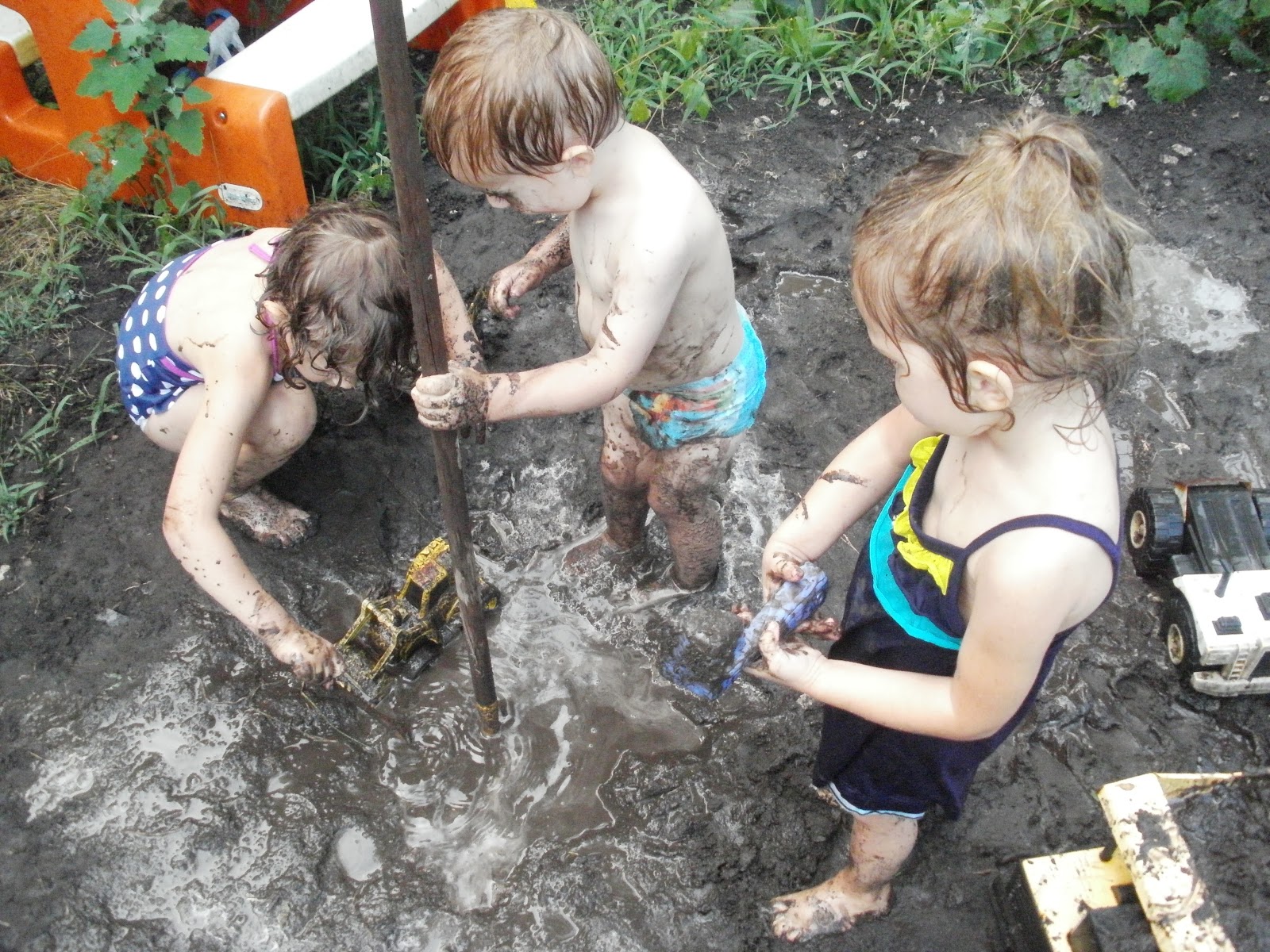
In celebration of International Mud Day, we got messy!

The construction pit was transformed with a little help from the hose. It went from this...


 To THIS...


We also played on our water pillow.


There was a lot of hopping,


flopping,


rolling, and laying. 


A wonderful sensory morning on a hot summer day.

To make the water pillow: 
  • Double over heavy duty plastic sheeting to twice the finished size you want 
  • Fold in half to finished size
  • Fold over edges twice and duct tape [use heavy duty tape] down as you go 
  • Leave one corner open for filling
  • Check seal of tape, securing firmly all the way around
  • Add a second tape layer, overlapping first by at least 1/2 inch, as needed
  • Place about 6 drops of green and 6 drops of blue food coloring into the hole
  • Fill  to desired depth, 1-2 inches
  • Double fold opening and seal with tape
Tags: water, play, sensory, mud, international mud day, june 29, outdoor, pillow, mattress, plastic, sheeting, childcare, child, care, daycare, preschool, fun

Tuesday, June 26, 2012

Patriotic Preschool Hats

These 4th of July hats are always a huge hit. They are also great for Memorial Day, Veteran's Day, Flag Day, President's Day, or made in yellow, purple and green for Mardi Gras. 


For older preschoolers, fold sheets of construction paper length-wise into 1 inch strips to create cutting lines. There are a LOT of strips to be cut, so I usually only have them do one sheet of cutting. For younger children, I try to do a few strips with teacher-assist scissors. The rest of the strips, I use my paper cutter. It will take 6 strips of each color, with an extra one for every year of age over 2. 


The large stars are used to cover the seam at the center of the headband. Older children can be provided with a template to trace and cut out. Younger ones will need teacher assistance with this.


The band is two 2-inch strips cut length-wise from the child's choice of red, white or blue construction paper. We glue the seam to keep it flat, but I also staple to ensure it doesn't fall apart with repeated use. Older children with especially large heads may need an additional filler piece inserted into the band. The two 11 inch long strips can be joined to make a headband up to 21 inches long. Two year old have about a 19 inch head circumference and it goes up by about an inch a year. 

The band is turned over and placed in front of the child. 


They then create the ABC pattern of red, white and blue. Once completed, and correct, I move the strips just above the top of the band, have the child glue all over the band, especially the edges, and then begin placing the strips down onto the headband.


Once the strips are secured, we turn it over. I ask the child to glue one star on top the stapled center seam. Then, they are free to place the other two stars where they want. 


I give them a strip of silver, red and blue star stickers and let them  at it. We count the number of stars of each color each child chose and graph them. 


When complete, I measure the band to fit the child's head and staple. I then use scissors to strip curl the red white and blue strips to create a firecracker effect. 


We will use these for many activities this week, not the least of which is acting like little firecrackers.

SKILLS

Math: patterning ABC, counting, 1-1 correspondence, left/right, logic/reasoning, shapes of star and rectangle
Art: creative expression, color recognition
Fine Motor: cut, paste, trace, scissors, placing, releasing stickers
Social: history, celebrations, traditions, following directions
Tags: 4th of July, craft, art, headband, hat, red, white, blue, star, stars and stripes, flag, patriotic, patriot, 4th, july, fourth, construction paper, glue, cut, paste, preschool, elementary, child, history, celebration, Independence Day, independence, parade, costume

Monday, June 25, 2012

4th of July Fuse & Pony Beads Necklace

 This cute 4th of July necklace was a huge hit when we did it. It is a great craft for preschoolers and early elementary children, really working those fine motor skills. 


We also discussed what the colors have come to mean, even though they had no meaning when originally used and the significance is really noted for the country's seal. 

"The colors of the pales (the vertical stripes) are those used in the flag of the United States of America; White signifies purity and innocence, Red, hardiness & valour, and Blue, the color of the Chief (the broad band above the stripes) signifies vigilance, perseverance & justice."

"The star is a symbol of the heavens and the divine goal to which man has aspired from time immemorial; the stripe is symbolic of the rays of light emanating from the sun."

-USFlag.org

We did this pattern using a basic fuse bead grid.


After fusing the beads together [iron with a piece of parchment paper over the bead piece], the children picked out their red, white or blue yarn for their necklaces. With a large-eyed needle, we threaded the yarn down through middle hole of one of the top corner fuse beads and back up again on the opposite side. 

The children then were shown the red-white-blue red-white-blue pattern and asked to copy it onto each side of their necklaces with pony beads. This took some thinking, and a couple of tries, because they had to thread them on in the opposite order. We discussed SYMMETRY. When done, we tied them in the back, ensuring they were long enough to easily slip on and off. The parents said the children wore them to every 4th of July celebration.

Should have had him turn his around prior to pic! Oh well...
SKILLS
Math: Patterning, symmetry, logic/reasoning
Fine Motor: Fuse bead placement, threading yarn, threading pony beads
Social Studies: Flag, colors and meanings of the flag.
Tags: 4th of July, craft, preschool, children's, Independence Day, necklace, fuse bead, pony bead, 4th, July, President's Day, Memorial Day, Labor Day, United States, Stars and Stripes

Friday, June 22, 2012

Pocket Folders for File Folder Games


File Folder Games are supposed to be in file folders. Right? Uh, no. Every file folder game has manipulatives that go with it. You place them in a baggie and stuff them in the middle of the file folder to store them. Right. Except my children have to move the file folder back and forth from the table, and the manipulatives seem to always fall out and get mangled. Most of my file folder games also have multiple games to be played on them, which means multiple baggies to fall and get mangled. SO...I started using pocket folders instead.


I get them at the back-to-school sales for anywhere from .10 to .01 depending on the store. So sometimes they are even more economical than using file folders. If you are used to doing file folder games, then this is pretty much review.
I laminate all my games pieces. 
The first thing I do is turn the folder inside out. Just like file folders, they are pretty cheap, so sometimes they have to be manhandled into submission.


Then I use spray adhesive on the back of my first game board. I like the Craft Bond because it's repositionable for a while. Which I sometimes need. Spray outside or in the garage with cardboard underneath your item. This stuff is horrible to try to get off, puts sticky all around and kinda smells. It just takes a VERY light coat. 


I center the game board upside down inside the folder and stick it back against the fold as snuggly as possible, then put the top down slowly, smoothing from the fold edge as I go to keep it neat inside.


 It ends up like this...


Then I spray the second board and center it on top of the first one, lift the back, snug it up against the fold again, and close the back over slowly, pressing it down from the fold.


 To look like this. 


To dress up the front and back, I add coordinating pieces of scrapbook paper. You don't have to. Since it looks like I will be teaching up to my death bed, it is worth the extra effort to me, as they will be in use for many years. 

Cut the scrapbook paper to size, spray the back and adhere. You can leave the sides a little long and trim later if you aren't good at getting a precise fit. But remember, the spray adhesive IS repositionable for a little bit.


If you don't use a background paper, it will look like this.

This Ants at the Picnic has 7 games, and 3 are also in Spanish, which makes 10 games total, so each set I place in a snack size baggie, use my label maker to identify, and while they will fit just fine down in the pocket, I like to stand them up so I can easily pick out which game I want a particular child to play, depending on the skill set I want them to be working on. The labels are placed on the INSIDE of the seal so that they won't get peeled off easily by normal use and wear.


I can put the Spanish manipulatives on the back pocket, or have easy ones in the front pocket and the more advanced ones in the back pocket. It's nice to be able to sort them out like that. 


No more lost or mangled manipulatives! WOO HOO!

New to file folder games? Check out my post on making them!


Tags: teacher, preschool, kindergarten, daycare, childcare, chi

Not looking to make your own? I have several available in my TPT store.
Tags: child care, daycare, homeschooling, preschool, pre-k, kindergarten, file folder, file folder game, preschool file folder games, tutorial, math, language, shapes, colors, alphabet, numbers, counting, reading, centers, center work, teaching

Thursday, June 21, 2012

Language Acquisition

The goal is to raise children who have a good vocabulary, proper/precise enunciation, varied pitch and tone, proper sentence structure, and an ability to converse in a socially acceptable manner.


First off, each child is VERY different, and language acquisition occurs in it's own time, at it's own pace. However, there are things that can be done to encourage and enable a child in this very important skill.


Secondly, children focus on either language or motor skills at any given time, never both. If a baby is learning to roll over, they coo less. Once that is mastered, they will be more interactive verbally. A child learning to walk, may stop using any words and again become less vocal. Even as they get older, a toddler focusing on running or kicking a ball may suddenly have a momentary lapse in verbal skills. This is normal and to be expected.


Research shows that the amount of verbal interaction an infant/toddler has with his/her MOTHER, is the deciding factor in how quickly and easily the child will acquire language skills. It is assumed that this connection is created inutero. No matter how much any other caregiver verbally interacts with a child, it is the MOTHER's interactions that take precedence and make the greatest impact and advancement. So PLEASE, mothers, talk incessantly to your child, using as much eye contact as possible, but even random babbling about what you see, hear or think will make a huge difference in your child's language skills. 


The tongue is the last muscle in the mouth to fully develop. Sucking, eating food (moving food to the back of the mouth), cooing and talking all help to develop this essential tool for speech. A child who constantly has a pacifier or thumb in her mouth, creates a passive mouth and may not be talking as much as she would without one. One thing I do to assist with increasing this muscle control, is to insist that children say YES, which is a whole mouth movement with a sharp consonant, rather than letting them get by with YEAH, which is a mushy, passive mouth word that does not help to increase the muscle formation. While it may sound like a small thing, children say YES many times a day. Every time they do, they are increasing their ability to speak distinctly.


Infants learn conversational conventions with their first coos to which you respond. The baby says maamaamaa, she stops, and you say maamaamaa, then stop and look at her, waiting for a response. Conversation is a give and take, and infants pick up on the expectation of that interaction very early. Repeat back as much as possible, as accurately as possible, the sounds your baby/toddler makes in a conversational manner. This will increase their interest and ability in language and is the necessary precursor to teaching the key element of mimicking. 


When speaking to your child, try, as much as possible, to be on eye level with him. When you stick your tongue out at a newborn, he will stick his out at you. Babies are innately programmed to mimick facial expressions and mouth movements. When you speak to your little one, exaggerate your mouth movements and speak distinctly, making the same sound and movement, over and over again. Hopefully until the child repeats the sound. A child that repeats sounds and words consistently will gain language skills at a higher level and far more quickly than a child that doesn't. With an older child that is having difficulty with specific words or sounds, you can assist in the same way; exaggerated mouth movements and enunciation, and having the child repeat after you several times, giving praise for efforts. One of the words we are working on with my 2s is pretzel. One says predel. So I get down on her level, ask her to watch my mouth, and very distinctly say PRRRREEEETZZZZ and have her repeat that, and then EL having her repeat that. Since she already has the second syllable down, I spend more time on the TZ sound she is having trouble forming. 


If a child does not have the words, you give them, providing a pause for them to chime in with a mimicking. "Milk?... Milk?... Milk, please?... Thank you!" Try to say the key word at least three times. I do this also with older children when they make a grammatical mistake, rather than pointing out the error to the child. They learn better and understand better by providing modeling in context. 


Child: "He want to go." 


   Me: "He wantSSS to go? You think Charlie wantSSS to go? 
           He wantSSS to go where?" 


Children who are read to daily have a much larger vocabulary. There are simply too few words that the normal human being utilizes in every day life. Children hear their parents' word choices from birth, so they have those down pretty quick. Reading books expands vocabulary, especially if new books are regularly introduced. 

Lastly, children learn language from hearing it. Keep in mind the manner you wish your child to eventually speak, and model that language. Please, thank you, you're welcome, may I, are appropriate from day one. 
Tags: language, speech, speak, teach, baby, infant, toddler, preschool, childcare, daycare, teaching, acquisition

We've Gone Buggy

The children were pretty surprised when they arrived and found this in the middle of the table. The terrarium hadn't been out in over a year. 


I purchased a dozen crickets from the pet store last night for instant gratification. We'll be collecting additional specimens this week. Unfortunately for bug collecting, it's raining today.


The terrarium has a dish of water with a sponge in the center for the insects to use for drinking and some rabbit feed in the corner. We'll be adding a few veggie scraps. 


We did grab a roly poly to observe and compare working the concept of insects are bugs but not all bugs are insects and why.

SKILLS
Observation
Science  scientific investigation, habitat, food cycles, magnification, insect anatomy
Math  counting insects and legs
Language observations, vocabulary
Social  helping each other find the insects, observations
Tags: cricket, science, observation, magnification, preschool, pre-k, prek, kindergarten, insect, insects, bug, bugs, curriculum, theme, unit